Flight Operations
Airport Beacon Colors and What Each Sequence Means
Green means land, yellow means water, and one field in the list flashes twice. Here is the whole code.
Key takeaway
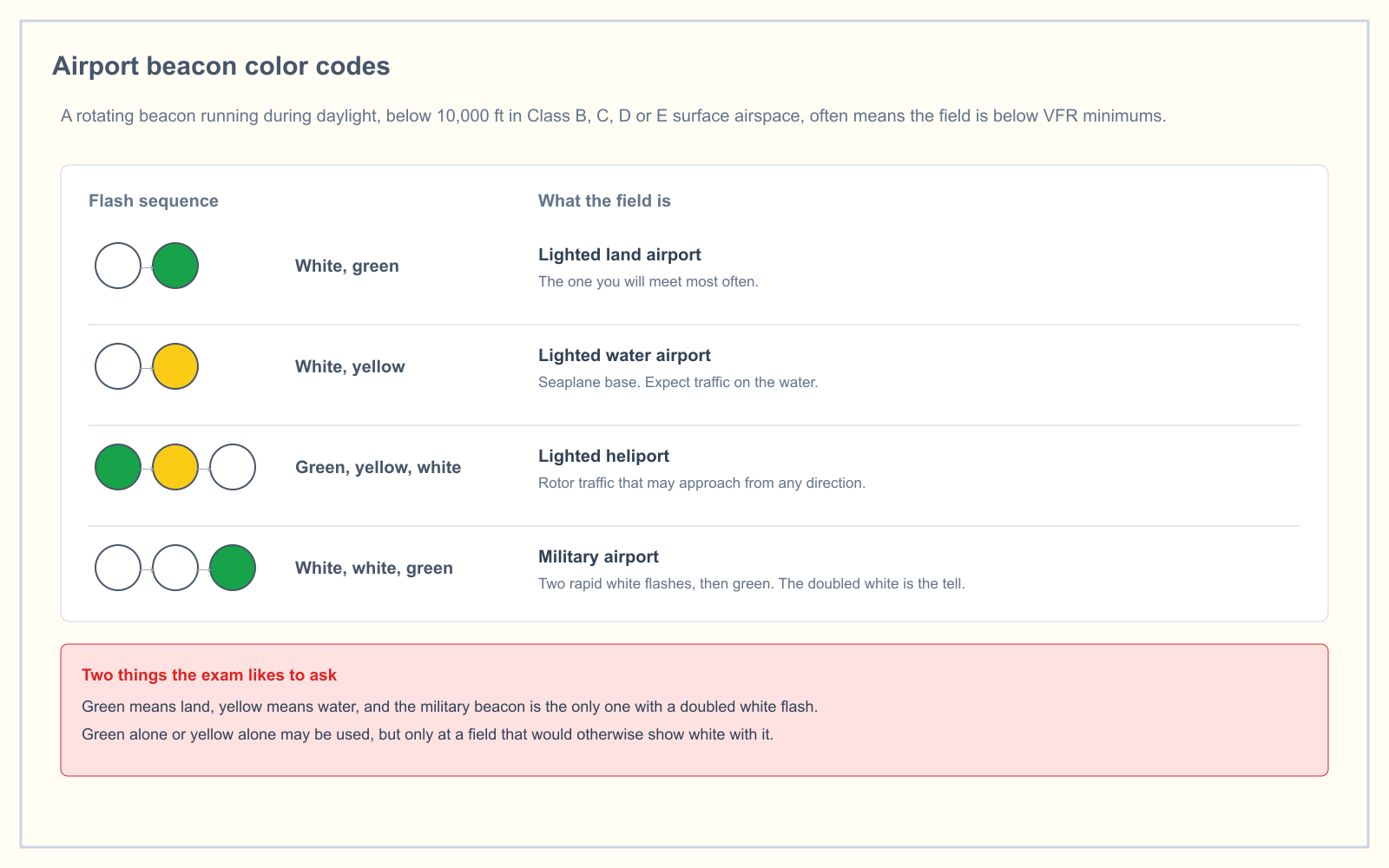
White and green is a lighted land airport, white and yellow a water airport, green-yellow-white a heliport, and a doubled white flash followed by green a military field.
A rotating airport beacon tells you two things: what kind of field it is, and — if it is running in daylight — that the weather there is probably below VFR minimums. The color code is short enough to learn in a minute.
| Flash sequence | What the field is |
|---|---|
| White, green | Lighted land airport |
| White, yellow | Lighted water airport |
| Green, yellow, white | Lighted heliport |
| White, white, green (doubled white flash, then green) | Military airport |
How to read the code
The logic is easier than the list suggests.
Green is land. Every civil land airport with lighting shows white alternating with green.
Yellow is water. A seaplane base shows white alternating with yellow. If you see yellow in the sequence, expect traffic operating on the water.
Green plus yellow plus white is a heliport. All three colors together. Helicopter traffic can approach from any direction and at any altitude, which for a remote pilot means the usual assumption about where arriving aircraft will be does not hold.
A doubled white flash means military. The sequence is two rapid white flashes followed by green. Everything else about it looks like a land airport, and the dual-peaked white is the only thing that distinguishes it.
There is one extra provision worth knowing: green alone or yellow alone may be used, but only at a location that would otherwise show white with that color. In practice this is uncommon, and the exam tends to test the four main sequences.
The daylight signal
This is the part that matters operationally, and it is where the exam most often goes.
In Class B, C, D and Class E surface areas, a rotating beacon operating during daylight hours often means the ground visibility is less than 3 statute miles, the ceiling is less than 1,000 feet, or both — in other words, that an ATC clearance is required for a manned aircraft to operate in that surface area under special VFR.
Two qualifications that catch people out:
- It is a strong hint, not a guarantee. There is no federal requirement to operate the beacon during the day when the weather goes below VFR minimums. Some fields do it as a matter of policy, some do not, and some leave beacons running continuously. A beacon that is off tells you nothing at all about the weather.
- It says nothing about your own legality. As a remote pilot you need 3 statute miles of flight visibility as observed from your control station under 14 CFR 107.51. A distant field's beacon is a clue about conditions there, not a determination about conditions where you are standing.
What a remote pilot should do with a beacon
Beacons show up in Part 107 material because they are one of the few pieces of airport information you can read without a radio and without a chart.
Identify the field type before you set up. A yellow beacon means seaplane traffic, which may approach at very low altitude over water on a line that has nothing to do with a runway. A heliport beacon means rotorcraft that may arrive from any bearing.
Treat a daytime beacon as a reason to look harder at the weather. If you can see a beacon running at 2 p.m., the conditions in that surface area are worth checking before you launch anywhere near it.
Remember that a military field means military traffic patterns. Military aircraft fly patterns at higher speeds and sometimes at different altitudes than civil traffic, and military training routes frequently connect to them.
Where beacons sit among the other airport lights
A beacon is only one of the lighting systems on an airport, and the exam sometimes tests them together.
| Light | What it marks |
|---|---|
| Rotating beacon | The airport itself, and its type, by color sequence |
| Runway edge lights | The edges of the usable runway; white, changing to yellow in the last 2,000 feet of an instrument runway |
| Threshold lights | Green when viewed on approach, red when viewed from the runway looking out |
| Taxiway lights | Blue edge lights; green centerline lights where installed |
| Obstruction lights | Red or flashing white on towers, structures and terrain |
| VASI / PAPI | Visual glideslope guidance on approach |
Pilot-controlled lighting is worth knowing about too. At many non-towered fields the lighting is activated by keying the CTAF a set number of times — commonly seven clicks within five seconds for maximum intensity, five for medium, three for low. Lights activated this way typically stay on for 15 minutes.
Why beacons exist at all
Before radio navigation, the entire transcontinental airway system was marked by rotating beacons on towers, spaced roughly every 10 miles, flashing a Morse identifier so a pilot could follow a lighted path across the country at night. Most of those are gone. What survives is the airport beacon, and the convention that a rotating light means this is an airport rather than this is an obstruction.
That history explains the one thing about beacons that otherwise looks arbitrary: the flash rate. Airport beacons flash at 24 to 30 flashes per minute; heliport beacons flash faster, at 30 to 45. A light flashing much faster or slower than that, especially a steady or slow-flashing red, is marking an obstruction rather than a field.
Reading the beacon against the chart
The beacon tells you the field type. The sectional chart tells you the same thing, plus everything else, and the two should agree.
| On the chart | On the ground |
|---|---|
| Blue airport symbol | Field has an operating control tower — beacon will be white and green |
| Magenta airport symbol | No operating control tower — beacon still white and green if it is a lighted land field |
| Anchor-style seaplane symbol | White and yellow beacon |
| Heliport symbol (H in a circle) | Green, yellow and white beacon |
A blue symbol means a tower exists, not that it is open. Many towers close overnight, at which point the airspace usually reverts to Class E or G and the field operates as a non-towered airport — with the beacon still running.
Beacons and night drone operations
Night flying under Part 107 no longer requires a waiver, but 14 CFR 107.29 does require the aircraft to display anti-collision lighting visible for at least 3 statute miles, with a flash rate sufficient to avoid a collision.
That requirement and the beacon code meet in a practical way. At night, an airport beacon is often the only thing that identifies a field from a distance — the runway lights may be off entirely until somebody keys the CTAF to activate them. A crew scouting a site after dark that sees a rotating white-and-green light on the horizon has found an airport that will not appear lit on any other cue.
The reverse is worth remembering too. Your aircraft's anti-collision light is the manned pilot's only cue that you exist. Choosing a site where a landing aircraft would see your strobe against a dark background, rather than against the lights of a town, is a small decision that costs nothing.
Frequently asked questions
What do airport beacon colors mean?
White alternating with green marks a lighted land airport. White alternating with yellow marks a lighted water airport. Green, yellow and white together mark a lighted heliport. Two rapid white flashes followed by green mark a military airport.
What does a green and white airport beacon mean?
A green and white rotating beacon identifies a lighted civil land airport. It is the most common beacon sequence in the United States.
What color beacon does a military airport have?
A military airport beacon flashes two rapid white flashes followed by green. The doubled white flash is the only feature that distinguishes it from a civil land airport beacon.
What does it mean if an airport beacon is on during the day?
In Class B, C, D or Class E surface airspace, a beacon operating during daylight often indicates the ground visibility is below 3 statute miles or the ceiling is below 1,000 feet. It is a useful hint rather than a rule, because operating the beacon in daytime is not federally required.
What color is a seaplane base beacon?
A lighted water airport, including a seaplane base, shows white alternating with yellow.
Does an airport beacon tell a drone pilot the weather is legal?
No. The beacon reports conditions in that airport's surface area. Under 14 CFR 107.51 your requirement is 3 statute miles of flight visibility as observed from your own control station, which you assess where you are standing.
Airport operations, lighting and traffic patterns are all part of the Operations knowledge area, which is 25 percent of the exam. Try the free readiness assessment to see how you score across all five areas.
Sources
Put this guide into practice.
Take the free assessment to see how this topic fits into your current exam readiness.
Start free practice