Flight Operations
Spatial Disorientation in Aviation: The Illusions, the Warning Signs, and What It Means for a Drone Pilot
Spatial disorientation is usually taught as a manned-cockpit problem. A remote pilot can lose orientation too, and the cause is different but just as predictable.
Key takeaway
Spatial disorientation is a mismatch between what your senses report and what the aircraft is actually doing. In a cockpit, trust the instruments. As a remote pilot, trust the telemetry and the aircraft's own display over your gut or a distant speck.
Spatial disorientation is the loss of orientation with regard to the position, attitude and movement of an aircraft in space. It happens when your senses, mainly the eyes and the inner ear, report something different from what the aircraft is really doing. The FAA's standing advice for manned pilots is to trust the instruments, not the sensation.
It sounds like a problem for pilots sitting inside an airplane in cloud, and most of what is written about it is. That framing leaves you with a gap, because the Part 107 exam asks about physiological factors, and because you can absolutely lose orientation without ever leaving the ground. The mechanism is different. The lesson is the same.
What is spatial disorientation in aviation?
The Pilot's Handbook of Aeronautical Knowledge describes it as the loss of orientation with regard to position, attitude and movement of the aircraft in space. It is not a sign of poor flying. It is a predictable result of the sensory system doing what evolution built it to do, in an environment it was not built for.
Humans orient using three inputs: vision, the vestibular system in the inner ear, and the somatosensory system, the pressure and position signals from your body. On the ground they agree. In flight they can disagree, and when vision is degraded, the other two take over and mislead.
Which senses fail, and why?
The vestibular system detects acceleration, not steady motion. Fluid in the inner ear moves when you turn, then settles if the turn continues at a constant rate, and at that point the ear reports that you have stopped turning. Your body cannot tell sustained flight from sitting still. Only vision corrects the error, which is why the handbook treats the horizon as the primary reference.
| Sense | What it does well | How it misleads in flight |
|---|---|---|
| Vision | Gives the horizon and the aircraft's attitude | Degrades at night, in haze, over water or snow |
| Vestibular (inner ear) | Detects the start of a turn or climb | Reports "level" during a sustained turn |
| Somatosensory (body) | Feels acceleration and G-forces | Cannot separate acceleration from tilt |
What are the vestibular illusions?
The handbook lists several. These are the ones worth recognizing by name:
- The leans. A bank too gradual to notice is followed by a correction. The pilot feels that the corrected, level attitude is a bank the other way and may lean to compensate.
- Coriolis illusion. Moving your head sharply during a prolonged turn creates an overwhelming sensation of rotating or tumbling on a different axis.
- Graveyard spiral. In a prolonged coordinated turn, the ear stops sensing it. When the pilot levels the wings, the ear reports a turn the other way, and the pilot re-enters the original bank. Airspeed and the descent rate both grow.
- Somatogravic illusion. Rapid acceleration can feel like a nose-up pitch, prompting a nose-down correction that is wrong.
- Inversion and elevator illusions. An abrupt level-off from a climb can feel like tumbling backward, and a sudden vertical updraft can feel like a climb.
What are the visual illusions?
Vision fails in its own ways, and these apply directly to anyone watching an aircraft against the sky:
- False horizon. Sloping cloud layers, or a dark scene with scattered lights, can look like the horizon and lead you to level against the wrong line.
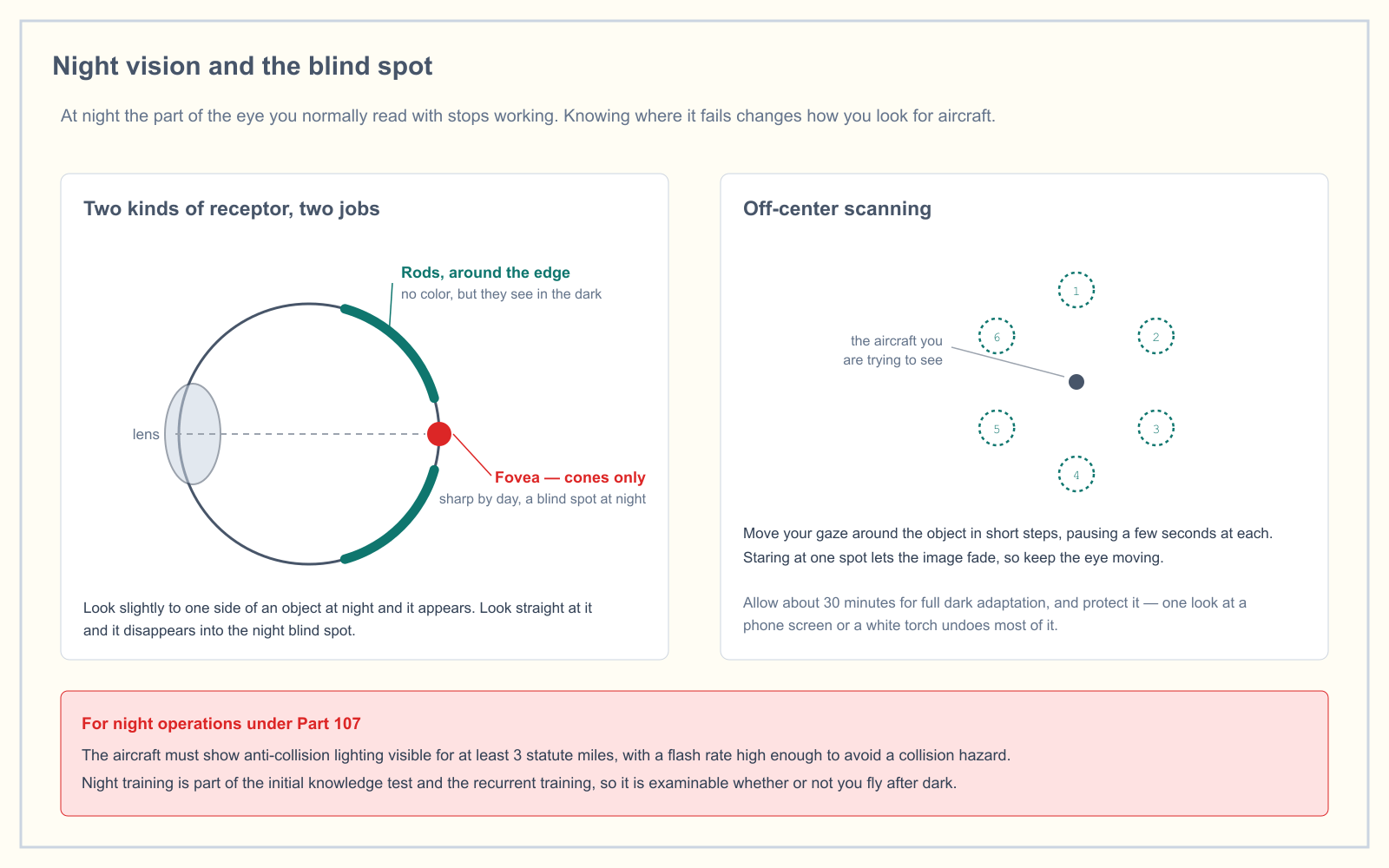
- Autokinesis. Stare at a single point of light in the dark and, after a few seconds, it appears to move. The fix is to scan rather than fixate.
- Loss of depth cues. Over featureless terrain, snow or water, you lose the references that tell you how high or how far away something is.
How does this apply to a drone pilot?
You are not in the aircraft, so the inner ear is not the problem. Vision is. Part 107 requires you to keep the aircraft in visual line of sight, and your ability to tell what it is doing comes from one source: a small object against a large sky.
Three failures show up repeatedly:
- Orientation loss at distance. Past a few hundred feet, a multirotor is nearly symmetrical. You cannot tell which way it faces, and stick inputs get reversed. A correction that should bring it back sends it away.
- Autokinesis at twilight. A single anti-collision light on a dark sky does exactly what the FAA describes. It appears to drift. You chase a movement that is not happening.
- Depth and distance errors. Judging height or closing distance against a flat sky or a uniform treeline is unreliable.
The regulations already lean on this. 14 CFR 107.31 requires the remote pilot or visual observer to maintain unaided visual line of sight and to be able to see the aircraft well enough to know its location, attitude, altitude and direction of flight. The rule describes spatial awareness in everything but name. For twilight work, 14 CFR 107.29 requires an anti-collision light visible for at least 3 statute miles, which also makes autokinesis a live risk.
See also flying a drone at night for the rod and cone limits behind the diagram above.
What are the warning signs?
Disorientation rarely feels like confusion. It feels like certainty, and the certainty is wrong. Watch for:
- A sensation that the aircraft is doing something the controller display contradicts
- Stick inputs that make things worse, then a larger input that makes them worse again
- Fixating on one point or one light instead of scanning
- Rising stress, which narrows attention just when you need breadth
How do you recover or prevent it?
For a manned pilot, the handbook's answer is to rely on the flight instruments and avoid sudden head movements. For a remote pilot the equivalents are:
- Switch from your eyes to your data. Check the app's heading, attitude and position indicators rather than the speck in the sky.
- Use the return-to-home or position-hold function if the aircraft has one and you trust it, then re-establish orientation before taking over again.
- Stop inputting. Release the sticks. A multirotor in position hold is stable, and a pilot fighting an illusion is not.
- Use a visual observer to call heading and distance, which is a recognized operating technique.
- Plan for it. Keep the aircraft where its orientation is readable, and set a distance limit shorter than the legal one.
What this means when you are actually working
The practical rule is to treat your own certainty as a hazard. If you cannot say which way the aircraft is facing without checking the display, you are already past the point where you should have brought it closer. Before launch, run through IMSAFE and PAVE: fatigue, stress and illness all make illusions more likely, and they also tie into the five hazardous attitudes, since "I can handle it" is the attitude that keeps a pilot fighting a disoriented aircraft.
How the exam asks about it
Expect questions on physiological factors rather than a spatial disorientation essay: what causes it, what the illusions are called, and what to do. The consistent answer is to trust the instruments. Use the free Part 107 readiness assessment to see how these scenarios are worded before test day.
Frequently asked questions
What are the symptoms of spatial disorientation?
The core symptom is a sensation that conflicts with what the aircraft is actually doing: feeling level when banked, feeling a climb when level, or feeling a turn that is not happening. The sensation is typically confident rather than confusing, which is why it is dangerous and why the instruments need to overrule it.
What is the most common form of spatial disorientation?
The FAA describes several, including the leans, the graveyard spiral and the coriolis illusion. The leans is among the most commonly cited because it follows a small, unnoticed bank. For a drone pilot, orientation loss at distance is the more common version.
Can anxiety cause spatial disorientation?
Stress does not create the illusions, but it narrows your attention and makes you more likely to fixate and misread cues. The FAA's pilot checklists treat stress as a performance risk, which is why IMSAFE asks about it before every flight.
How do you prevent spatial disorientation?
Keep visual references, scan instead of staring, avoid abrupt head movements in a manned cockpit, and trust the instruments over your senses. As a remote pilot, add a visual observer, keep the aircraft where its orientation is readable, and use the display as your primary reference.
Can a drone pilot get spatially disoriented?
Yes, though not through the inner ear. A remote pilot loses orientation when the aircraft is too far or too small to read, when a single light appears to drift, or when stick inputs are reversed. Treat the display and your visual observer as the instruments.
Sources
Put this guide into practice.
Take the free assessment to see how this topic fits into your current exam readiness.
Start free practice