Flight Operations
Can You Fly a Drone at Night? The Part 107 Night Rules, Explained
Night flight stopped requiring a waiver in 2021, but two conditions replaced it. Here is exactly what 14 CFR 107.29 demands, and when night legally begins.
Key takeaway
You may fly at night without a waiver, but only if your knowledge test or recurrent training was completed after 6 April 2021 and the aircraft shows anti-collision lighting visible for 3 statute miles.
Yes. Under 14 CFR 107.29 you may fly a small unmanned aircraft at night without a waiver, provided two conditions are met: the remote pilot in command completed an initial knowledge test or recurrent training after 6 April 2021, and the aircraft carries anti-collision lighting visible for at least 3 statute miles with a flash rate sufficient to avoid a collision.
That rule replaced a waiver process that used to take weeks. What it did not do is make night flying a free-for-all, and the part people get wrong is almost never the lighting. It is the question of when night legally starts, because the regulations contain two different definitions of civil twilight and they do not describe the same window.
What changed in 2021, and what replaced the waiver
Before the rule took effect, night operations under Part 107 required a certificate of waiver from the FAA. Amendment 107-8 removed that requirement and substituted the two conditions above. It also closed the door behind it: 107.29(d) terminated the old night waivers outright, so a waiver issued under the previous system is not a thing you can still rely on.
The two conditions divide cleanly:
| Requirement | Where it sits | Waivable? |
|---|---|---|
| Training completed after 6 April 2021 | 107.29(a)(1) | No |
| Anti-collision lighting, 3 SM, at night | 107.29(a)(2) | Yes |
| Anti-collision lighting, 3 SM, during civil twilight | 107.29(b) | Yes |
That last column is worth pausing on. Section 107.205 lists the regulations the FAA can waive, and for night it names only 107.29(a)(2) and (b) — the lighting. The training requirement at 107.29(a)(1) is not on the list. You cannot apply your way out of it.
When does night actually start?
Here is where the confusion lives, and it is a genuine ambiguity in the regulations rather than a case of people not reading carefully.
Definition one. 14 CFR 1.1 defines night as the time between the end of evening civil twilight and the beginning of morning civil twilight, as published in the Air Almanac, converted to local time. Air Almanac civil twilight ends when the center of the sun reaches 6 degrees below the horizon. That moment moves with your latitude and the date. In June in Seattle it is a long time after sunset. In December in Miami it is not.
Definition two. Section 107.29(c) then supplies its own definition, but only for the purposes of paragraph (b):
| Period | Definition under 107.29(c) |
|---|---|
| Morning civil twilight | Begins 30 minutes before official sunrise, ends at official sunrise |
| Evening civil twilight | Begins at official sunset, ends 30 minutes after official sunset |
| Alaska | The period of civil twilight as defined in the Air Almanac |
So Part 107 gives you a fixed 30-minute clock for the twilight lighting requirement, while "night" itself still traces back to the Air Almanac. Outside Alaska those two windows are close but not identical, and at high latitudes in summer the true civil twilight period runs considerably longer than 30 minutes.
The practical resolution: turn the anti-collision lights on at sunset and leave them on until sunrise. Every reading of the regulation is satisfied by that, the cost is nothing, and you never have to defend a calculation about the sun's angle to an inspector. Official sunrise and sunset times for your location are published by the U.S. Naval Observatory, which is the source the Air Almanac figures come from.
What counts as anti-collision lighting
The regulation asks for two things and specifies neither a color nor a position. The lighting must be visible for at least 3 statute miles and have a flash rate sufficient to avoid a collision.
A few consequences follow:
- The navigation LEDs your drone shipped with almost certainly do not qualify. They are position lights, meant to show orientation to you at a hundred feet. They are not visible for three miles.
- A steady light does not satisfy it. The rule says flash rate, which means the light has to flash.
- You may dim it, but never turn it off. Section 107.29 permits the remote pilot in command to reduce the intensity of the anti-collision lighting if operating conditions make that safer, but explicitly forbids extinguishing it.
- Three statute miles is a claim you should be able to support. Strobes marketed for Part 107 compliance state a visibility rating. Keeping that documentation with the aircraft costs you nothing and answers the question if it is ever asked.
The training requirement, and why it catches people out
Section 107.29(a)(1) requires that your initial knowledge test or training under 107.65 was completed after 6 April 2021. Anyone who has tested or completed recurrent training since then has it. The people who do not are those certificated in the original 2016 to 2021 window who have not refreshed since.
Section 107.65 requires currency every 24 calendar months by one of three routes: passing an initial aeronautical knowledge test, completing recurrent training, or, if you hold a Part 61 certificate and a current flight review, completing the training specified in 107.74. The same amendment added operation at night to the list of knowledge areas at 107.73(m), which every initial test and recurrent training must cover. Staying current and being night-qualified have therefore collapsed into the same act. If you are behind on currency, you are not legal to fly at all, let alone after dark. The renewal and recurrent training guide walks through counting the 24 calendar months, which is not done the way most people assume.
The night vision your exam actually tests
The regulations are only half of it. The other half is physiology, and it appears on the knowledge test because the FAA considers it a safety issue rather than trivia.
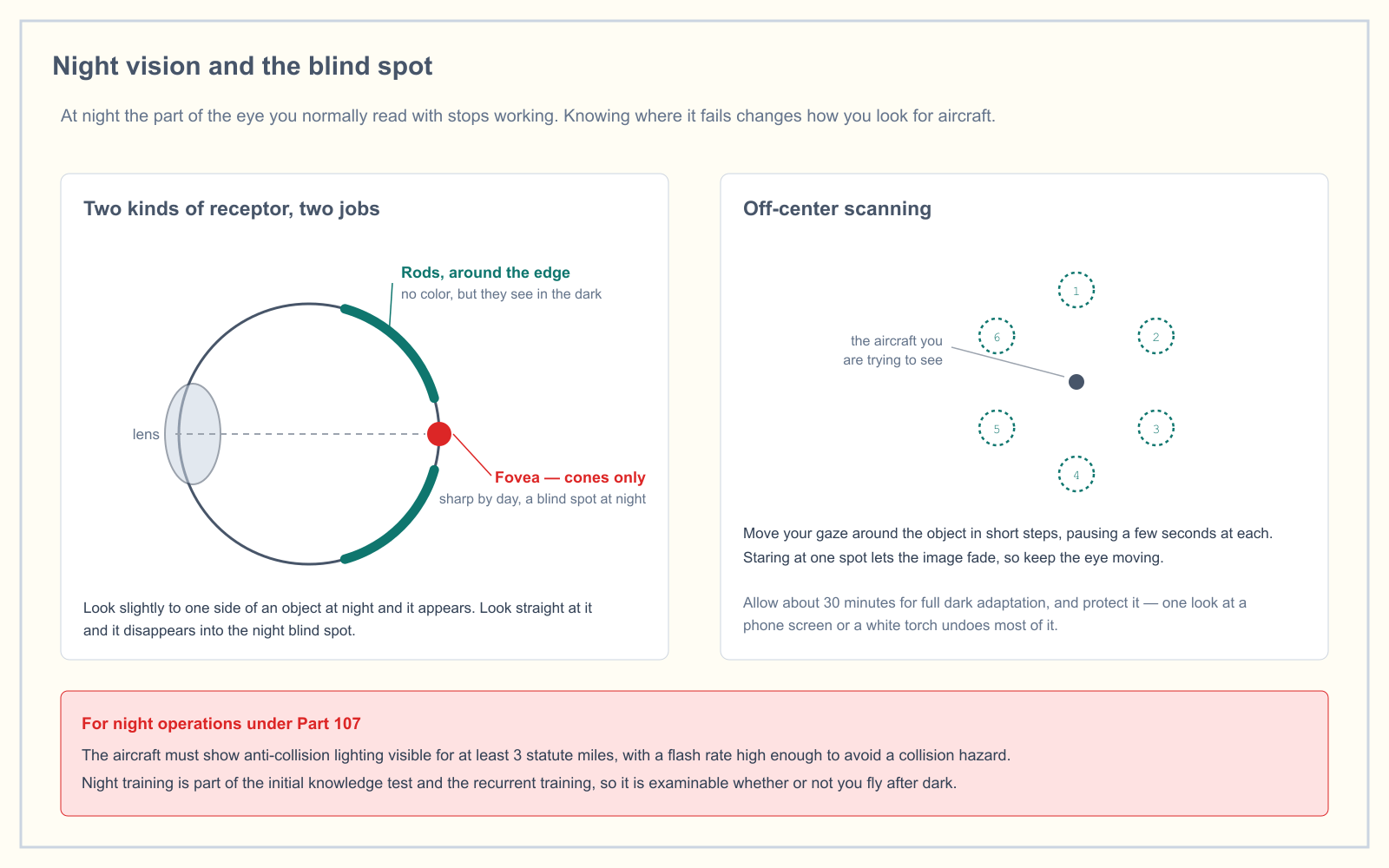
Your retina carries two receptor types. Cones cluster in the fovea at the center of your visual field, give you color and fine detail, and need light to work. Rods sit around the periphery, see no color, and function in very low light. The fovea contains no rods at all.
That produces the effect in the diagram above. At night the center of your vision goes blind. The FAA's Airplane Flying Handbook puts the night blind spot at the central 5 to 10 degrees of the visual field, and notes that an object looked at directly at night may go undetected entirely, or fade away after you first spot it. The blind spot hides progressively larger objects as distance increases.
The countermeasures are three:
- Off-center viewing. Look about 10 degrees to one side of what you are trying to see, so the image falls on rods rather than the foveal blind spot.
- Keep the eye moving. Move your gaze around the object in short steps, pausing a few seconds at each. Staring lets the image fade.
- Protect your dark adaptation. Maximum dark adaptation takes up to 30 minutes. A bright light source lasting a second or more temporarily undoes it, which in practice means your phone screen and your white flashlight are the enemy. Anti-collision lights do not cause this problem, because the flashes last under a second.
You can drill these alongside the rest of the operations material in the Part 107 study guide.
What actually changes operationally after dark
The regulations that are not in 107.29 do not relax at night. Several of them get considerably harder to satisfy.
Visual line of sight is the big one. Section 107.31 still requires that you see the aircraft unaided throughout the flight. At night you are not tracking an airframe, you are tracking your own strobe. Judging distance and orientation from a flashing point of light is much harder than judging it from a visible aircraft, and the range at which you genuinely know where the drone is pointing shrinks a long way.
Weather minimums do not change. Part 107 asks for 3 statute miles of flight visibility and 500 feet below and 2,000 feet horizontally from clouds, and those figures are identical by day and night. This is a common trap, because Part 91 minimums do change with time of day. The VFR weather minimums breakdown covers why the two rules diverge.
Obstacles stop being visible. Towers, wires, cranes and trees that you would simply see during the day are invisible or nearly so. Survey the site in daylight before you fly it at night, and note the obstruction heights off the sectional rather than relying on what you can make out.
Manned traffic is easier to spot, not harder. This is the one thing that gets better. Aircraft position and anti-collision lights are visible far further at night than an airframe is by day. Airport beacons also become the most obvious feature of the landscape, which makes locating a nearby field straightforward.
Frequently asked questions
Can I fly my DJI drone at night?
Yes, if you hold a Part 107 certificate, your knowledge test or recurrent training was completed after 6 April 2021, and you fit anti-collision lighting visible for 3 statute miles. The navigation LEDs built into DJI aircraft are position lights and do not meet the 3-statute-mile standard, so an add-on strobe is required.
Can you fly a drone at night without a Part 107 certificate?
Recreational flyers operating under the exception for limited recreational operations may fly at night, but the FAA requires them to do so in accordance with the safety guidelines of an FAA-recognized community-based organization that have night procedures detailing the required lighting. Any flight for work or business purposes requires a Part 107 certificate regardless of the time of day.
Do I need a waiver to fly a drone at night?
No. Since Amendment 107-8 took effect in April 2021, night operations meeting the conditions of 107.29 require no waiver, and night waivers issued under the old system were terminated. A waiver is only relevant if you cannot meet the lighting requirement, since 107.205 permits waiver of 107.29(a)(2) and (b) but not the training requirement.
When exactly does night begin for a Part 107 flight?
Section 107.29(c) defines evening civil twilight as beginning at official sunset and ending 30 minutes after, and 14 CFR 1.1 defines night as beginning when Air Almanac civil twilight ends. The two do not align exactly outside Alaska. Running anti-collision lighting from sunset to sunrise satisfies both readings.
Do the strobes that came with my drone count as anti-collision lighting?
Almost certainly not. Factory navigation LEDs are designed to show you the aircraft's orientation at short range, not to be seen from three miles away. Section 107.29 requires lighting visible for at least 3 statute miles with a flash rate sufficient to avoid a collision, which in practice means a dedicated strobe.
Are the weather minimums different at night under Part 107?
No. Section 107.51 requires 3 statute miles of flight visibility from the control station and 500 feet below and 2,000 feet horizontally from clouds, and those figures apply identically day and night. Part 91 minimums do change with time of day, which is where the confusion originates.
Night questions show up in the operations and regulations material, which together make up the majority of the knowledge test. The free readiness assessment mixes them in with the rest so you find out whether you actually know 107.29 or merely recognize it.
Sources
- 14 CFR 107.29 — Operation at night
- 14 CFR 1.1 — General definitions
- 14 CFR 107.65 — Aeronautical knowledge recency
- 14 CFR 107.205 — List of regulations subject to waiver
- 14 CFR 107.73 — Knowledge and training
- 14 CFR 107.31 — Visual line of sight aircraft operation
- FAA — Recreational Flyers & Community-Based Organizations
- FAA Airplane Flying Handbook, Chapter 11: Night Operations
- FAA — Getting Started with Drones
- U.S. Naval Observatory sun and moon data
Put this guide into practice.
Take the free assessment to see how this topic fits into your current exam readiness.
Start free practice