Weather
VFR Weather Minimums: The Complete Chart for Drone and Manned Pilots
The visibility and cloud-clearance table that trips up more candidates than any other, explained class by class — plus the one place where Part 107 breaks from the Part 91 pattern.
Key takeaway
Part 107 uses one number everywhere — 3 statute miles visibility, 500 feet below and 2,000 feet horizontally from clouds — while Part 91 changes the requirement with airspace class and altitude.
VFR weather minimums are the visibility and cloud-clearance figures you must have before flying under visual flight rules. Under 14 CFR 107.51, a drone flight needs 3 statute miles of flight visibility from the control station, and the aircraft must stay 500 feet below and 2,000 feet horizontally from any cloud. Manned aircraft follow 14 CFR 91.155, where the numbers change with airspace class, altitude and time of day.
That difference is the whole reason this topic causes trouble. Most study material teaches the Part 91 table because that is what pilots have used for decades, and then a drone candidate tries to apply the same table to a Part 107 flight. The tables are related, but they are not the same rule.
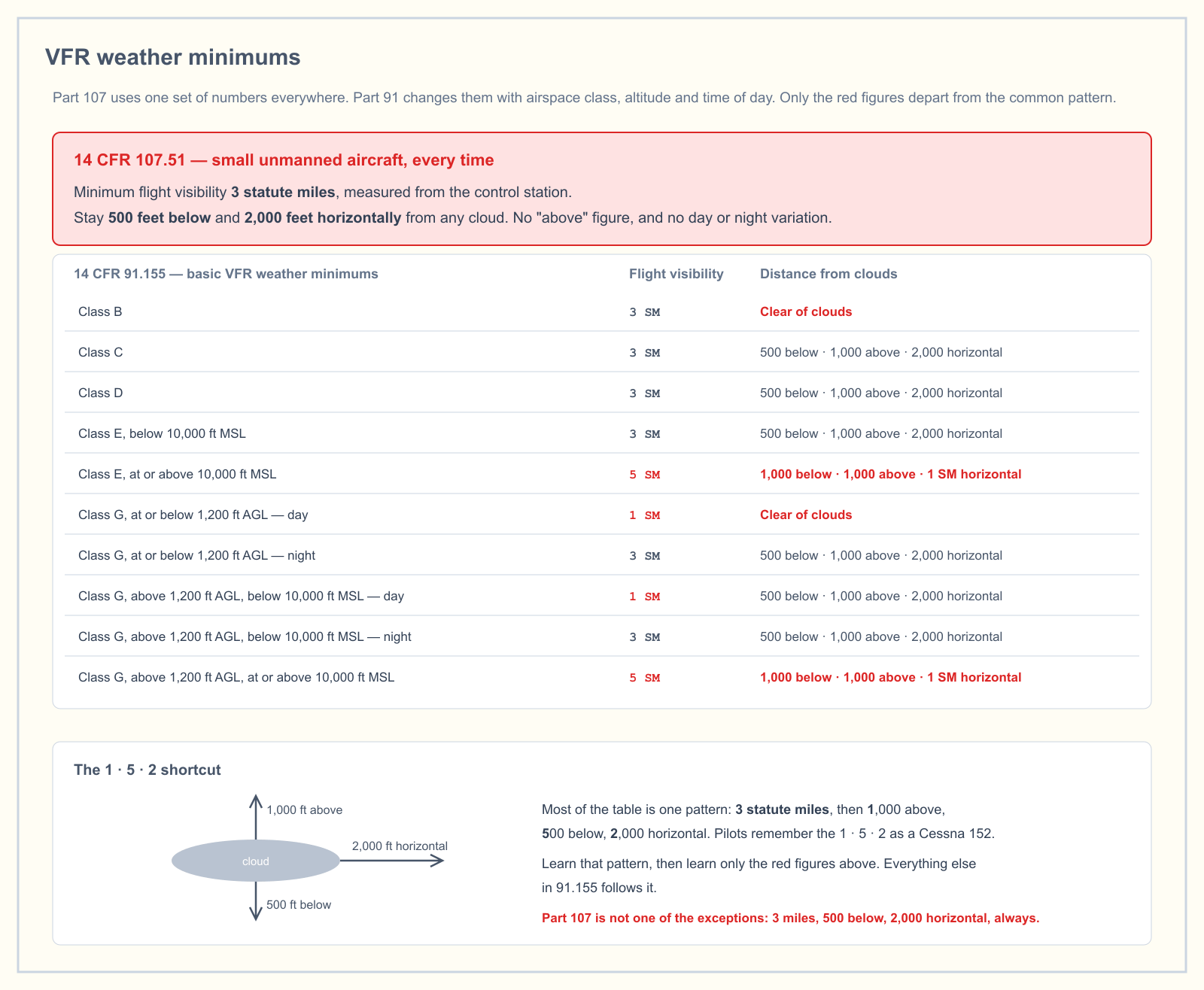
What the Part 107 weather minimums actually are
Section 107.51 gives four operating limitations, and two of them are weather:
| Limitation | Figure |
|---|---|
| Minimum flight visibility | 3 statute miles, observed from the control station |
| Minimum distance below a cloud | 500 feet |
| Minimum distance horizontally from a cloud | 2,000 feet |
| Maximum groundspeed | 87 knots (100 mph) |
| Maximum altitude | 400 feet AGL, or 400 feet above a structure within a 400-foot radius of it |
Three things about that list are worth pinning down, because each one is a question the exam likes to ask.
There is no "above the cloud" figure. Part 91 pilots learn three cloud clearances — below, above and horizontal. Part 107 gives you two. A question that offers "1,000 feet above" as an option for a drone flight is offering you the Part 91 answer.
The visibility is measured from the control station, not from the aircraft. The regulation defines flight visibility here as the average slant distance from the control station at which prominent unlighted objects can be seen and identified by day, and prominent lighted objects by night. You are the instrument. If you are standing in a valley where you can see two miles down the road, you do not have three miles of flight visibility, regardless of what the aircraft can see from 380 feet.
The numbers never change. Not for airspace class, not for altitude, not for day versus night. One rule, everywhere, all the time.
Why Part 91 changes the numbers and Part 107 does not
The Part 91 table exists to solve a see-and-avoid problem between fast aircraft. A Cessna at 110 knots and an airliner descending at 250 knots need enough visibility to spot each other and turn. How much is enough depends on how fast the traffic around you is likely to be moving, which is why the requirement tightens in busier airspace and at higher altitudes, and why it relaxes down low in the quietest airspace there is.
A drone at 400 feet in Class G is a different problem. The FAA set a single conservative figure rather than a sliding scale, because the remote pilot is on the ground and the traffic that matters is arriving from somewhere the remote pilot may not be looking.
The 1 · 5 · 2 pattern, and the four exceptions
Here is the trick that makes 91.155 memorable. Most of the table is one pattern:
3 statute miles visibility, 1,000 feet above, 500 feet below, 2,000 feet horizontally.
Pilots remember the cloud clearances as a Cessna 152 — one, five, two. Learn that pattern and you have most of the table. Then learn only the places it breaks:
| Where the pattern breaks | What it becomes |
|---|---|
| Class B | 3 SM, clear of clouds — ATC is separating everyone, so no clearance figures apply |
| At or above 10,000 feet MSL (Class E or G) | 5 SM, and 1,000 below · 1,000 above · 1 statute mile horizontal |
| Class G, at or below 1,200 feet AGL, by day | 1 SM, clear of clouds |
| Class G, above 1,200 feet AGL but below 10,000 MSL, by day | 1 SM, with the normal 1 · 5 · 2 clearances |
Two patterns explain all four. Above 10,000 feet MSL the figures grow because traffic is faster and may be operating above 250 knots. Down low in Class G by day the figures shrink because there is very little else there.
Notice that Class G at night is not an exception. Below 1,200 feet AGL at night you are back to 3 statute miles and 1 · 5 · 2 — the same as Class C, D and low Class E.
Working the table at an actual launch site
Take a real decision. You are launching from a field 4 miles from a small non-towered airport. The sectional shows a faded magenta vignette over your position, so Class E begins at 700 feet AGL and Class G lies beneath it. You plan to fly at 300 feet. It is 10 a.m., the reported visibility is 4 statute miles, and there is a scattered layer at 1,500 feet.
A Part 91 pilot at 300 feet here is in Class G below 1,200 feet AGL, by day: 1 statute mile and clear of clouds. They are legal with plenty of margin.
You are not that pilot. Part 107 asks for 3 statute miles — you have 4, so that passes — and 500 feet below the cloud. The scattered layer is at 1,500 feet and you are at 300, which gives you 1,200 feet of separation. That passes too. You are legal.
Now change one thing. The layer drops to 700 feet. You are still at 300 feet, so you now have 400 feet of vertical separation from a cloud that Part 91 would let you fly right up to. Under Part 107 you are illegal, and the fix is to descend to 200 feet or wait.
That is the situation the exam is testing when it gives you a METAR and an altitude. It is rarely asking whether you know the number. It is asking whether you subtract in the right direction.
What the exam actually asks
Weather sits inside the Weather and Loading area of the Airman Certification Standards, which is 5 percent of the Unmanned Aircraft General knowledge test under the blueprint effective 29 September 2025. Weather minimum questions almost always take one of three shapes:
- Direct recall. "What is the minimum distance from clouds for a small unmanned aircraft?" The answer is 500 feet below and 2,000 feet horizontally.
- A METAR plus an altitude. You are given a report with a cloud layer, and you have to decide whether a proposed altitude is legal. Convert the cloud height to the same reference you are flying against, then subtract.
- A distractor built from Part 91. The options include "1,000 feet above" or "clear of clouds", both of which are correct answers to a different question.
You can drill the second shape directly in the METAR practice trainer, which gives you real report formats rather than a decoded summary.
Can you get a waiver from the weather minimums?
Yes. Section 107.51 appears in the list of waivable regulations at 14 CFR 107.205, so the FAA can issue a certificate of waiver permitting a deviation. In practice this is not a common waiver, and applications succeed when they describe a specific mitigation — a tethered operation, a fixed site with known obstacles, redundant observers — rather than simply asking for lower minimums.
Two related points that candidates conflate with waivers:
- Special VFR is a Part 91 provision. Section 91.157 lets a manned pilot request an ATC clearance to operate in a surface area with 1 statute mile and clear of clouds. It is not available to you under Part 107, and asking a tower for special VFR as a remote pilot is not a thing.
- An airspace authorization is not a waiver. LAANC or DroneZone authorization lets you enter controlled airspace. It says nothing about weather. You still need 3 statute miles and 500-and-2,000 inside authorized Class D.
Frequently asked questions
What are the VFR weather minimums for a drone?
Under 14 CFR 107.51 a small unmanned aircraft requires a minimum flight visibility of 3 statute miles as observed from the control station, and must remain at least 500 feet below and 2,000 feet horizontally from any cloud. These figures do not change with airspace class, altitude or time of day.
How do I remember the VFR weather minimums?
Learn the common pattern first — 3 statute miles visibility with 1,000 feet above, 500 feet below and 2,000 feet horizontally, remembered as a Cessna 152. Then memorize only the four places 14 CFR 91.155 departs from it: Class B, anything at or above 10,000 feet MSL, and daytime Class G below and above 1,200 feet AGL.
What is the difference between Part 107 and Part 91 weather minimums?
Part 91 minimums change with airspace class, altitude and time of day, and specify three cloud clearances. Part 107 gives one fixed rule for every situation — 3 statute miles, 500 feet below and 2,000 feet horizontally — and has no "above the cloud" figure at all.
Is there a cloud clearance above the aircraft under Part 107?
No. Section 107.51(d) lists only two distances: 500 feet below the cloud and 2,000 feet horizontally from it. Any answer offering a figure for flying above a cloud is drawn from Part 91, not Part 107.
Does Part 107 have different weather minimums at night?
No. The visibility and cloud-clearance figures are identical by day and by night. What changes at night is the lighting requirement — 14 CFR 107.29 requires anti-collision lighting visible for at least 3 statute miles with a flash rate sufficient to avoid a collision.
What does flight visibility from the control station mean?
Section 107.51(c) defines it as the average slant distance from the control station at which prominent unlighted objects can be seen and identified by day, and prominent lighted objects by night. You assess it from where you are standing, not from the aircraft's position or from a reported figure at a distant airport.
Ready to test whether this has stuck? The free readiness assessment mixes weather questions in with the other four knowledge areas, so you find out where you actually stand rather than where you feel confident.
Sources
Put this guide into practice.
Take the free assessment to see how this topic fits into your current exam readiness.
Start free practice