Weather
What Is Zulu Time? How Pilots Use UTC, and How to Convert It for Your Time Zone
Every METAR, TAF, NOTAM and TFR is stamped in Zulu time. Here is what it is, why aviation uses it, and how to convert it without getting the date wrong.
Key takeaway
Zulu time is UTC. Add 5 hours to Eastern Standard Time (4 during daylight saving) to get Zulu, and check whether the date has rolled over.
Zulu time is Coordinated Universal Time (UTC), the single 24-hour clock that aviation runs on worldwide. The "Z" after a time in a METAR, TAF or NOTAM means UTC, and "Zulu" is simply the phonetic word for Z. In the United States, Zulu is 4 to 10 hours ahead of local time, depending on your time zone and whether daylight saving is in effect.
It trips people up because it is almost never the time on your phone. A forecast change at 2000Z looks like an evening event, and on the east coast in summer it is 4 p.m. Read Zulu as local and you plan the flight around weather that has already come and gone, or has not arrived yet.
What is meant by Zulu time?
Zulu time is UTC expressed on a 24-hour clock, written as four digits followed by Z. 1753Z is 5:53 p.m. UTC. There is no a.m. or p.m. and no colon, and the day runs from 0000 to 2359.
The FAA is explicit about this. Paragraph 4-2-12 of the Aeronautical Information Manual states that the FAA uses Coordinated Universal Time for all operations, and that the word "Zulu" may be used to denote UTC. When a controller or weather product means local time, it has to say "local" or name the zone. If nothing is said, assume UTC.
For practical aviation purposes, Zulu, UTC and Greenwich Mean Time (GMT) are the same clock. The scientific differences between UTC and GMT amount to under a second and never matter for a flight plan or a weather briefing.
Why is it called Zulu time?
The world's time zones were assigned letters. The zone centered on the prime meridian at Greenwich, with zero offset, is the Z zone. In the phonetic alphabet pilots and the military use on the radio, Z is spoken as "Zulu." So "Z time" became "Zulu time."
The other US zones have letters too (Eastern Standard Time is R, or "Romeo," in the military system), but nobody in civil aviation uses them. The only one you need is Z.
Why does aviation use UTC instead of local time?
Because aviation crosses time zones, and weather does too. A thunderstorm line moving from Kansas into Missouri crosses no boundary on a Zulu clock. On local clocks it would jump an hour in the middle of the forecast.
A single reference clock means:
- A METAR from Denver and one from Atlanta can be compared directly.
- A forecast issued in one zone and read in another means the same thing to both readers.
- There is no ambiguity twice a year when daylight saving begins and ends. The local hour between 1 a.m. and 2 a.m. repeats every November; a Zulu time never does.
For a drone pilot who never leaves the county, this can feel like overhead. It is not optional overhead. Every official weather and airspace product you are expected to consult is stamped in Zulu.
How do you convert local time to Zulu time?
Add your zone's offset to local time. The AIM gives the standard time offsets, and during daylight saving you add one hour less.
| Time zone | Add to local standard time | Add to local daylight time | Noon local is |
|---|---|---|---|
| Eastern | 5 hours | 4 hours | 1700Z (standard) / 1600Z (daylight) |
| Central | 6 hours | 5 hours | 1800Z / 1700Z |
| Mountain | 7 hours | 6 hours | 1900Z / 1800Z |
| Pacific | 8 hours | 7 hours | 2000Z / 1900Z |
| Alaska | 9 hours | 8 hours | 2100Z / 2000Z |
| Hawaii | 10 hours | No daylight saving | 2200Z |
Daylight saving time in the US begins at 2 a.m. local on the second Sunday in March and ends at 2 a.m. local on the first Sunday in November. Hawaii and most of Arizona do not observe it, so a Phoenix pilot uses the Mountain standard offset of 7 hours all year.
The method, every time:
- Convert local time to 24-hour format. 3:30 p.m. is 1530.
- Add the offset for your zone and season.
- If the result is 2400 or more, subtract 2400 and move the date forward one day.
To go from Zulu back to local, reverse it: subtract the offset, and if the result goes below 0000, add 2400 and move the date back one day.
What is Zulu time vs EST?
Eastern Standard Time is UTC minus 5 hours. So Zulu is 5 hours ahead of EST: 9 a.m. EST is 1400Z, and 1400Z is 9 a.m. EST.
The catch is that "EST" is often used loosely to mean whatever time it is on the east coast. From the second Sunday in March to the first Sunday in November, the east coast is on Eastern Daylight Time, which is UTC minus 4. In summer, 1400Z is 10 a.m. Eastern, not 9.
A worked example, Chicago in July (Central Daylight Time, add 5 hours). Your job is at 7:45 p.m. local.
- 7:45 p.m. is 1945.
- 1945 + 0500 = 2445.
- That is past 2400, so subtract 2400: 0045Z, on the following day.
That last step is the one people skip.
Why does the date change in Zulu?
Because Zulu reaches midnight before you do. For anyone in the continental US, the Zulu date rolls over sometime between late afternoon and early evening local time: 7 p.m. Eastern Standard, 4 p.m. Pacific Standard, an hour earlier than each during daylight saving.
So an afternoon or evening flight is often "tomorrow" in Zulu. This matters when you read a product that carries a day of the month:
| Product | How the time is written | Example |
|---|---|---|
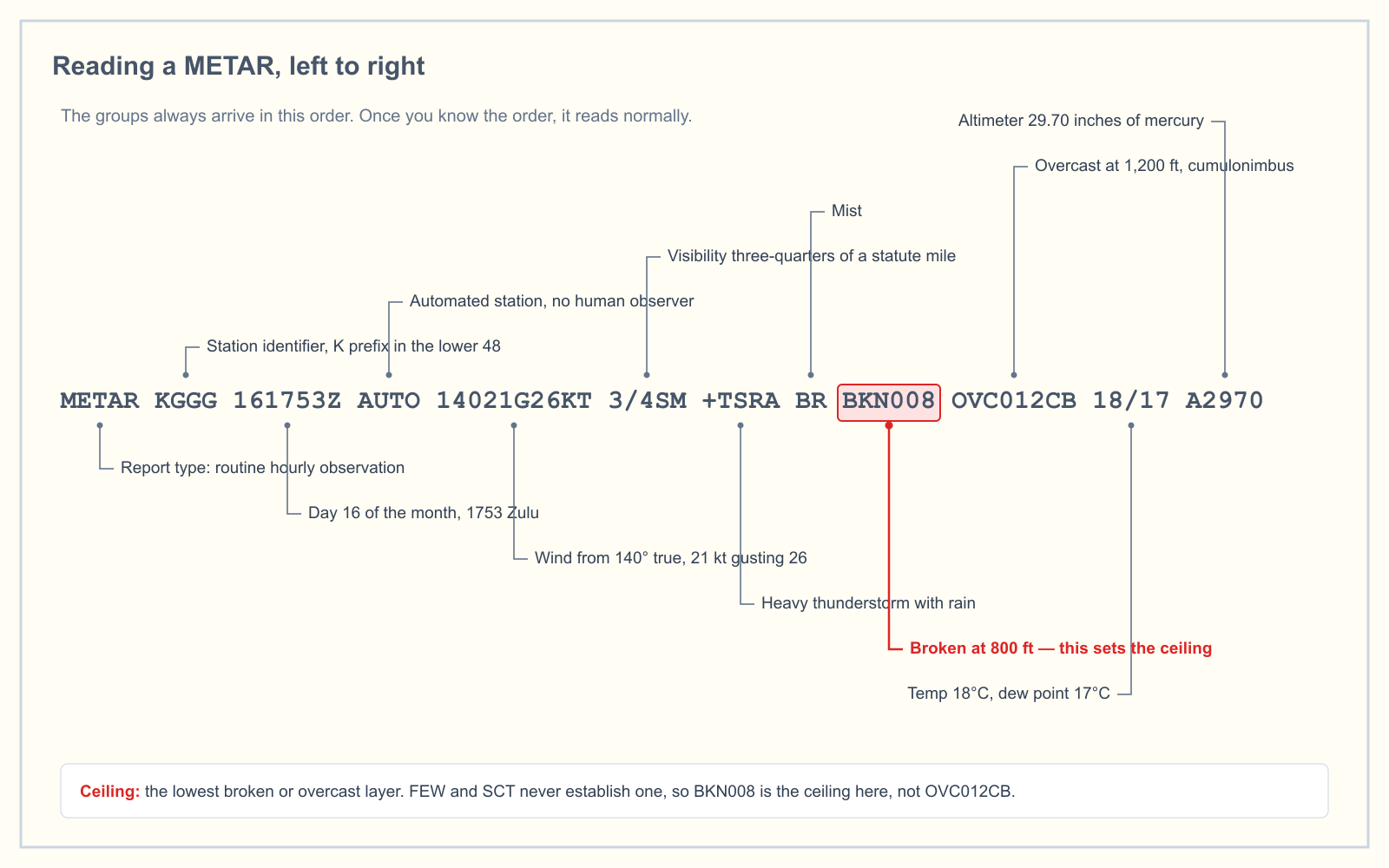
| METAR | Day and time of observation | 161753Z is the 16th at 1753Z |
| TAF | Issue time, then a day-and-hour valid period | 1212/1312 is the 12th at 1200Z to the 13th at 1200Z |
| TAF change group | Day, hour and minute | FM130200 is from the 13th at 0200Z |
| NOTAM | Start and end as year, month, day, hour, minute | 2609281400-2609282200 |
| PIREP | Time group /TM | /TM 1815 is 1815Z |
If you plan a 6 p.m. Eastern Daylight Time job on the 12th, that is 2200Z on the 12th. Push it to 9 p.m. and it is 0100Z on the 13th, and you need the part of the TAF labeled with the 13th. Find the evening block by looking for "the 12th" and you are reading the wrong forecast.
Where does a drone pilot actually see Zulu time?
More often than you might expect.
- Weather. METARs, TAFs, PIREPs, AIRMETs, SIGMETs and the graphical products on aviationweather.gov all use UTC.
- NOTAMs. Effective and expiration times are in UTC. A NOTAM closing a runway "until 2300Z" does not end at 11 p.m. your time.
- TFRs. The temporary flight restrictions that matter most to drone operations, around stadiums, disasters and VIP movements, are issued as NOTAMs and carry UTC effective times. Some displays add a local conversion. Do not assume they have done it correctly for your zone.
- The Chart Supplement. Each airport entry lists its UTC offset, written like
UTC-5(-4DT): 5 hours behind UTC in standard time, 4 during daylight time. That is the conversion for that airport, printed for you.
What this means when you are actually working
The regulation does not mention Zulu time. It does require, under 14 CFR 107.49, that before flight you assess the operating environment, including local weather conditions and flight restrictions. Every official source for those two things is in UTC. Converting correctly is not a nicety; it is how you meet the preflight requirement with information that actually applies to your flight window.
Three habits save most of the mistakes:
- Write the Zulu window on the job sheet. If the job runs 1 p.m. to 3 p.m. Central Daylight, write
1800Z–2000Znext to it. Then match products to that window, not to a feeling about what "afternoon" looks like. - Check the date as well as the hour. For any late-day job, confirm whether you have rolled into tomorrow's Zulu date.
- Recheck the offset twice a year. The week after the daylight saving change is when pilots who have memorized "add 4" start being an hour off.
On the knowledge test, times appear in the METAR and TAF questions in the airman testing supplement, and they are always in Zulu. Weather is only 5% of the current test blueprint, but those questions routinely hinge on reading the right block of a forecast, which means reading the time correctly. You can drill decoding in the METAR practice tool.
Frequently asked questions
What is meant by Zulu time?
Zulu time means Coordinated Universal Time, or UTC, written on a 24-hour clock with a Z after it. It is the single reference clock the FAA uses for all operations, so a time like 1430Z means 2:30 p.m. UTC regardless of where you are. Zulu is the phonetic word for the letter Z.
How do you convert local time to Zulu time?
Put local time in 24-hour format, then add your zone's offset: 5 hours for Eastern, 6 Central, 7 Mountain, 8 Pacific, 9 Alaska and 10 Hawaii in standard time. Subtract one hour from each offset during daylight saving. If the answer reaches 2400 or more, subtract 2400 and advance the date by one day.
What is Zulu time vs EST?
Zulu time is 5 hours ahead of Eastern Standard Time, so noon EST is 1700Z. From the second Sunday in March to the first Sunday in November the east coast uses Eastern Daylight Time instead, which is only 4 hours behind Zulu. In summer, noon on the east coast is 1600Z.
Is Zulu time the same as GMT?
For aviation purposes, yes. Zulu, UTC and Greenwich Mean Time all describe the time at the prime meridian with zero offset. The technical differences between UTC and GMT are fractions of a second, which never affect a weather briefing, a NOTAM or a flight plan. The UK moves to British Summer Time in summer, but Zulu itself never changes.
Does Zulu time change for daylight saving?
No. Zulu time never observes daylight saving. What changes is the gap between Zulu and your local clock. When US clocks spring forward in March the offset shrinks by one hour, and it grows back in November. That is why the same local job time converts to a different Zulu time in winter and in summer.
Are NOTAMs and TFRs in Zulu time?
Yes. NOTAM effective and expiration times are given in UTC, and TFRs are issued as NOTAMs, so their official times are UTC as well. Some apps and maps convert them to local for display. Treat the UTC time in the NOTAM text as authoritative and convert it yourself if the flight is close to a start or end time.
Want to check you can pull the right time out of a coded report under exam pressure? The free readiness assessment mixes weather questions in with the other four knowledge areas.
Sources
- Aeronautical Information Manual 4-2-12 — Time, with the standard time to UTC table
- 14 CFR 107.49 — Preflight familiarization, inspection, and actions for aircraft operation
- FAA Aeronautical Chart Users' Guide
- FAA Airman Certification Standards
- US Department of Transportation — Daylight Saving Time
- Aviation Weather Center
Put this guide into practice.
Take the free assessment to see how this topic fits into your current exam readiness.
Start free practice