Flight Operations
Aeromedical Factors for Drone Pilots: Hyperventilation, Alcohol, Fatigue, Vision and the Rest
The FAA lists six physiological factors that degrade a remote pilot, and the exam asks about every one. Here is what each does, how you spot it, and the fix the FAA expects.
Key takeaway
The FAA's list for remote pilots is hyperventilation, stress, fatigue, dehydration, heatstroke, and alcohol and drugs. Breathing normally cures hyperventilation, only rest cures acute fatigue, and the 8-hour and 0.04 alcohol limits apply to you through 14 CFR 107.27.
Aeromedical factors are the physical and physiological conditions that degrade a pilot's performance. For remote pilots, the FAA's study guide names six: hyperventilation, stress, fatigue, dehydration, heatstroke, and the effects of alcohol and drugs. Vision and scanning come next. The alcohol limits (8 hours, 0.04) are regulatory under 14 CFR 107.27.
Most people study this material as if it were written for someone sitting in a cockpit at 12,000 feet, because the source chapter in the Pilot's Handbook of Aeronautical Knowledge largely was. A remote pilot stands on the ground. That changes which factors actually bite. Hypoxia from altitude barely applies to you. Dehydration on a July roof job applies a great deal. The exam tests the list, and this article sorts the list by how much each item matters on a real job.
What are the aeromedical factors on the Part 107 exam?
The FAA's Remote Pilot Small Unmanned Aircraft Systems Study Guide (FAA-G-8082-22) covers this in Chapter 9, "Physiological Factors (Including Drugs and Alcohol) Affecting Pilot Performance." It lists the important medical factors as hyperventilation, stress, fatigue, dehydration, heatstroke, and the effects of alcohol and drugs, then moves on to vision and scanning.
The Pilot's Handbook of Aeronautical Knowledge Chapter 17, "Aeromedical Factors," has a longer list written for manned pilots. It adds hypoxia, middle ear and sinus problems, spatial disorientation, motion sickness and carbon monoxide poisoning. Those can still turn up on the test, so it pays to know the basics.
| Factor | What causes it | What you notice | The FAA's fix |
|---|---|---|---|
| Hyperventilation | Breathing too fast and too deep, usually from stress | Lightheadedness, tingling, hot and cold sensations, muscle spasms, visual impairment | Slow your breathing, talk aloud, or breathe into a paper bag |
| Stress | Physical, physiological or psychological demands | Higher heart rate and breathing; performance falls off rapidly when chronic | Manage the stressor; chronic stress means do not fly and see a physician |
| Fatigue | Sleep loss, physical work, prolonged mental effort | Poor attention, impaired coordination, worse communication | Rest. No amount of training overcomes it |
| Dehydration | Heat, wind, humidity, caffeine, alcohol | Headache, fatigue, cramps, sleepiness, dizziness | Drink before you are thirsty |
| Heatstroke | The body cannot control its temperature | Dehydration symptoms, sometimes only collapse | Carry water and drink at intervals whether thirsty or not |
| Alcohol and drugs | Anything that affects your faculties | Impaired judgment, coordination, vision and memory | 8 hours, below 0.04, no impairing drugs |
What is hyperventilation, and how do you fix it?
Hyperventilation is the excessive rate and depth of breathing that drives too much carbon dioxide out of the blood. The study guide notes it happens to pilots more often than people realize, and that it is usually set off by an unexpected stressful situation. Picture a fly-away near a crowd, or a low battery warning over water.
It rarely incapacitates you completely, but the symptoms are alarming. They include lightheadedness, tingling, hot and cold sensations, muscle spasms and visual impairment, and in the extreme, unconsciousness. The trap is the loop: the symptoms frighten you, fright speeds up your breathing, and faster breathing makes the symptoms worse.
The cure is to restore the carbon dioxide level. Per the FAA, breathing normally is both the best prevention and the best cure. Slowing your breathing rate, talking aloud, or breathing into a paper bag all help, and recovery is usually rapid. Talking aloud is the useful one for a remote pilot. Calling out what the aircraft is doing to your visual observer slows your breathing and briefs the crew at the same time.
How do stress and fatigue affect a remote pilot?
Stress is the body's response to physical and psychological demands. The FAA divides it into acute stress, the short-term fight-or-flight response, and chronic stress, a level that exceeds your ability to cope and makes performance fall sharply. The study guide is blunt about the second: a pilot at that level is not safe and should not exercise their privileges.
Fatigue is, in the FAA's words, frequently associated with pilot error. It degrades attention and concentration, coordination, and your ability to communicate. Acute fatigue comes from strenuous effort, excitement or lost sleep, and rest plus 8 hours of sound sleep normally cures it. Chronic fatigue is not cured by rest and needs a physician.
The study guide singles out skill fatigue, which has two effects worth knowing for the exam:
- Timing disruption. You appear to fly normally, but each control input is slightly out of step with the next.
- Disruption of the perceptual field. Your attention narrows to the center of your vision and you stop noticing the periphery. For a pilot keeping a small aircraft in sight, that is the worst place to lose attention.
The FAA's position is that if fatigue sets in during an operation, no amount of training or experience overcomes it. The only prevention is adequate rest.
Why are dehydration and heatstroke such a problem for drone pilots?
Because you work outdoors, often in full sun, often standing still on asphalt or a roof for hours. The FAA lists hot temperatures, wind, humidity and diuretic drinks (coffee, tea, alcohol and caffeinated soft drinks) as causes of dehydration.
The first noticeable effect is fatigue, which is why dehydration so often goes undiagnosed. Left alone it progresses to dizziness, weakness, nausea, tingling and cramps. The thirst mechanism does not help much. The study guide notes most people do not feel thirsty until they are down about 1.5 quarts, or 2 percent of body weight. A sip of water then switches the thirst signal off before you have replaced what you lost.
The FAA's guidance figures:
- Two to four quarts of water every 24 hours as a general guide
- In heat stress, one quart per hour for severe conditions or one pint per hour for moderate ones
- Drink at intervals whether thirsty or not
Heatstroke is the body losing control of its own temperature. It can announce itself through dehydration symptoms, and the study guide warns it has sometimes been recognized only at complete collapse.
What are the alcohol and drug rules for drone pilots?
This is the one section where the aeromedical material becomes regulation. 14 CFR 107.27 applies 14 CFR 91.17 and 91.19 to the remote pilot in command, the person manipulating the controls, and the visual observer. You may not act within 8 hours of drinking any alcoholic beverage, while under the influence, with a blood alcohol concentration of 0.04 percent or more, or while using any drug that affects your faculties contrary to safety. The IMSAFE and PAVE article covers how the 8-hour and 0.04 tests interact.
The consequences sit in two more sections. Under 14 CFR 107.57, a drug conviction or an act prohibited by 91.17(a) or 91.19(a) is grounds for denying an application for up to 1 year, or for suspending or revoking your certificate. Under 107.59, refusing an alcohol test requested under 91.17(c) carries the same consequences.
Three FAA points the exam likes:
- A hangover is still being under the influence. The study guide notes considerable alcohol can remain in the body for over 16 hours.
- Alcohol causes histotoxic hypoxia. The PHAK states that one ounce of alcohol can equate to an extra 2,000 feet of physiological altitude.
- New medication: wait at least 48 hours after the first dose before flying, to make sure you have no adverse side effects. The FAA specifically flags antihistamines containing diphenhydramine for drowsiness and a long half-life.
Does hypoxia matter if you never leave the ground?
Mostly, no, but the exam can still ask about it. The PHAK defines four types by cause:
| Type | Cause | Example |
|---|---|---|
| Hypoxic | Not enough oxygen available to the body | Reduced partial pressure at altitude |
| Hypemic | Blood cannot carry enough oxygen | Carbon monoxide poisoning, blood donation |
| Stagnant | Oxygen-rich blood is not flowing to the tissues | Excessive G-loads, cold, a limb "going to sleep" |
| Histotoxic | Cells cannot use the oxygen they receive | Alcohol, narcotics, poisons |
Hypoxic hypoxia is the cockpit problem. The PHAK says symptoms increase in severity above 10,000 feet. A remote pilot is unlikely to meet it, unless you launch from very high mountain terrain. The two that can reach you are histotoxic, through alcohol and drugs, and hypemic, through carbon monoxide. Carbon monoxide comes from engine exhaust and is odorless and colorless. Flying from the driver's seat of an idling vehicle is a habit worth dropping.
Hypoxia and hyperventilation share symptoms: lightheadedness, tingling and visual impairment. On the ground, with no altitude involved, hyperventilation is the far more likely explanation.
How should a remote pilot scan for other aircraft?
Vision is the factor you use on every flight. The study guide describes a scanning method borrowed from manned flight:
- Scan left to right or right to left, starting at the farthest distance you can see and working inward
- Look at sectors about 30 degrees wide
- Stop on each sector for no longer than 2 to 3 seconds
- Overlap each new sector with the previous one by 10 degrees
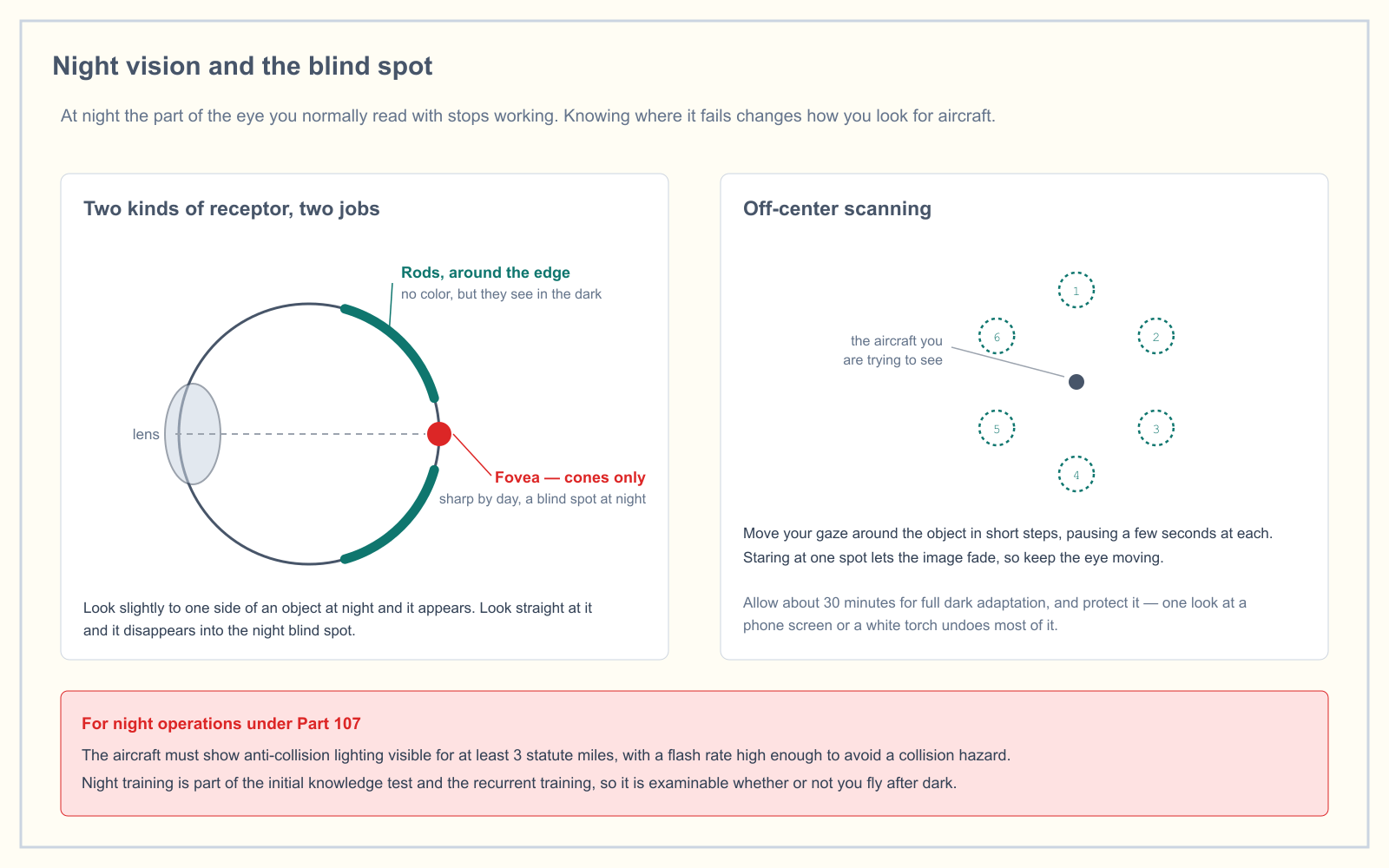
At night, the diagram above explains the extra problem: the fovea has no rods, so whatever you look straight at can disappear. Off-center viewing and protecting your dark adaptation are covered in detail in Can You Fly a Drone at Night?. The illusions that follow from bad visual cues are in the spatial disorientation guide.
What this means when you are actually working
Part 107 has no medical certificate and no examiner. 14 CFR 107.17 prohibits you from operating if you know or have reason to know of a physical or mental condition that would interfere with safe operation. The study guide also places responsibility on the remote PIC to make sure no crewmember participates while impaired. Self-assessment is the whole system, which is why the material is on the test.
In practice that means a few habits:
- Pack water as you would pack batteries. On a hot job, schedule drinks between flights rather than waiting to feel thirsty.
- Treat a long day as a risk factor. Your fifth inspection of the day is flown by a more tired pilot than your first. Skill fatigue narrows your attention to the center of the screen, exactly when you should be watching the sky.
- Check your visual observer too. A VO who drank last night or skipped sleep is your regulatory problem, not only theirs.
- When something goes wrong, talk. Narrating the problem aloud controls your breathing and keeps the crew informed.
Run the IMSAFE checklist before each job, and watch for the hazardous attitudes that make people fly when they shouldn't.
How the exam asks about aeromedical factors
Physiology sits in the Operations area, which carries 25 percent of the current UAG blueprint. Expect questions that give a symptom and ask for the cause or the cure. "A remote pilot feels tingling and lightheadedness during an emergency" points to hyperventilation and to slowing the breathing rate. Expect the numbers too: 8 hours, 0.04, 48 hours for new medication, and the first sign of dehydration being fatigue.
Frequently asked questions
What are the aeromedical factors in aviation?
Aeromedical factors are health and physiological conditions that degrade pilot performance. The PHAK's Chapter 17 lists hypoxia, hyperventilation, ear and sinus problems, spatial disorientation, motion sickness, carbon monoxide poisoning, stress, fatigue, dehydration, heatstroke, alcohol and drugs. The Part 107 study guide narrows this to hyperventilation, stress, fatigue, dehydration, heatstroke, and alcohol and drugs, plus vision.
What is the 8 hours bottle to throttle rule for drone pilots?
Under 14 CFR 107.27, which applies 14 CFR 91.17 to remote pilots, you may not act as remote pilot in command, manipulate the controls, or serve as visual observer within 8 hours of drinking any alcoholic beverage. You also may not fly with a blood alcohol concentration of 0.04 percent or more, even after 8 hours.
Do drone pilots need an FAA medical certificate?
No. Part 107 does not require a medical certificate or an aviation medical examination. Instead, 14 CFR 107.17 prohibits operating if you know or have reason to know of a physical or mental condition that would interfere with safe operation. That makes the remote pilot responsible for honestly assessing their own fitness, and their crew's, before every flight.
What is the best cure for hyperventilation?
According to the FAA, breathing normally is both the best prevention and the best cure. Hyperventilation results from losing too much carbon dioxide, so the goal is to restore it by slowing your breathing rate. Breathing into a paper bag or talking aloud also helps, and recovery is usually rapid once your breathing returns to normal.
How long should you wait after starting a new medication before flying a drone?
The FAA's Remote Pilot Study Guide says to wait at least 48 hours after the first dose of any new medication, prescription or over-the-counter, before flying. That gives you time to confirm it has no side effects that would make operating unsafe. Antihistamines containing diphenhydramine are specifically flagged for drowsiness and a long half-life.
What is the first sign of dehydration?
The FAA says the first noticeable effect of dehydration is fatigue, which is why it often goes unrecognized. Other signs include headache, cramps, sleepiness and dizziness. Thirst arrives late, typically after losing about 1.5 quarts, so drink water at regular intervals during outdoor operations rather than waiting until you feel thirsty.
Test yourself on the physiology questions with the free Part 107 practice test.
Sources
- Remote Pilot – Small Unmanned Aircraft Systems Study Guide (FAA-G-8082-22), Chapter 9
- Pilot's Handbook of Aeronautical Knowledge (FAA-H-8083-25C), Chapter 17: Aeromedical Factors
- 14 CFR 107.17 — Medical condition
- 14 CFR 107.27 — Alcohol or drugs
- 14 CFR 107.57 — Offenses involving alcohol or drugs
- 14 CFR 107.59 — Refusal to submit to an alcohol test or to furnish test results
- 14 CFR 91.17 — Alcohol or drugs
Put this guide into practice.
Take the free assessment to see how this topic fits into your current exam readiness.
Start free practice