Weather
Density Altitude: Why Your Drone Underperforms on a Hot Day
The aircraft is not higher. The air simply behaves as though it were — and the motors feel it long before you do.
Key takeaway
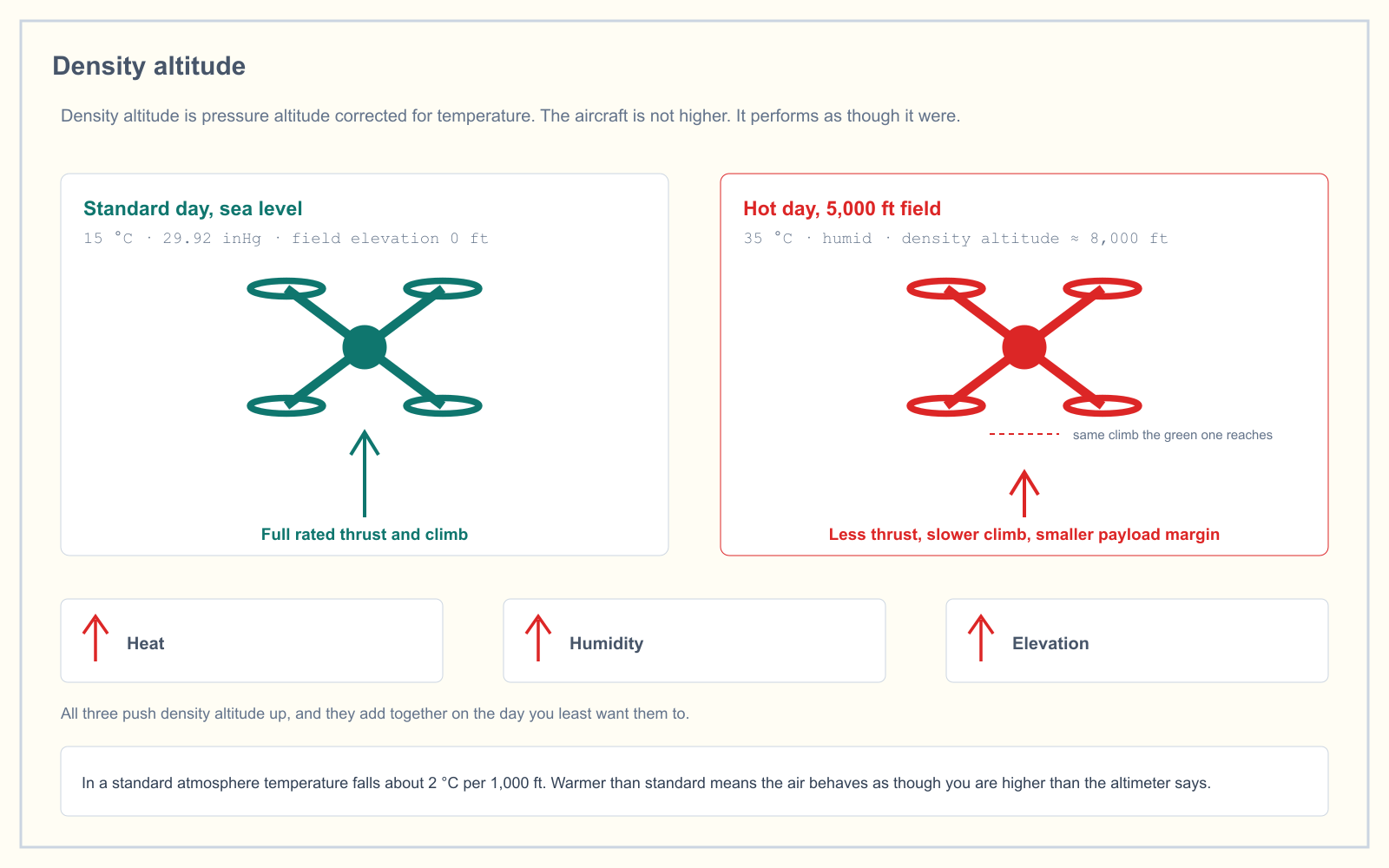
Density altitude is pressure altitude corrected for non-standard temperature. Heat, humidity and elevation all raise it, they arrive together, and the result is less thrust, a slower climb and less payload margin.
Density altitude is pressure altitude corrected for non-standard temperature. It is the altitude at which the air you are actually flying in would be found in a standard atmosphere. The aircraft is not higher than the altimeter says — the air simply behaves as though it were, and the motors feel that long before you do.
Three things push it up, and on the day it matters they arrive together: heat, humidity and field elevation.
The chain of definitions
The words get confused constantly, so it is worth fixing all four in order.
| Term | Definition |
|---|---|
| Indicated altitude | What the altimeter reads with the current altimeter setting in the window |
| Pressure altitude | What the altimeter reads with 29.92 inHg set in the window — the height above the standard datum plane |
| True altitude | Actual height above mean sea level |
| Density altitude | Pressure altitude corrected for temperature — a performance figure, not a position |
Density altitude is the odd one out. The first three describe where the aircraft is. Density altitude describes what the aircraft can do.
How to work it out
Step 1 — get pressure altitude. Set 29.92 in the altimeter, or calculate it:
Pressure altitude = field elevation + (29.92 − altimeter setting) × 1,000
A field at 2,000 feet with an altimeter setting of 29.42 has a pressure altitude of 2,000 + (0.50 × 1,000) = 2,500 feet.
Step 2 — correct for temperature. The standard temperature at sea level is 15 °C, falling about 2 °C per 1,000 feet. A rough rule that is accurate enough for planning:
Density altitude ≈ pressure altitude + 120 × (actual temperature °C − standard temperature °C)
Continuing the example: standard temperature at 2,500 feet is 15 − (2.5 × 2) = 10 °C. If it is actually 30 °C, that is 20 degrees above standard, so density altitude ≈ 2,500 + (120 × 20) = 4,900 feet.
The aircraft sits on a field at 2,000 feet and performs as though it were at nearly 5,000.
What humidity does
Water vapor is lighter than dry air. This is genuinely counterintuitive — humid air feels heavy — but a water molecule has a molecular weight of about 18 against roughly 29 for the nitrogen and oxygen it displaces. Replace some of the air with water vapor and the mixture gets less dense.
The effect is smaller than heat, and most density altitude calculations ignore it. It is not nothing, though: on a hot, humid day near sea level it can add several hundred feet, and the FAA guidance is explicit that high humidity degrades performance and should be treated as a reason for additional margin rather than a number to compute.
What it does to a multirotor
A propeller generates thrust by accelerating a mass of air downward. Thin air means less mass per revolution, which means less thrust for the same RPM.
The consequences compound:
- Reduced thrust at the same power. The motors must spin faster to hover, which draws more current.
- Shorter flight time. More current for the same lift means the battery depletes faster, and endurance figures printed by the manufacturer assume standard conditions near sea level.
- Slower climb rate. The margin between hover thrust and maximum thrust narrows.
- Less payload capability. The aircraft that lifts a heavy camera at sea level may not lift it at 8,000 feet density altitude.
- Less control authority. This is the one that hurts. Correcting a gust requires spare thrust on one side, and spare thrust is the first thing thin air takes away.
Fixed-wing UAS get the same problem plus a longer takeoff roll and a higher true airspeed for the same indicated airspeed.
The dangerous combination
The classic accident chain is described in the FAA handbooks as hot, high and heavy — high temperature, high field elevation, and a heavy aircraft. Each alone is manageable. Together they eliminate margin.
For a remote pilot the specific scenario is a summer job at a mountain site with a full payload. The site is at 6,500 feet, it is 32 °C by mid-afternoon, and the aircraft is carrying a heavy sensor. Density altitude is comfortably above 9,000 feet. The aircraft will fly — it will just have almost nothing left for a gust, a go-around, or a return-to-home into a headwind.
The mitigations are all boring and all effective:
- Fly early, before the surface heats up
- Reduce payload
- Reduce planned flight time and land with a bigger reserve
- Test hover performance at low altitude before committing to the mission profile
- Treat manufacturer endurance figures as sea-level, standard-day figures, because that is what they are
A worked example you can check against
Numbers make this concrete. Take three sites on the same July afternoon, each with an altimeter setting of 29.92 so pressure altitude equals field elevation.
| Site | Field elevation | Standard temp | Actual temp | Density altitude |
|---|---|---|---|---|
| Coastal park | 20 ft | 15 °C | 24 °C | ≈ 1,100 ft |
| Inland county field | 1,800 ft | 11 °C | 33 °C | ≈ 4,400 ft |
| Mountain survey site | 6,500 ft | 2 °C | 30 °C | ≈ 9,900 ft |
The coastal site is barely affected. The county field, which most operators would think of as low, is already performing like 4,400 feet. The mountain site is performing like 9,900 feet on a day when the altimeter reads 6,500.
Now notice what happens if the mountain job slips to mid-afternoon and the temperature reaches 35 °C. Standard is still 2 °C, so the correction becomes 120 × 33 = 3,960 feet, and density altitude passes 10,400 feet. Waiting three hours cost another 600 feet of performance.
What the exam asks
Density altitude sits in the Weather and Loading area of the Airman Certification Standards. The questions come in three recognizable shapes:
- Definition. "Density altitude is..." The answer is pressure altitude corrected for non-standard temperature.
- Effect. "What effect does high density altitude have on performance?" Reduced thrust, reduced climb, longer takeoff, reduced payload.
- Which factors raise it. Heat, humidity and elevation. A question offering "low temperature" or "high pressure" as an answer is offering you the inverse.
A fourth shape appears occasionally: given a field elevation and an altimeter setting, compute pressure altitude. That is arithmetic, not judgment, and the formula above is all you need.
Frequently asked questions
What is density altitude?
Density altitude is pressure altitude corrected for non-standard temperature. It expresses the altitude at which the current air density would be found in a standard atmosphere, and it is a measure of aircraft performance rather than of the aircraft's actual position.
How do you calculate density altitude?
First find pressure altitude by adding (29.92 − altimeter setting) × 1,000 to the field elevation. Then add approximately 120 feet for every degree Celsius the actual temperature exceeds the standard temperature for that pressure altitude, where standard is 15 °C at sea level falling about 2 °C per 1,000 feet.
What three factors increase density altitude?
High temperature, high humidity and high field elevation all increase density altitude. Temperature has the largest effect, elevation is the baseline, and humidity adds a smaller amount because water vapor is less dense than the dry air it displaces.
Does high humidity increase or decrease density altitude?
High humidity increases density altitude. Water vapor has a lower molecular weight than the nitrogen and oxygen it displaces, so moist air is less dense than dry air at the same temperature and pressure.
How does density altitude affect a drone?
High density altitude reduces the mass of air the propellers can accelerate, so the aircraft produces less thrust at the same RPM. The practical effects are a slower climb, shorter flight time, reduced payload capacity and — most importantly — less spare thrust available to correct a gust.
What is the difference between pressure altitude and density altitude?
Pressure altitude is what the altimeter reads with 29.92 inHg set, and it depends only on atmospheric pressure. Density altitude takes that figure and corrects it for temperature, which is what makes it a performance number rather than a height.
Density altitude, weight and balance, and load factor are tested together in the Weather and Loading section. See where you stand with the free readiness assessment.
Sources
Put this guide into practice.
Take the free assessment to see how this topic fits into your current exam readiness.
Start free practice