Regulations
Right-of-Way Rules in Aviation: Who Yields to Whom, and Why a Drone Always Yields
Manned aircraft work through a hierarchy to decide who gives way. A drone skips the hierarchy entirely and yields to all of it. Here is both rule, and why they differ.
Key takeaway
Under 14 CFR 107.37(a) a small unmanned aircraft yields the right of way to all aircraft, with no exceptions and no hierarchy. The 91.113 pecking order tells you what the other aircraft will do; it never gives you priority.
Right-of-way rules decide which aircraft gives way when two converge. Under 14 CFR 91.113, an aircraft in distress outranks everything, then balloons, gliders, aircraft towing or refueling, airships, and finally powered aircraft. Under 14 CFR 107.37(a) a drone sits below all of it and yields to every aircraft, always.
That second sentence is the whole reason a remote pilot studies the first one. You will never win a right-of-way contest. You learn the hierarchy not to claim priority but to predict what the manned aircraft around you is about to do, because the rule tells you which way it will turn and where it will descend.
What does right-of-way mean in aviation?
It is not a claim to a piece of sky. Section 91.113(b) defines the duty side of it precisely: when a rule gives another aircraft the right of way, the pilot shall give way to that aircraft and may not pass over, under, or ahead of it unless well clear.
Two things fall out of that wording.
Having the right of way does not excuse you from looking. The same paragraph requires each person operating an aircraft to maintain vigilance so as to see and avoid other aircraft whenever weather permits, regardless of whether the flight is IFR or VFR. Right of way tells you who maneuvers. It never tells anybody to stop watching.
Giving way has a defined shape. You do not merely avoid a collision. You may not cut over the top, slide underneath, or cross in front unless you are well clear. That phrase, "over, under, or ahead of it unless well clear," is reused verbatim in the drone rule, which is not an accident.
The right-of-way hierarchy, in order
Section 91.113(d) handles converging traffic. If the two aircraft are of the same category and at approximately the same altitude, the rule is geometric: the aircraft to the other's right has the right of way. Look right, give way right.
If the categories differ, the hierarchy takes over:
| Priority | Aircraft | Source |
|---|---|---|
| 1 | In distress | 91.113(c) — right of way over all other air traffic |
| 2 | Balloon | 91.113(d)(1) — over any other category |
| 3 | Glider | 91.113(d)(2) — over powered aircraft |
| 4 | Towing or refueling another aircraft | 91.113(d)(4) — over all other powered aircraft |
| 5 | Airship | 91.113(d)(3) — over all other powered aircraft, except towing or refueling |
| 6 | Airplane, rotorcraft, and other powered aircraft | Everything left over |
| 7 | Small unmanned aircraft | 107.37(a) — yields to all of the above |
Note where towing sits. Paragraph (d)(3) gives an airship priority over all other powered aircraft except an aircraft towing or refueling, and (d)(4) gives the towing aircraft priority over all other powered aircraft. A tow plane therefore outranks an airship, which is the one pair in the list most study guides get backwards.
The logic running down the column is maneuverability. A balloon goes where the wind goes. A glider cannot add power to climb out of the way, and every turn it makes costs altitude it may need. A tug on a tow line cannot maneuver sharply without endangering the glider behind it. The less an aircraft can do about the conflict, the higher it sits.
Converging, head-on and overtaking
Three geometries, three rules, and only one of them gives anybody priority.
| Geometry | Rule | Who maneuvers |
|---|---|---|
| Converging at approximately the same altitude, same category | The aircraft to the other's right has the right of way — 91.113(d) | The aircraft that sees traffic on its right gives way |
| Head-on, or nearly so | Each pilot shall alter course to the right — 91.113(e) | Both. Nobody has the right of way |
| Overtaking | The aircraft being overtaken has the right of way; the overtaking aircraft alters course to the right to pass well clear — 91.113(f) | The aircraft doing the overtaking |
The head-on case is the one candidates misread. There is no winner. Both pilots turn right, which is what makes the rule work — if only one had priority and the other guessed wrong, both would turn the same way into each other.
The pattern underneath all three is that the corrective turn is to the right, in the head-on case and the overtaking case alike. That is worth committing to memory, because it is also what a manned aircraft will do near you.
Who has the right-of-way at an airport?
Landing traffic, by 91.113(g), with two limits attached.
Aircraft on final approach to land, or while landing, have the right of way over other aircraft in flight or operating on the surface. That is the strongest priority in the section short of an aircraft in distress.
The limits exist because priority invites abuse:
- An aircraft on final may not use the rule to force an aircraft off the runway that has already landed and is trying to clear the surface for it.
- When two or more aircraft are approaching to land, the aircraft at the lower altitude has the right of way, but it may not use that rule to cut in front of another aircraft on final, or to overtake it.
So the answer to "who has priority when two aircraft are on final at the same time" is the lower one, with a caveat that stops a pilot diving to manufacture the advantage. Both halves of that sentence are testable, and the second half is the half that gets left out.
Why a drone yields to everything
Section 107.37 is two sentences of consequence:
(a) Each small unmanned aircraft must yield the right of way to all aircraft, airborne vehicles, and launch and reentry vehicles. Yielding the right of way means that the small unmanned aircraft must give way to the aircraft or vehicle and may not pass over, under, or ahead of it unless well clear.
(b) No person may operate a small unmanned aircraft so close to another aircraft as to create a collision hazard.
Three details in there matter more than the headline.
There is no category, no geometry, and no exception. It does not matter whether the manned aircraft is converging from your left, overtaking you, or approaching head-on. It does not matter that the 91.113 hierarchy would put a Cessna near the bottom. The drone yields. Every time.
The list is wider than "aircraft." Airborne vehicles, and launch and reentry vehicles, are named separately. This is the paragraph that covers you near a spaceport or a balloon launch, and it is why the rule cannot be reduced to "give way to planes."
Paragraph (b) is a separate offense. You can yield properly and still violate 107.37(b) by operating close enough to create a collision hazard. It is not a restatement of (a); it is a floor underneath it.
The waiver detail almost nobody gets right
Section 107.205 lists which Part 107 rules the FAA can waive. It names § 107.37(a) — Yielding the right of way. It does not name 107.37(b).
So the yielding duty is, in principle, waivable — that is the provision a beyond-visual-line-of-sight operation with a detect-and-avoid system has to address. The collision-hazard prohibition is not waivable at all. There is no certificate of waiver that permits you to fly close enough to another aircraft to create a collision hazard.
How you actually yield when you cannot see the traffic
Here is the practical problem. Right-of-way rules were written for pilots who can see each other. You are on the ground, the aircraft is a dot, and by the time you have identified it, the geometry has changed.
Section 107.31 is what makes the duty workable. You, or your visual observer, must be able to see the unmanned aircraft throughout the flight in order to, among other things, observe the airspace for other air traffic or hazards. The scan is a regulatory requirement, not good practice. If your eyes are on the controller screen, you are not meeting 107.31(a)(3), and you will not meet 107.37 either.
What yielding looks like in the field, in order of speed:
- Descend. It is the fastest way to become irrelevant to an aircraft that is above you and is almost always the right first move. A drone at 80 feet is not a factor to a Cessna at 800.
- Land. If the aircraft is low — on approach, on a survey line, a helicopter working a scene — get on the ground. You are not obliged to hold station.
- Do not climb, and do not run. Climbing moves you toward the conflict. A lateral dash at 40 mph solves nothing against an aircraft doing 120 knots, and it moves your aircraft to a position you had not planned to fly.
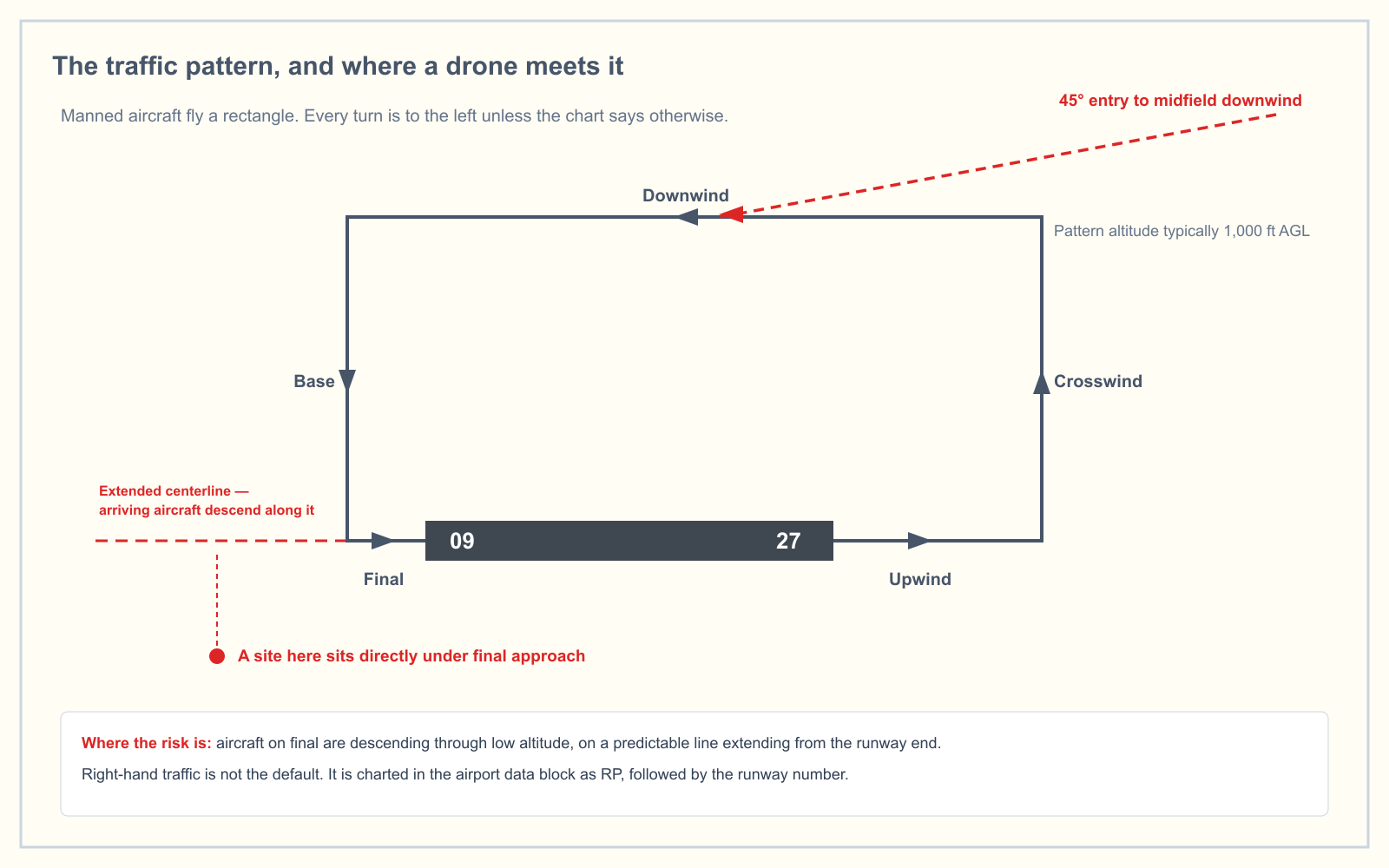
Near a non-towered field, the hazardous geometry is specific: you are most exposed under the extended centerline off the approach end, because that is where arriving aircraft are lowest. The traffic pattern legs tell you where to expect them, and monitoring CTAF tells you when. Neither is required by Part 107, and both are how experienced operators buy themselves the thirty seconds the rule assumes you have.
One more operational point. Helicopters and agricultural aircraft do not fly patterns. A medical helicopter will arrive from any direction, at any altitude, with no radio call you are listening to. "I checked the pattern" is not a scan.
How the exam asks about right of way
Regulations is 48 percent of the Unmanned Aircraft General knowledge test under the blueprint effective 29 September 2025, which makes this section high-value. Questions come in three shapes:
- The drone rule, stated plainly. "Who has the right of way when a small unmanned aircraft and a manned aircraft are converging?" The manned aircraft, always. Answer options that invoke the converging or overtaking geometry are distractors.
- The 91.113 hierarchy. Usually balloon versus glider versus airplane, or the same-category converging rule. Remember: same category, the aircraft on the right has it.
- Head-on. Both aircraft turn right. Options offering "the aircraft on the right has the right of way" are importing the converging rule into the wrong geometry.
The trap across all three is assuming the hierarchy applies to you. It describes the traffic around you. It never promotes you.
You can drill these against real question formats in the regulations practice bank, which is where the distractor patterns become obvious.
Frequently asked questions
What does right-of-way mean in aviation?
It identifies which aircraft must maneuver when two conflict. Under 14 CFR 91.113(b), an aircraft required to give way must not pass over, under, or ahead of the other unless well clear. Having the right of way does not remove the duty to see and avoid, which applies to every pilot whenever weather conditions permit.
Who has the right-of-way at all times in an airport?
An aircraft in distress outranks all other air traffic under 91.113(c). Short of that, aircraft on final approach to land or while landing have the right of way over other aircraft in flight or on the surface, though they may not use that priority to force an aircraft that has already landed off the runway.
Who has the right-of-way when two aircraft are on final approach at the same time?
The aircraft at the lower altitude, under 91.113(g). The rule attaches a limit: the lower aircraft may not use it to cut in front of another aircraft that is on final approach to land, or to overtake it. Both halves of the rule are regularly tested together.
Does a drone ever have the right of way over a manned aircraft?
No. Section 107.37(a) requires a small unmanned aircraft to yield the right of way to all aircraft, airborne vehicles, and launch and reentry vehicles, without exception for category, altitude or geometry. The 91.113 hierarchy governs the traffic around you; it never assigns a drone priority over anything.
What is the order of right-of-way priority in aviation?
In distress first, then balloons, then gliders, then aircraft towing or refueling, then airships, then all other powered aircraft including airplanes and rotorcraft. The ordering follows maneuverability: an aircraft that cannot readily climb or turn out of a conflict sits higher in the list.
Which way do you turn when two aircraft approach head-on?
Both pilots alter course to the right, under 91.113(e). Neither aircraft has the right of way in this geometry, which is the point of the rule. If priority were assigned to one of them, a misidentification would send both aircraft the same way and make the conflict worse.
Want to know whether the regulations area is actually solid? The free readiness assessment samples all five knowledge areas so you find out where you stand before you pay for the test.
Sources
Put this guide into practice.
Take the free assessment to see how this topic fits into your current exam readiness.
Start free practice