Flight Operations
CTAF vs UNICOM: Which Frequency to Use at a Non-Towered Airport
Almost every explanation treats these as two competing frequencies. They are not the same kind of thing at all, and once you see why, the whole topic collapses.
Key takeaway
CTAF is a job assigned to whichever frequency serves an airport with no operating tower. UNICOM, MULTICOM, an FSS frequency or even the tower frequency can each hold that job. Look up the CTAF for the field you are working near and monitor it.
They are not two competing frequencies. CTAF is a role — the common traffic advisory frequency designated for advisory practices at an airport without an operating control tower. UNICOM is a station — a nongovernment air/ground radio at the field. A UNICOM frequency is very often the CTAF, but a MULTICOM, FSS or tower frequency can be the CTAF instead.
That distinction is why the forum answers on this question go in circles. People argue about which one you use, as though they sit side by side on the dial, when one of them is a job and the other is one of four things that can hold the job. Get the category right and the rest follows without memorization.
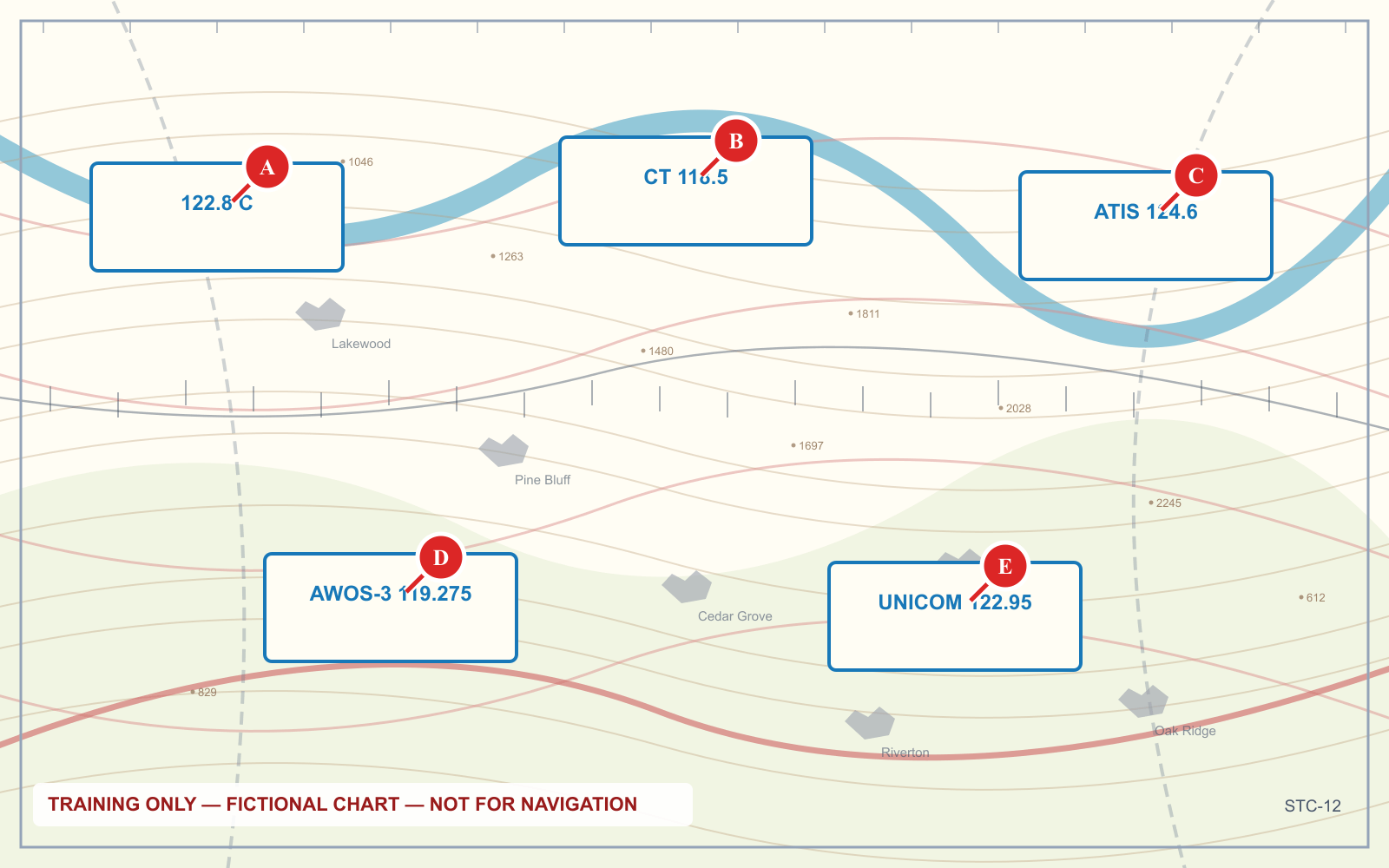
What does CTAF stand for, and what is a CTAF frequency used for?
CTAF stands for Common Traffic Advisory Frequency. AIM 4-1-9 defines it as a frequency designated for the purpose of carrying out airport advisory practices while operating to or from an airport without an operating control tower.
The AIM is explicit about the part that trips people up: "The CTAF may be a UNICOM, MULTICOM, FSS, or tower frequency and is identified in appropriate aeronautical publications."
So CTAF has no frequency of its own. It is a label the FAA hangs on whichever frequency is already serving that airport. At one field the CTAF is the UNICOM frequency. At the next it is 122.9, the MULTICOM frequency, because there is no UNICOM at all. At a part-time towered field it is the tower frequency, used differently after hours.
What the frequency is for is self-announcing. Nobody is sequencing traffic. Pilots broadcast position and intentions so that everyone else within earshot can build a picture. Inbound aircraft are advised to monitor and communicate on the CTAF from 10 miles to landing, and departing aircraft from start-up and taxi until 10 miles from the airport.
What does UNICOM stand for?
UNICOM is a contraction of Universal Communications. Per AIM 4-1-9, it is a nongovernment air/ground radio communication station which may provide airport information at public use airports where there is no tower or FSS.
The word to underline is nongovernment. A UNICOM operator is not a controller and holds no authority. It is usually whoever is behind the desk at the fixed-base operator — the fuel desk, the flight school, sometimes an answering machine. On pilot request, a UNICOM station may provide weather information, wind direction, the recommended runway, or other necessary information.
Note "recommended runway," not "assigned runway." A UNICOM operator can tell you what everyone else is using. They cannot clear you to do anything.
Some fields now run an automated UNICOM, which delivers weather, a radio check and airport advisory information through microphone clicks with no human involved at all. Availability is published in the Chart Supplement and on approach charts.
CTAF vs UNICOM vs MULTICOM: the comparison
MULTICOM is the third name in the pile, and it is the simplest: a frequency for self-announcing where there is nobody on the ground to talk to.
| CTAF | UNICOM | MULTICOM | |
|---|---|---|---|
| What it is | A role, assigned to a frequency | A ground radio station | A frequency for self-announce |
| Who is on the other end | Depends on which frequency holds the role | An FBO employee, or an automated system | Nobody |
| Has its own fixed frequency | No | No, one of several designated | Yes, 122.900 |
| Can give you the wind and runway | Only if a UNICOM or FSS holds the role | Yes, on request | No |
| Any ATC authority | None | None | None |
| Used where | Any field with no operating tower | Fields with an FBO radio | Fields with no tower, FSS or UNICOM |
The FAA's own decision table in AIM 4-1-9 runs in exactly that order. Where there is a UNICOM and no tower or FSS, communicate with the UNICOM station on the published CTAF frequency, and if you cannot raise them, self-announce on the CTAF anyway. Where there is no tower, FSS or UNICOM, self-announce on MULTICOM frequency 122.9.
The designated frequencies, and what each one tells you
The Federal Communications Commission assigns these, and the list in AIM 4-1-11 is short enough to be worth reading once.
| Frequency | Designated use |
|---|---|
| 122.700, 122.725, 122.800, 122.975, 123.000, 123.050, 123.075 | Airports without an operating control tower |
| 122.900 | MULTICOM. Temporary, seasonal or emergency activity and search and rescue, plus airports with no tower, FSS or UNICOM |
| 122.925 | MULTICOM. Forestry and fire suppression, fish and game, environmental monitoring |
| 122.950 | Airports with a control tower or FSS on the airport |
The last row is the one that catches people. 122.950 is a UNICOM frequency that is not a CTAF. It exists at towered fields for FBO business — fuel, parking, a call ahead for a rental car. The AIM even warns that wind direction and runway information may not be available on it. If you hear 122.95 and assume it is the traffic frequency, you are listening to a fuel order.
Two more from the adjacent FCC table are worth knowing because drone crews sometimes hear them and wonder: 122.750 is private fixed-wing air-to-air, and 123.300 and 123.500 are aviation instruction, glider and hot air balloon frequencies, explicitly not to be used for advisory service.
Do you use CTAF or UNICOM when the tower is closed?
You use the CTAF, and at most part-time towered fields the CTAF is the tower frequency.
AIM 4-1-9 puts it plainly: if an airport has a tower and it is temporarily closed, or operated on a part-time basis, and there is no FSS on the airport or the FSS is closed, use the CTAF to self-announce your position or intentions.
The frequency does not change when the tower goes home. Its function does. At 4 p.m. that frequency carries clearances from a controller. At 10 p.m. it carries pilots talking to each other, and nobody is in charge.
This is the single most practical thing on this page for a remote pilot. A part-time tower means the class of airspace can change with the clock too. A Class D surface area typically reverts to Class E or Class G when the tower closes, and your authorization requirement changes with it. The airport is not a different airport after dark, but the rules around it are different rules.
What is the difference between UNICOM and ATIS?
They travel in opposite directions.
ATIS is a broadcast. It is a continuous recorded loop of noncontrol information at busier terminal areas — weather, approach in use, active runway, NOTAMs — and it only exists where somebody is there to record it. You listen. You cannot talk to it.
UNICOM is a two-way conversation with a person. You call, they answer, you ask for the wind.
There is also a coverage difference that matters when you are standing at a launch site. If a UNICOM or an FSS advisory is unavailable, AIM 4-1-9 suggests getting wind and weather from a nearby controlled airport's ATIS or AWOS frequency instead. Our ATIS, AWOS and ASOS breakdown covers what each of those broadcasts actually contains and how often it updates.
Where the frequency appears on a sectional and in the Chart Supplement
On a sectional, the airport data block next to the airport symbol lists the frequencies, and the CTAF is marked with a white C in a solid circle directly after the number. The CT entry is the control tower frequency, UNICOM is the advisory station, and where the same number serves both roles you will see it flagged once. The sectional chart symbols guide walks through the rest of the data block, and you can drill live panels in the sectional chart trainer.
In the Chart Supplement the communications line is printed in a fixed order — single frequency approach, then CTAF, then UNICOM, then ATIS — and where the CTAF and UNICOM are the same number it is printed once as CTAF/UNICOM. That shared entry is the most common case in the US and the reason so many pilots use the two words interchangeably. Our Chart Supplement walkthrough covers the full airport entry line by line.
AIM 4-1-9 lists every publication that carries the CTAF: the Chart Supplement U.S., the Chart Supplement Alaska, the Alaska Terminal Publication, instrument approach charts and departure procedure charts. You can also get it by contacting any FSS.
What this means when you are actually working
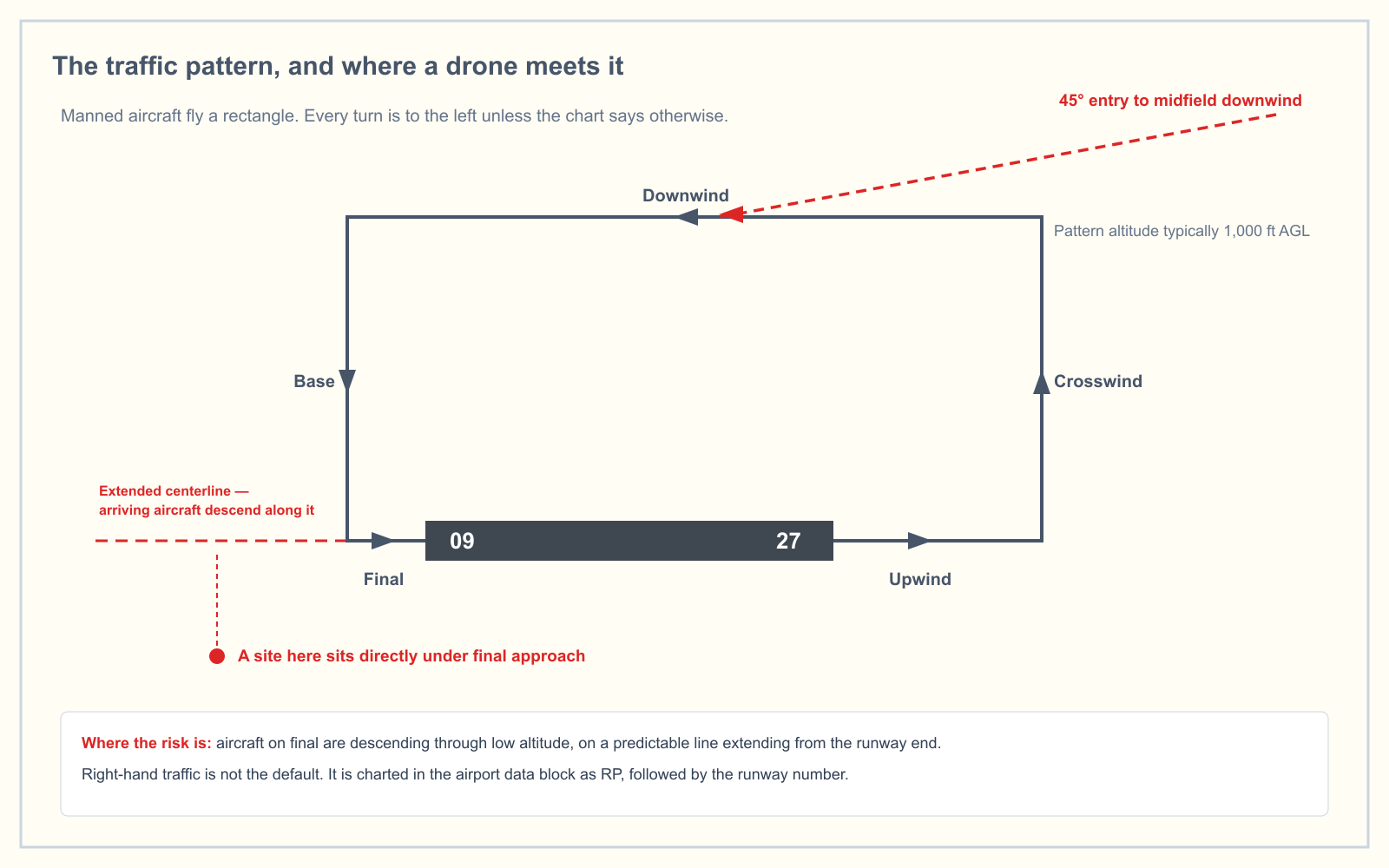
Under 14 CFR 107.49, the remote pilot in command must assess the operating environment before flight, and that assessment includes local airspace and any flight restrictions. 14 CFR 107.43 then sets the standard you are being measured against: no person may operate a small unmanned aircraft in a manner that interferes with operations and traffic patterns at any airport, heliport, or seaplane base.
You cannot avoid interfering with a traffic pattern you cannot hear. Four things follow.
Look up the CTAF before you drive out, not when you arrive. It takes thirty seconds in the Chart Supplement and it is the difference between listening and guessing.
Monitoring is the whole value. Transmitting usually is not. Part 107 does not require a radio and does not put you into the traffic flow. A broadcast from a remote pilot adds an aircraft to the mental picture of every pilot listening — one they cannot see and cannot separate from. Monitor unless there is a specific reason to speak and you know the phraseology. The non-towered airport article has the fuller argument.
Position calls come in leg names, not compass headings. "Left downwind for two seven" is only useful if you know where left downwind is. That is the diagram above, and it is why the pattern is worth learning even though you will never fly one.
The airport name is spoken twice for a reason. AIM 4-1-9 asks pilots to say the airport name at the beginning and end of each self-announce transmission, because a nearby field may share the same UNICOM or MULTICOM frequency. If you are monitoring 122.9 and hear traffic on final, check which airport they named. It may not be yours.
How the exam asks about this
Operations is 25 percent of the Unmanned Aircraft General knowledge test under the blueprint effective 29 September 2025, and Airspace is another 20 percent. This topic sits in the overlap and shows up in two shapes.
The first is a chart question: you are given an airport data block and asked to identify the frequency you would monitor. The answer is the number followed by the white C in a circle, not the UNICOM line, not the AWOS.
The second is a definition question turning on the fact that CTAF can be a UNICOM, MULTICOM, FSS or tower frequency. Any answer option claiming CTAF has one fixed frequency is wrong, and any option claiming 122.9 is the universal CTAF is wrong as well. 122.9 is the MULTICOM frequency used where there is nothing else.
Frequently asked questions
Do you use CTAF or UNICOM when the tower is closed?
You use the CTAF, and at a part-time towered field the CTAF is normally the tower frequency itself. AIM 4-1-9 directs pilots to self-announce on the CTAF when a tower is closed or part time and there is no FSS on the airport. The number stays the same; nobody is answering on it.
What does UNICOM stand for?
Universal Communications. It is a nongovernment air/ground radio station at a public use airport with no tower or FSS, usually operated by the fixed-base operator. On request it can give you weather, wind direction and the recommended runway. It has no air traffic control authority and cannot clear or sequence anyone.
What is a CTAF frequency used for?
Self-announcing position and intentions at an airport with no operating control tower, so pilots can separate themselves by listening. Inbound aircraft monitor it from 10 miles to landing; departing aircraft use it from start-up through taxi until 10 miles out. It is also frequently used to activate pilot-controlled airport lighting.
What is the difference between UNICOM and ATIS?
ATIS is a one-way recorded loop of weather and airport information at busier fields, updated hourly and on change. UNICOM is a two-way conversation with a person on the ground. You listen to ATIS and you talk to UNICOM. ATIS carries the whole operational picture; UNICOM answers the specific question you ask.
Is 122.9 always the CTAF?
No. 122.900 is the designated MULTICOM frequency, used for self-announce only where an airport has no tower, no FSS and no UNICOM. Where a UNICOM exists, the CTAF is normally that UNICOM frequency instead. Always read the CTAF for the specific field from the Chart Supplement or sectional.
Can a drone pilot legally transmit on CTAF?
Nothing in Part 107 prohibits it, and nothing requires a radio either. The practical guidance is to monitor rather than transmit. A position report from an aircraft other pilots cannot see or separate from adds workload without adding safety, unless there is a specific coordination need and you know the correct phraseology.
Ready to see how you would handle the chart questions on the real thing? Take the free Part 107 readiness assessment.
Sources
- AIM Chapter 4, Section 1 — Traffic Advisory Practices at Airports Without Operating Control Towers (4-1-9), Designated UNICOM/MULTICOM Frequencies (4-1-11)
- 14 CFR 107.43 — Operation in the vicinity of airports
- 14 CFR 107.49 — Preflight familiarization, inspection, and actions for aircraft operation
- FAA Digital Chart Supplement
- FAA Aeronautical Chart Users' Guide
- FAA Airman Certification Standards and test blueprints
Put this guide into practice.
Take the free assessment to see how this topic fits into your current exam readiness.
Start free practice