Flight Operations
The Four Forces of Flight: Lift, Weight, Thrust and Drag on a Multirotor
Every explanation of the four forces of flight draws an airplane. Here is what lift, weight, thrust and drag actually do on an aircraft that has no wings and cannot glide.
Key takeaway
On a multirotor, lift and thrust are the same vector. Tilt the aircraft to move and that single vector has to do two jobs at once, which is why wind, weight and forward speed all eat into the same margin.
The four forces of flight are lift, weight, thrust and drag. Lift acts upward, weight acts downward through the center of gravity, thrust acts forward, and drag acts rearward opposing thrust. In steady, unaccelerated flight the opposing pairs are in balance, so the aircraft neither accelerates nor changes its flight path.
That is the airplane version, and it is the version every diagram on the internet draws. It is also not quite the aircraft you fly. A multirotor has no wings, no propeller pulling it forward, and no ability to glide when the power stops. The four forces still apply, but two of them collapse into one vector, and understanding that is the difference between memorizing a diagram and knowing why your aircraft struggles on a hot, windy day.
What are the four forces of flight?
The FAA defines them in Chapter 5 of the Pilot's Handbook of Aeronautical Knowledge. They are the forces acting on any aircraft in flight, and the definitions are written around a fixed-wing airplane.
| Force | Direction | What produces it | What it opposes |
|---|---|---|---|
| Lift | Upward, perpendicular to the flight path | Airflow over an airfoil | Weight |
| Weight | Downward, through the center of gravity | Gravity acting on the total mass | Lift |
| Thrust | Forward, along the flight path | The powerplant and propeller | Drag |
| Drag | Rearward, parallel to the relative wind | The aircraft disrupting the air it moves through | Thrust |
Note what "opposes" means. It does not mean the forces are always equal. It means each force has a partner pulling the other way, and the difference between a pair is what makes the aircraft accelerate, climb or slow down. Equal pairs means steady flight. Unequal pairs means something is changing.
Where does lift come from when there are no wings?
From the same place. A multirotor's propeller blades are airfoils, and each one generates lift exactly the way a wing does, by being driven through the air at an angle of attack. The difference is that an airplane drags its wings through the air by moving the whole aircraft forward, while a multirotor spins its airfoils around a hub and leaves the aircraft where it is.
That is the entire trick of a rotorcraft. You do not need airspeed to make lift if you can make your own relative wind. The blade does not care whether the air is moving past it because the aircraft is flying at 90 knots or because the motor is turning at 6,000 rpm. It only cares about the relative wind it sees.
The cost is that the lift now has to be paid for continuously by the motors. An airplane at cruise gets its lift almost free, as a byproduct of forward motion that the engine was producing anyway. A hovering multirotor is buying every ounce of lift directly from the battery, every second, which is why hover endurance is the number your flight time is really limited by.
Why thrust and lift are the same force in a hover
Here is the part the airplane diagram cannot show you.
On an airplane, thrust points forward and lift points up. They are perpendicular, produced by different parts of the aircraft, and you can change one without much affecting the other. On a multirotor in a hover, the rotor disc is level and the total rotor force points straight up. That single force is carrying the weight and it is the only force the powerplant produces. Lift and thrust are not two forces at right angles. They are one vector with two labels.
In a stationary hover the picture is simple:
- Rotor force up equals weight down
- There is no horizontal motion, so drag is effectively zero
- Nothing is accelerating, so the aircraft holds its position
This is the state the FAA would call unaccelerated flight, and on a multirotor it is the only condition where the four forces reduce to two.
What happens when a multirotor tilts to move
A multirotor cannot push itself sideways. To translate, it tilts the whole aircraft so the rotor force points partly forward, and the horizontal component of that force becomes thrust.
The problem is that the vertical component shrinks at the same time. Tilt the aircraft 20 degrees and only about 94 percent of the rotor force is still holding you up. If the motors keep doing the same work, you descend. To stay level you have to spin up, and the amount extra follows the same cosine relationship that governs load factor in a banked turn:
| Tilt angle | Rotor force needed to stay level | Horizontal thrust produced |
|---|---|---|
| 0° (hover) | 1.00 × weight | none |
| 10° | 1.02 × weight | 0.18 × weight |
| 20° | 1.06 × weight | 0.36 × weight |
| 30° | 1.15 × weight | 0.58 × weight |
| 45° | 1.41 × weight | 1.00 × weight |
Read the right-hand column and you can see why speed is expensive. Every knot of groundspeed is bought by borrowing from the force that was holding you up, and the motors have to make up the shortfall. Add a headwind and the aircraft tilts further just to hold station, which is why a drone fighting a 20-knot wind can be working harder while hovering motionless than it does in cruise on a calm day.
This is also the honest answer to why your controller shows plenty of battery and then the aircraft will not climb. You are not out of power. You are out of the margin between the thrust the motors can produce and the thrust the current attitude, weight and air density demand.
Drag, and the two kinds a drone produces
Drag is the rearward force caused by the aircraft disrupting the air it moves through. The handbook splits it into two kinds, and both matter to a multirotor.
Parasite drag is everything that is not connected to producing lift: the airframe, the arms, the landing gear, the payload bolted underneath, the skin friction of the air sliding over all of it. It rises roughly with the square of airspeed, so it is negligible in a hover and dominant at speed.
Induced drag is the price of making lift. It is a byproduct of the rotor blade doing its job, and it is greatest when the blade is working hardest at low speed and high angle of attack. That is the opposite trend to parasite drag, which is why total drag is lowest somewhere in the middle of the speed range rather than at either end.
A hovering multirotor sits at the induced drag end of that curve, working the blades hard with no forward motion to help. It is the least efficient thing the aircraft can do.
Weight: the force you actually control
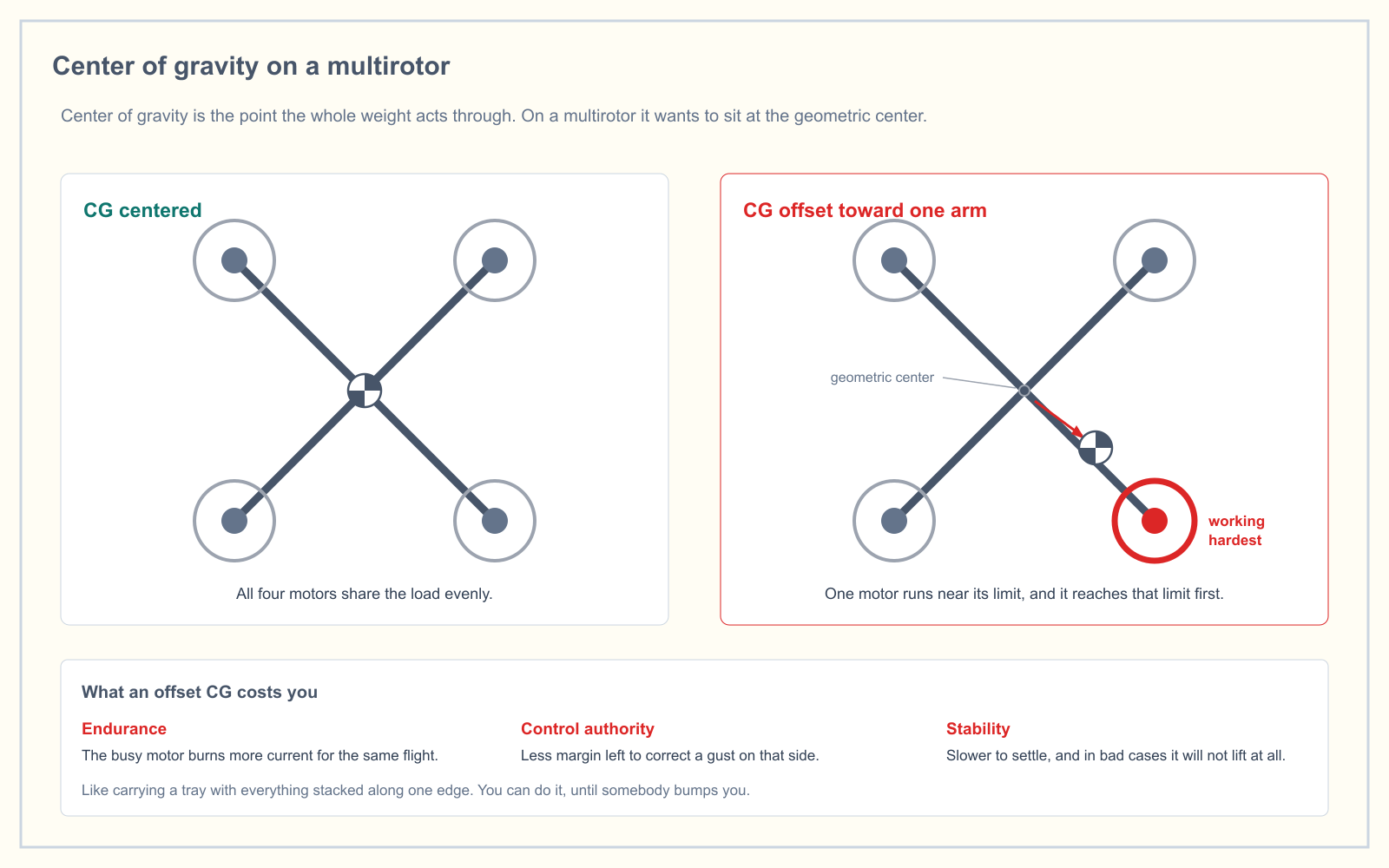
Weight is the only one of the four forces you get to set before the flight. Gravity acts on the total mass of the aircraft, the battery, the payload and anything strapped to it, and the resultant pulls straight down through the center of gravity.
Two regulatory limits attach to weight.
The first is the definition itself. Under 14 CFR 107.3, a small unmanned aircraft weighs less than 55 pounds on takeoff, including everything on board or otherwise attached. Go over and you are no longer operating under Part 107 at all. The weight that counts is takeoff weight, not the figure on the box.
The second is subtler. 14 CFR 107.49 requires the remote pilot in command to ensure, before flight, that all objects attached to or carried by the aircraft are secure and do not adversely affect its flight characteristics or controllability. Part 107 gives you no weight-and-balance envelope and no loading chart. It gives you a duty, and it puts the judgment on you.
An off-center payload does not just make the aircraft heavier. It moves the CG away from the geometric center of the rotor disc, and the flight controller compensates by running the motors on one side harder for the entire flight. Those motors run hotter, draw more current and reach their limit sooner, so the first sign of a bad CG is usually not a handling complaint. It is an endurance shortfall or a warning about one motor.
When are the four forces of flight in equilibrium?
In steady, unaccelerated flight. That means constant speed, constant altitude and a constant flight path, and it includes a hover, a steady climb at unchanging rate and a constant-speed cruise. The forces balance; the aircraft is not motionless.
The moment any pair stops balancing, something changes:
| Imbalance | Result |
|---|---|
| Lift exceeds weight | The aircraft climbs |
| Weight exceeds lift | The aircraft descends |
| Thrust exceeds drag | The aircraft accelerates |
| Drag exceeds thrust | The aircraft slows |
A climb is not a state in which lift permanently exceeds weight. Lift exceeds weight to start the climb, then the forces rebalance and the aircraft climbs at a steady rate with everything back in equilibrium.
What this means when you are actually working
The four forces are not a classroom abstraction on a drone job. They are the reason for three decisions you make on site.
The thrust margin is what you are really preflighting. Your aircraft has a maximum rotor force it can produce, and hovering spends a fixed portion of it. Everything else — climbing, fighting wind, carrying a payload, maneuvering — comes out of what is left. Anything that raises the required force or lowers the available force eats that margin.
Density altitude attacks both sides at once. Thin air means the blades produce less force at the same rpm, and the motors have less air to cool them. A hot, high, humid day reduces what the aircraft can make while the weight you are asking it to carry stays exactly the same. This is the most common way a perfectly airworthy aircraft runs out of performance, and it is worth understanding how density altitude works before you plan a summer job at elevation.
Wind is a permanent tilt. Holding station in a 15-knot wind is not a free hover. The aircraft is tilted into the wind the entire time, spending extra rotor force to stay in one place, with the return leg into wind costing the most. Plan the battery around the into-wind leg, not the average.
How the exam asks about the four forces
Loading and performance is 2 percent of the current UAG blueprint, effective 29 September 2025, so there will be roughly one question from this area on a 60-question exam. The forces themselves also surface inside operations questions about performance and inside weather questions about density altitude.
The questions tend to ask which force opposes which, what condition puts the forces in equilibrium, or what happens to required power when weight or density altitude increases. None of them require arithmetic. They require knowing that lift opposes weight, thrust opposes drag, equilibrium means unaccelerated rather than motionless, and that anything raising the weight or thinning the air raises the force the aircraft has to produce.
Frequently asked questions
What are the four forces acting on an aircraft in flight?
Lift, weight, thrust and drag. Lift acts upward perpendicular to the flight path, weight acts downward through the center of gravity, thrust acts forward along the flight path, and drag acts rearward opposing thrust. Each force has an opposing partner, and the difference within a pair is what causes the aircraft to accelerate, climb or slow.
What are the four fundamentals of flight?
This is a different list, and the similar name causes confusion. The four fundamentals are maneuvers, not forces: straight-and-level flight, turns, climbs and descents. The four forces are lift, weight, thrust and drag. An exam question naming "fundamentals" is asking about maneuvers; one naming "forces" is asking about the aerodynamic pairs.
When are the four forces of flight in equilibrium?
In steady, unaccelerated flight, which means constant speed on a constant flight path. That includes a stationary hover, a steady cruise and a climb at an unchanging rate. Equilibrium does not mean the aircraft is stationary. It means nothing is changing, so the opposing forces balance and the net force is zero.
Do drones have the same four forces as airplanes?
Yes, but the geometry differs. On a multirotor, lift and thrust come from the same rotor force rather than from separate wings and a propeller. In a hover that force points straight up and does the lifting; tilt the aircraft and part of it becomes forward thrust while the vertical part shrinks, which is why the motors must work harder to hold altitude while moving.
Which force opposes lift?
Weight. Lift acts upward perpendicular to the flight path and weight acts downward through the center of gravity, so the two work against each other directly. When lift exceeds weight the aircraft climbs, and when weight exceeds lift it descends. Thrust and drag form the other opposing pair, acting forward and rearward along the flight path.
What is the difference between parasite drag and induced drag?
Parasite drag comes from the airframe pushing through the air and rises roughly with the square of speed, so it dominates at high speed. Induced drag is a byproduct of producing lift and is greatest at low speed and high angle of attack. Total drag is therefore lowest at an intermediate speed, not at either extreme.
Want to know whether you would pass today? Take the free Part 107 readiness assessment and find out in about ten minutes.
Sources
- Pilot's Handbook of Aeronautical Knowledge, FAA-H-8083-25C, Chapter 5: Aerodynamics of Flight
- Helicopter Flying Handbook, FAA-H-8083-21B
- 14 CFR Part 107 — Small Unmanned Aircraft Systems
- 14 CFR 107.3 — Definitions
- 14 CFR 107.49 — Preflight familiarization, inspection, and actions for aircraft operation
- FAA Unmanned Aircraft General (UAG) Airman Certification Standards and test information
Put this guide into practice.
Take the free assessment to see how this topic fits into your current exam readiness.
Start free practice