Flight Operations
Angle of Attack Explained: Why a Wing Stalls, and What It Means for a Drone
A wing does not stall at a speed. It stalls at an angle, and that angle is the same at any airspeed, any weight and any attitude. Here is what angle of attack actually measures and why it matters to a remote pilot.
Key takeaway
Angle of attack is the angle between the wing's chord line and the relative wind. A wing stalls when it exceeds its critical angle of attack, and it does that at any airspeed, in any attitude, at any power setting.
Angle of attack is the angle at which the chord line of the wing meets the relative wind. A wing stalls when that angle exceeds the critical angle of attack, and that angle is a fixed property of the airfoil. It does not move with airspeed, weight or bank. As the FAA puts it, a stall can occur at any airspeed, in any attitude, at any power setting.
That last sentence is the whole reason the concept exists, and it is the part almost every casual explanation gets backwards. People learn that an aircraft stalls when it goes too slow. It does not. Slow flight is just the most common way to end up at a high angle of attack, so the two got welded together in the popular version. Break the weld and a lot of aerodynamics suddenly makes sense.
What is angle of attack in aviation?
Two lines define it.
The chord line is a straight line drawn through the profile of the wing, connecting the leading edge to the trailing edge. It is a geometric property of the airfoil and it never changes.
The relative wind is the direction of the airflow arriving at the wing. It is the opposite of the flight path. If the aircraft is descending, the relative wind comes from below and ahead. If it is climbing, from above and ahead.
Angle of attack is the angle between those two. AC 61-67C defines it exactly that way, and adds the consequence: "The AOA must be small enough to allow attached airflow over and under the airfoil to produce lift."
Notice what is not in the definition. The ground is not in it. The horizon is not in it. Pitch attitude is not in it. You can hold a nose-high pitch attitude at a low angle of attack, and you can be pointed at the ground at an angle of attack past the critical one. This is why "the nose was down, so it could not have been a stall" is wrong, and why it keeps killing people.
How angle of attack produces lift, and then stops
Raise the angle of attack from zero and lift climbs more or less proportionally. The wing is deflecting more air downward and the pressure difference across it grows. This is the useful, linear part of the curve, and it is where an aircraft spends its entire working life.
Keep raising it and you reach a point where the airflow can no longer follow the curvature of the upper surface. It separates. AC 61-67C describes the result plainly: separation of airflow from the wing, loss of lift, a large increase in drag, and a stall if the angle of attack is not reduced.
The angle where that happens is the critical angle of attack. Past it, lift falls off and drag rises sharply. Exceeding the critical angle for a particular airfoil section, the FAA notes, will always result in a stall of that section.
There is no single number for it. The critical angle is a property of the airfoil shape, and for typical general aviation airfoils it sits somewhere in the mid to high teens of degrees. The FAA's own guidance does not publish a universal figure, and you should be suspicious of any source that does. What matters far more than the number is that for a given wing in a given configuration, the number does not move.
The stall is the angle, not the speed
Here is the sentence worth memorizing, taken straight from the advisory circular: "The stall is the result of excessive AOA - not insufficient airspeed."
Stall speed is a derived figure. It is the airspeed at which, in one specific set of conditions, level flight happens to require the critical angle of attack. Change the conditions and the speed moves. The angle does not.
| Change | Effect on stall speed | Effect on critical angle of attack |
|---|---|---|
| Increase weight or payload | Higher | No change |
| Increase bank angle | Higher | No change |
| Add flaps | Lower | Changes with configuration |
| Fly at higher density altitude | No change indicated | No change |
| Ice, frost or snow on the wing | Higher | Reduced |
Two rows in that table deserve a note. Altitude has little or no effect on indicated stall speed, because the airspeed indicator is fooled in exactly the same direction the wing is. True airspeed at the stall does rise, which is why density altitude lengthens every takeoff roll and flattens every climb without changing the number on the dial.
Contamination is the exception that proves the rule. A layer of frost changes the shape of the airfoil, and shape is what sets the critical angle. That is the one case where the angle itself gets worse.
Angle of attack vs angle of incidence
These two get confused constantly, and the distinction is clean.
| Angle of attack | Angle of incidence | |
|---|---|---|
| Measured between | Chord line and relative wind | Chord line and the aircraft's longitudinal axis |
| Changes in flight? | Constantly | Never |
| Set by | The pilot, and by gusts | The designer, when the wing was bolted on |
| Can it cause a stall? | Yes, past the critical angle | No |
Angle of incidence is a rigging angle. It is fixed when the aircraft is built and it is the reason most airplanes cruise slightly nose-up rather than perfectly level. Angle of attack is a flight condition that changes second by second. If a question asks which one the pilot controls, it is angle of attack every time.
The accelerated stall, and why load factor belongs in this conversation
Turning requires extra lift. Extra lift at the same speed means extra angle of attack. Push the turn hard enough and you reach the critical angle while the airspeed indicator still reads a comfortable number.
AC 61-67C gives the arithmetic: stall speed increases in proportion to the square root of the load factor. An airplane with a normal stall speed of 45 knots can be stalled at 90 knots under a load factor of 4G. At a 60-degree bank in level coordinated flight the load factor is 2G and the stall speed increases by 40 percent.
That is an accelerated stall, and the advisory circular warns it is usually more severe than the unaccelerated kind. The wing did nothing unusual. It reached its critical angle, as it always does. The pilot simply arrived there from an unexpected direction. There is more on the G-load side of this in our piece on load factor in aviation.
Where the center of gravity comes in
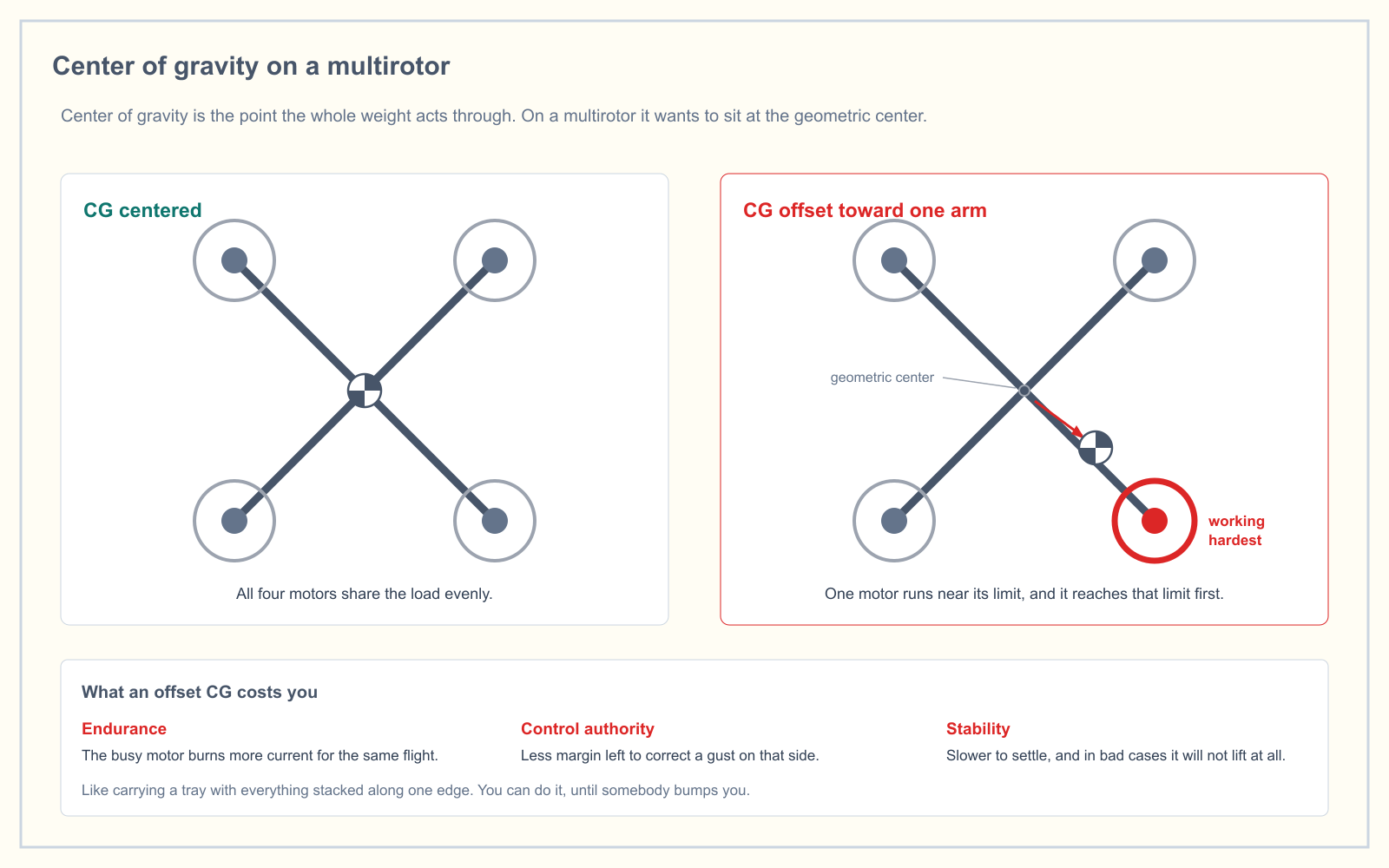
CG position does not change the critical angle, but it changes how easily you reach it.
The FAA is specific here. As the CG moves aft, the amount of elevator deflection needed to stall the airplane at a given load factor is reduced, so an increased angle of attack is achieved with less control force. Inadvertent stall entries get easier and recoveries get twitchier. A forward CG does the opposite: the stalling angle of attack is reached at a higher airspeed, and more back pressure is needed to get there.
On a small unmanned aircraft this is not theoretical. Hang a heavier camera off a mount that was balanced for something else and you have shifted the CG of an airframe that weighs a few pounds. The flight controller will hold a standing correction to compensate, and that correction comes out of the control authority you were counting on for the gust.
What this means when you are actually flying a drone
You will never see an angle of attack indicator on a drone controller. The concept still earns its place:
- A gust is an angle of attack event. AC 61-67C states it directly: a vertical gust or wind shear can cause a sudden change in the relative wind and an abrupt increase in AOA. The air moved, so the relative wind moved, so the angle changed without anyone touching a control. That is why a gust spread on a METAR matters more than the steady wind, and why reading wind barbs before launch is worth the minute it takes.
- Fixed-wing UAS can genuinely stall. A survey aircraft flying a slow, tight turn at the end of a transect at maximum payload is combining every factor on this page. Widen the turn rather than tightening it.
- A multirotor tilts to move. It does not stall in the classical sense, because thrust comes from rotors, not a fixed wing. But each blade is an airfoil with its own angle of attack, and in a fast descent into your own downwash, or in a sharp gust, blades can lose lift locally. The symptom is a wobble or a sudden sink rather than a nose drop.
- Payload is not free. Weight increases the angle of attack required to hold the aircraft up, which spends part of your margin before you leave the ground. Under 14 CFR 107.49 you are required to confirm before every flight that anything attached to the aircraft does not adversely affect its flight characteristics or controllability. That is this paragraph, written as a rule.
- Slow down in rough air. For manned aircraft the FAA advice is to use an airspeed well above the stall and below maneuvering speed in turbulence. The drone version is the same instinct: reduce speed, widen turns, stop chasing the shot.
How the exam asks about angle of attack
The Unmanned Aircraft General knowledge test puts 2 percent of its questions in Loading and Performance and 25 percent in Operations, so this material shows up in small but reliable doses. Questions tend to test one of three things: the definition of the chord line and relative wind, the fact that a stall happens at a fixed angle regardless of airspeed or attitude, and how weight or CG shifts the airspeed at which you reach it.
The trap is always the same. If an answer option ties the stall to a specific airspeed and another ties it to the critical angle of attack, the angle is the correct one.
Want to see how you handle questions like this under time pressure? Take the free Part 107 readiness assessment and find out where the gaps are.
Frequently asked questions
What is the angle of attack of an aircraft?
It is the angle between the wing's chord line and the relative wind, where the chord line runs from the leading edge to the trailing edge and the relative wind is the airflow arriving at the wing. It changes continuously in flight as the pilot maneuvers and as gusts alter the direction of the oncoming air.
How do you calculate the angle of attack?
You generally do not calculate it in the cockpit. It is measured, by a vane or pressure-differential sensor feeding an angle of attack indicator, on aircraft that have one. Geometrically it is the difference between the pitch attitude and the flight path angle, but that relationship is only useful when both are known precisely.
What is the critical angle of attack for a Cessna 172?
Cessna does not publish a critical angle of attack in the pilot's operating handbook, and the FAA does not give a universal figure. Published wind tunnel data for the NACA 2412 airfoil used on the 172 puts maximum lift in the region of 16 degrees. Treat that as airfoil data, not a certificated limit.
Does angle of attack change with airspeed?
The critical angle of attack does not. The angle of attack you are flying at does, because slower flight requires a higher angle to produce the same lift. That is the whole relationship between the two: airspeed is a proxy for angle of attack, and the proxy breaks the moment load factor, weight or configuration changes.
What is the difference between angle of attack and pitch attitude?
Pitch attitude is measured against the horizon. Angle of attack is measured against the relative wind, which is set by the flight path. An aircraft in a steep descent can be pitched nose-down relative to the horizon while flying at an angle of attack past the critical one, which is exactly how stalls happen with the nose below level.
Do drones have an angle of attack?
Yes. A fixed-wing UAS has a wing with a chord line and a relative wind, and it stalls the same way any wing does. On a multirotor, each rotor blade is a rotating airfoil with its own angle of attack, which is why sharp gusts and descents through disturbed air produce sudden loss of lift even though the aircraft has no wing at all.
Sources
- AC 61-67C, Stall and Spin Awareness Training — FAA
- Pilot's Handbook of Aeronautical Knowledge, FAA-H-8083-25 — FAA
- Airplane Flying Handbook, FAA-H-8083-3 — FAA
- 14 CFR 107.49, Preflight familiarization, inspection, and actions for aircraft operation — eCFR
- 14 CFR 107.51, Operating limitations for small unmanned aircraft — eCFR
Put this guide into practice.
Take the free assessment to see how this topic fits into your current exam readiness.
Start free practice