Flight Operations
Vortex Ring State: The One Aerodynamic Trap a Drone Pilot Can Fly Into
Most aerodynamic hazards on the Part 107 exam are things that happen to other aircraft. Vortex ring state is the one you can cause yourself, with the controls in your hands, on an ordinary job.
Key takeaway
Vortex ring state needs three things at once: a near-vertical descent of at least 300 fpm, power applied, and almost no horizontal speed. Break any one of them and it cannot form. The recovery is sideways, never upward.
Vortex ring state is an aerodynamic condition in which a rotor descends into its own downwash, loses most of its efficiency, and keeps sinking even at full power. The FAA lists three conditions that must occur together: a vertical or near-vertical descent of at least 300 feet per minute, the rotor using 20 to 100 percent of available power, and horizontal velocity below effective translational lift. Remove any one and it cannot develop.
Almost every hazard the Part 107 exam asks about is something that happens to you. Wake turbulence comes from an airliner you did not see. A microburst comes from a storm cell. Vortex ring state is different. It is the one aerodynamic trap you can fly your own aircraft into, deliberately, with the sticks in your hands, on a job as routine as bringing a drone straight down off a rooftop.
What is vortex ring state?
The FAA defines it in Chapter 11 of the Helicopter Flying Handbook (FAA-H-8083-21B). Vortex ring state "describes an aerodynamic condition in which a helicopter may be in a vertical descent with 20 percent up to maximum power applied, and little or no climb performance."
Start with a normal hover. Your rotors hold the aircraft up by pushing a large mass of air downward through the disc. At the tip of every blade, a little of that air curls up around the edge and rejoins the air coming in from above. Those are tip vortices, and every airfoil makes them. In a stable hover they are small, and they cost you a slight loss of rotor efficiency and nothing more.
Now descend vertically. The aircraft starts moving down into the column of air it just pushed down. The tip vortices no longer trail away below you, because you are following them. They grow. Instead of the rotor drawing clean air from above and pushing it away below, the rotor begins recirculating the same air in a doughnut-shaped ring around the disc.
The handbook puts the consequence plainly: "most of the power developed by the engine is wasted in circulating the air in a doughnut pattern around the rotor."
What causes vortex ring state? The three conditions
The FAA gives a specific combination. All three have to be present at once:
| # | Condition | What it means on a multirotor |
|---|---|---|
| 1 | A vertical or nearly vertical descent of at least 300 fpm | Left stick held down, coming straight down. The actual critical rate depends on gross weight, rpm and density altitude. |
| 2 | The rotor disc using 20 to 100 percent of available power | The motors are working. This is not a dead-stick fall; it is a powered descent. |
| 3 | Horizontal velocity slower than effective translational lift | Little or no sideways movement. The aircraft is not outrunning its own wake. |
That table is the whole hazard, and it is also the whole defense. Vortex ring state is not a condition that ambushes you. It requires three specific things simultaneously, and you control all three. Break any one of them and the vortex cannot form.
The FAA also names the situations that invite it: "attempting to hover OGE without maintaining precise altitude control, and approaches, especially steep approaches, with a tailwind component." Out of ground effect, steep, and downwind. Hold that thought, because it describes a lot of drone work.
What happens when the rotor stops working
There is a second mechanism layered on the first, and it is the reason the condition gets violent rather than merely inefficient.
If the aircraft descends faster than the rotor is pushing air down through the inner part of the blade, then near the hub the airflow reverses. It is now going up through the disc while the outer part of the blade is still pushing air down. Somewhere along the blade there is a boundary between those two flows, and the handbook explains that a secondary vortex ring forms at exactly that point.
The result, in the FAA's words, is "an unsteady turbulent flow over a large area of the disk. Rotor efficiency is lost even though power is still being supplied."
A fully developed vortex ring state is characterized by "uncommanded pitch and roll oscillations," almost no collective authority, and a descent rate that "may approach 6,000 feet per minute if allowed to develop." That figure is for a full-size helicopter with hundreds of feet to lose. A drone working at 200 feet AGL does not have room for a fraction of it.
Why adding power makes it worse
This is the part worth memorizing, because the instinct is exactly backwards.
You are sinking. Every reflex you have says add power. The FAA describes what happens next: "the pilot tends first to try to stop the descent by increasing collective pitch. However, this only results in increasing the stalled area of the rotor, thereby increasing the rate of descent."
More power means a stronger downwash, which means a bigger recirculating ring, which means more of the blade is working in disturbed air. You are feeding the vortex. The handbook's own training exercise says it outright: "the application of additional up collective increases the vibration and sink rate. As the power is increased, the rate of sink of the aircraft in the column of air will increase."
More throttle is the one input that reliably makes it worse. On the exam and in the field, that is the answer.
How to recover from vortex ring state
The recovery is horizontal, not vertical. You are not trying to out-power the vortex; you are trying to leave it.
The traditional recovery is "accomplished by increasing airspeed, and/or partially lowering collective to exit the vortex." Fly forward out of the disturbed column, and ease off the power so the downwash stops feeding it. The recovery is complete when the aircraft reaches translational lift and a normal climb is established.
The Vuichard Recovery, added to the handbook in the 2019 revision and named for the Swiss examiner who developed it, works differently. It combines lateral cyclic with an increase in power and lateral antitorque thrust, and the FAA says it "will produce the quickest exit from the hazard" in most helicopters. It recovers "by eliminating the descent rate as opposed to exiting the vortex" — it pushes the aircraft sideways into clean air rather than flying forward out of the column.
For a multirotor pilot, the two techniques converge on one instruction: push a stick sideways or forward, and stop pulling up on the throttle. You do not have a collective or a tail rotor, so the mechanics differ, but the principle is identical. Get the rotors into air you have not already disturbed.
One warning from the handbook is worth carrying over. If the descent is allowed to progress into what is called the windmill brake state, where airflow is completely upward through the rotor, "the only recovery may be an autorotation." A multirotor cannot autorotate. There is no recovery past that point, only impact.
Vortex ring state vs settling with power
These are the same thing, and the FAA says so directly: vortex ring state is "formerly referenced as settling-with-power."
The older name came from the plain observation that the aircraft keeps settling even with full engine power applied. It described the symptom. It was replaced because it invited confusion with a different and much more common problem: simply not having enough power to hold a hover, usually because of weight, altitude or temperature. That is a performance shortfall, not an aerodynamic one, and the fix is entirely different.
| Vortex ring state | Not enough power to hover | |
|---|---|---|
| Cause | Rotor recirculating its own downwash | Insufficient power available for the conditions |
| Power available | Plenty, 20 to 100 percent in use | Already at or near the limit |
| Adding power | Makes it worse | Helps, if you have any left |
| Fix | Move horizontally into clean air | Reduce weight, wait for cooler air, or descend |
| Onset | Sudden, with vibration and wallowing | Gradual, predictable from a performance check |
If you see "settling with power" in an older study guide, read it as vortex ring state. If you see it used to mean a heavy drone that will not climb on a hot day, that is the misuse the FAA renamed the condition to avoid.
What this means when you are actually working
The FAA wrote this chapter for helicopters. The aerodynamics are rotor aerodynamics, and a multirotor's propellers are airfoils generating lift exactly as described in our piece on the four forces of flight. Where the handbook says collective, read throttle. The physics does not care about the airframe.
What makes it a real Part 107 concern is that ordinary drone jobs walk straight into all three conditions:
- The rooftop or tower descent. You finish an inspection at 200 feet, point the camera down, and bring the aircraft straight home on the left stick. Vertical, powered, no horizontal speed. All three boxes.
- The out-of-ground-effect hover with sloppy altitude. Holding a shot over open ground, drifting down a little, correcting up, drifting down again. The FAA names this one specifically.
- The steep downwind approach. With a tailwind, your airspeed can be near zero while your groundspeed looks healthy on the controller. The aircraft is sitting in its own wake and the telemetry does not show it.
- The fast descent to beat a battery warning. The one situation that most tempts a pilot to hold maximum descent rate all the way down.
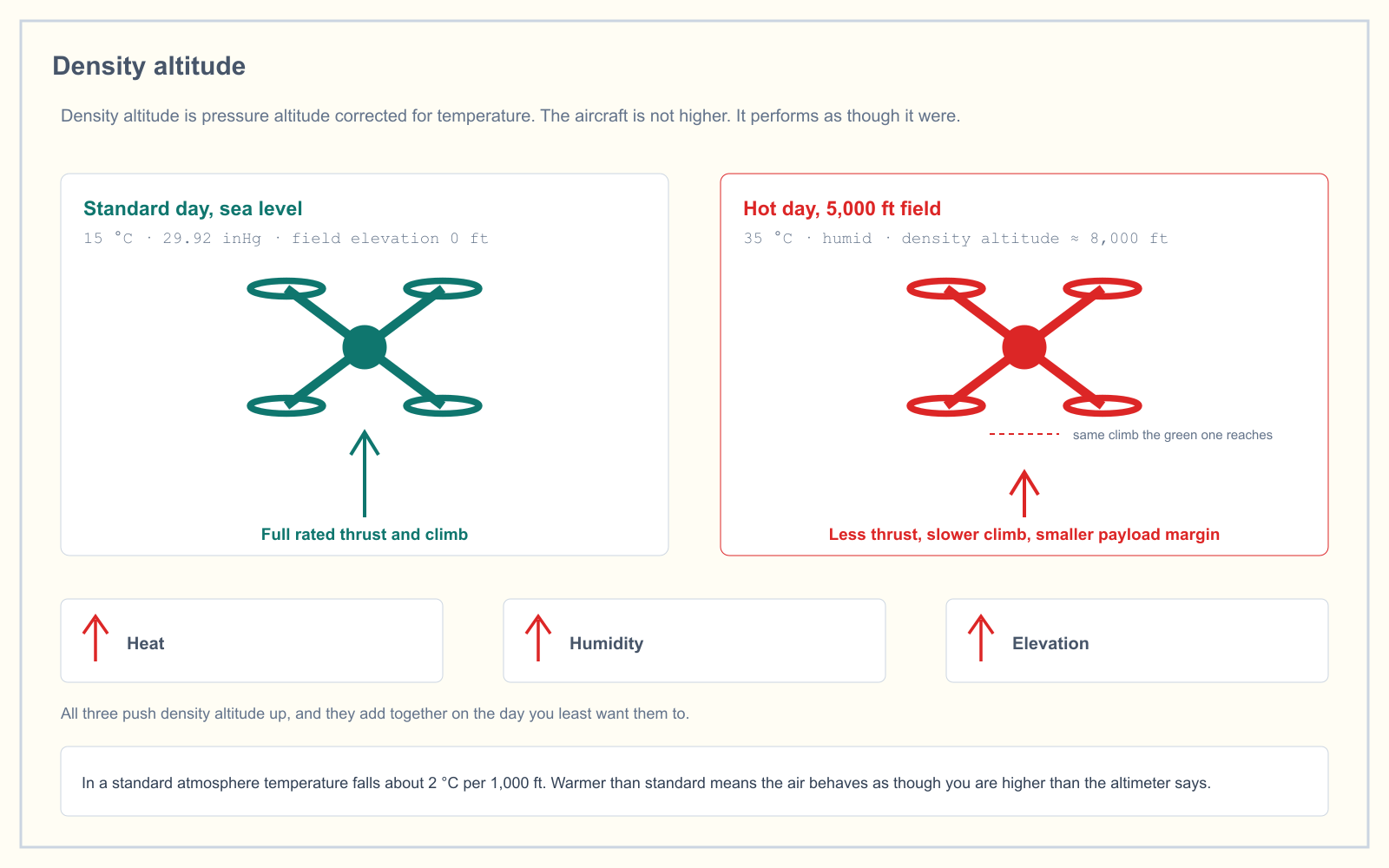
Density altitude makes every one of these worse, because it shrinks the power margin you would need to fly out of trouble.
Two regulatory hooks attach to this. Under 14 CFR 107.49, you must assess the operating environment before flight, including local weather conditions and the airspace and obstacles you will work around. Under 14 CFR 107.19, the remote pilot in command is directly responsible for, and the final authority as to, the operation of the small unmanned aircraft system. Nothing in Part 107 mentions vortex ring state by name. It does not need to. Losing an aircraft to an avoidable aerodynamic condition is squarely inside the responsibility you accepted.
The habit that prevents all of it is small: never descend straight down from height. Come down on a diagonal. Add even a few knots of lateral movement and condition three is broken before it starts.
How the exam asks about vortex ring state
Weather and aerodynamics questions sit in the smaller slices of the current UAG blueprint, with Weather at 5 percent and Loading and Performance at 2 percent, while Operations carries 25 percent. Rotor-aerodynamics questions tend to appear framed as operational judgment rather than pure theory.
Expect the question to test the counterintuitive part. A stem describing a drone in a rapid vertical descent that will not respond to increased throttle is asking whether you know that more power deepens the problem. The correct answer will involve horizontal movement or a reduction in power, never an increase.
The other common form asks you to identify which combination of conditions produces the state. Learn the three: near-vertical descent of at least 300 fpm, 20 to 100 percent power applied, horizontal velocity below translational lift.
Frequently asked questions
How do you avoid vortex ring state?
Break one of the three conditions. The easiest to control is horizontal velocity, so never descend vertically from altitude — always come down on a diagonal with some forward or lateral movement. Keeping the descent rate below roughly 300 feet per minute also works, as does avoiding steep approaches with a tailwind, where your airspeed is lower than the telemetry suggests.
What are the symptoms of vortex ring state?
The FAA describes a fully developed vortex ring state as an unstable condition with uncommanded pitch and roll oscillations and little or no collective authority. On a drone you would notice vibration or a shudder, a mushy or unresponsive feel, and a descent rate that keeps increasing even as you add throttle. The aircraft appears to wallow rather than fly.
What is the difference between settling with power and vortex ring state?
They are the same condition. The FAA Helicopter Flying Handbook states that vortex ring state was "formerly referenced as settling-with-power." The older term described the symptom of the aircraft settling despite full power applied, and it was retired because pilots confused it with a simple lack of available power, which is a performance problem with an entirely different fix.
Can a quadcopter get into vortex ring state?
Yes. Any rotor that can descend into its own downwash can enter it, and a multirotor meets the conditions easily during a straight-down descent. The consequence is arguably worse than in a helicopter, because a multirotor cannot autorotate and typically operates far below the 1,000 feet AGL the FAA recommends as a minimum recovery altitude for training.
How fast do you have to descend to enter vortex ring state?
The FAA gives at least 300 feet per minute as the threshold for a vertical or near-vertical descent, while noting that the actual critical rate depends on gross weight, rpm, density altitude and other factors. That is not a fast descent. Many consumer and commercial drones exceed 300 fpm on a normal full-down stick input.
Does vortex ring state show up on the Part 107 knowledge test?
Rotor aerodynamics can appear in the Operations and Loading and Performance areas, usually framed as a scenario rather than a definition. The testable point is the counterintuitive one: increasing power deepens the condition, and recovery requires horizontal movement out of the disturbed air. Full test content is outlined by the FAA's airman testing materials.
Work through scenario questions like these in the free Part 107 readiness assessment before you book the test.
Sources
Put this guide into practice.
Take the free assessment to see how this topic fits into your current exam readiness.
Start free practice