Flight Operations
What Is Load Factor in Aviation? The G-Load Behind Steep Turns and Gusts
A 60-degree bank doubles the load on the wings, and it does that at any speed and any weight. Here is the formula, the chart, and the gust case that actually matters to a small unmanned aircraft.
Key takeaway
Load factor is lift divided by weight, expressed in G. In a level turn it depends only on bank angle: 30 degrees is 1.15G, 45 degrees is 1.41G, and 60 degrees is 2.0G.
Load factor is the ratio of the lift an aircraft is producing to its weight, expressed in G. Straight and level flight is 1G. In a level turn it depends only on bank angle: 1.15G at 30 degrees, 1.41G at 45 degrees and 2.0G at 60 degrees. Higher load factor also raises the stall speed.
The word causes trouble because it means two unrelated things. Airline analysts use "load factor" for the percentage of seats sold. Pilots use it for structural G-load. Search for the term and you get both, mixed together, which is why most explanations feel like they are answering someone else's question.
What is load factor in aviation?
Load factor is lift divided by weight:
Load factor = Lift ÷ Weight
When an aircraft is flying straight and level, lift equals weight and the answer is 1. That is 1G, and it is the condition your aircraft spends most of its life in.
The moment the aircraft does anything other than fly straight and level, lift has to change. In a turn, the lift vector tilts. Part of it still holds the aircraft up, and part of it is now pulling the aircraft around the corner. To keep the vertical component equal to weight, total lift has to grow, and the amount it grows by is the load factor.
That extra lift is not free. It is carried by the structure, and it is what the airframe designer sizes the spar for. A 2G turn does not mean the aircraft got heavier. It means the wings are working as if it had.
Why the search results for this term are split
Two different fields borrowed the same phrase:
| Meaning | Field | What it measures | Typical value |
|---|---|---|---|
| Structural load factor | Aerodynamics, flight training | Lift ÷ weight, expressed in G | 1.0 in cruise, 2.0 in a 60-degree bank |
| Passenger load factor | Airline economics | Seats sold ÷ seats available | 80 to 85 percent, industry-wide |
Nothing connects them beyond the word. If you are studying for a knowledge test, the aerodynamic meaning is the only one that will appear. If a page starts talking about revenue passenger miles, you are reading about the other one.
How do you calculate load factor?
For a level, coordinated turn there is a single formula, and it contains one variable:
Load factor = 1 ÷ cos(bank angle)
Bank angle is the only input. Not speed, not weight, not aircraft type.
| Bank angle | Load factor | Stall speed multiplier |
|---|---|---|
| 0° | 1.00 G | 1.00× |
| 15° | 1.04 G | 1.02× |
| 30° | 1.15 G | 1.07× |
| 45° | 1.41 G | 1.19× |
| 60° | 2.00 G | 1.41× |
| 75° | 3.86 G | 1.97× |
Read the curve, not the rows. From level to 30 degrees the load barely moves. From 45 to 60 degrees it climbs steeply. Past 60 degrees it runs away: the last 15 degrees on that table nearly doubles the load again. This is why the FAA's Airplane Flying Handbook treats a 45-degree bank as a training maneuver and a bank beyond 60 degrees as something that quickly exceeds what a standard general aviation airframe is designed to take.
The counterintuitive part is what is missing from the formula. A 60-degree bank is 2G in a Cessna at 90 knots, in an airliner at 300 knots, and in a 3-pound quadcopter. Load factor is a ratio, so the weight cancels out. A heavier aircraft in a 2G turn is producing more lift in absolute pounds, but the ratio to its own weight is identical.
Load factor and the accelerated stall
An aircraft does not stall at a speed. It stalls at an angle of attack. Speed is only a proxy, and the proxy shifts the moment load factor changes.
Because lift rises with the square of airspeed, the stall speed rises with the square root of the load factor. That is the third column in the table above.
A wing that stalls at 50 knots in level flight stalls at roughly 71 knots in a 60-degree bank, because the square root of 2 is 1.41. The aircraft has lost nothing and gained nothing. It simply needs more lift, and more lift at the same speed means more angle of attack, and there is a limit to how much of that is available.
This is the accelerated stall, and it is the reason AC 61-67C warns against excessively steep banks: the aircraft will stall at a much higher speed than the number printed on the airspeed indicator, and it will do so with the nose nowhere near where a pilot expects a stall to happen.
Limit load factors, and what changed in the rules
Aircraft structures are certificated to a limit load factor, the highest load the structure must carry without permanent deformation, and an ultimate load of 1.5 times that, which it must carry without failing. The FAA handbooks teach the classic certification figures:
| Category | Positive limit | Negative limit |
|---|---|---|
| Normal | +3.8 G | −1.52 G |
| Utility | +4.4 G | −1.76 G |
| Acrobatic | +6.0 G | −3.0 G |
One caveat that most study material has not caught up with. Those prescriptive category tables came from the old 14 CFR 23.337, which the FAA removed when it rewrote Part 23 in Amendment 23-64. Current Part 23 is performance-based, and 14 CFR 23.2230 now simply requires an applicant to determine limit loads and apply a 1.5 factor of safety for ultimate loads. The numbers above are still what the handbooks and the training tradition use, and still what a test question will expect. They are just no longer a rule you can point to by section number.
None of this applies directly to your drone. Small unmanned aircraft flown under Part 107 are not type certificated at all, so there is no published limit load factor for a Mavic. What the manufacturer gives you instead is a maximum wind speed and a maximum payload, and those are doing the same job by a different route.
The gust load, which is the case that matters to a drone
Most Part 107 aircraft are multirotors that never bank past 35 degrees on their own. So why does any of this matter?
Because turning is not the only way to generate G. A vertical gust does it too, and it does it without asking. When rising air hits the rotor disc or the wing, it increases the angle of attack instantly. Lift jumps. That is a load factor spike, and it happens in a fraction of a second.
The strength of that spike depends on the gust velocity, the airspeed, and how much wing area you have relative to weight. Light aircraft with large lifting surfaces respond hardest, which is exactly the description of a fixed-wing survey drone. A gust that a King Air passenger would barely notice is a structural and control event for a 4-pound airframe.
Three practical consequences follow:
- Gust spread on a METAR is a load factor forecast. A report of
18015G28KTis telling you the airframe will be loaded and unloaded repeatedly, 13 knots at a time. - Turbulence near terrain is the same problem, concentrated. Mountain wave rotor and mechanical turbulence downwind of a treeline both produce sharp vertical gusts at exactly the altitudes you work in.
- A slower airspeed reduces the spike. This is the drone version of maneuvering speed. Fixed-wing UAS pilots who slow down in turbulence are not being cautious for its own sake.
How weight, payload and CG change the picture
Load factor itself ignores weight. What weight changes is the margin you have left.
An aircraft loaded to its maximum takeoff weight is closer to its structural limit in absolute terms, has a higher stall speed to begin with, and has less power in reserve to recover from a gust-induced excursion. A drone at maximum payload in gusty conditions is being squeezed from both ends.
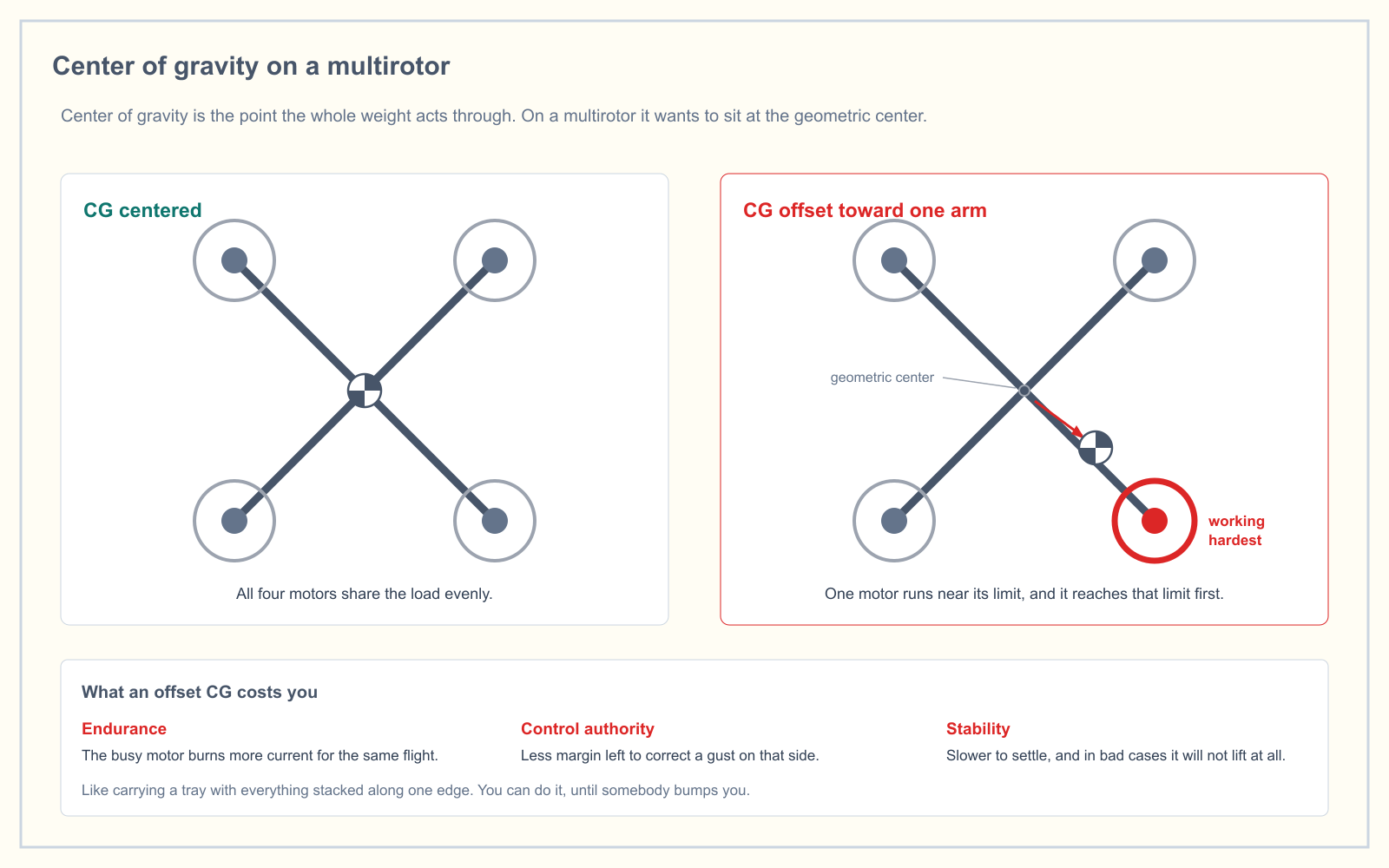
Center of gravity does something different again. An aft CG reduces longitudinal stability, so the aircraft is slower to damp out a pitch disturbance. Combine an aft CG with a gusty day and the airframe takes longer to settle after every bump. On a multirotor with a slung camera or a mismatched payload mount, an off-center load also forces the flight controller to hold a permanent correction, which eats into the control authority you were relying on to handle the gusts.
Part 107 has a rule that reaches this directly. Under 14 CFR 107.49, before every flight the remote pilot in command must ensure that any object attached to or carried by the aircraft is secure and does not adversely affect the flight characteristics or controllability of the aircraft. That is a weight-and-balance requirement written in plain language. And 14 CFR 107.3 defines a small unmanned aircraft as one weighing less than 55 pounds on takeoff, including everything on board or otherwise attached — the payload counts.
What this means when you are actually working
You will never read a G-meter on a drone job. Here is what the concept actually buys you:
- Treat the gust figure as the go/no-go number, not the steady wind. A steady 20 knots is a manageable, predictable load. A 10-knot wind gusting 25 is a series of impacts, and it is harder on the airframe and on your control margin.
- Fly the payload you tested. A new camera, a heavier battery or a parachute mount changes weight, CG and drag together. Test it in calm air before it flies in rough air.
- Bank angle is a proxy for how hard you are working the aircraft. An aggressive orbit in wind at full payload combines every factor on this page at once. Widen the radius instead of tightening the bank.
- Descending through a shear layer is a load event. Gaining or losing 10 knots of headwind at 200 feet changes the lift instantly. Descend gently through the layer rather than dropping through it.
- Hot and high makes everything worse. Density altitude reduces the lift available at any given angle of attack, so you have less margin above the stall and less power to recover from a gust.
How the exam asks about load factor
Load factor sits in the Loading and Performance area of the Unmanned Aircraft General knowledge test, which is 2 percent of the test under the blueprint effective 29 September 2025. That is roughly one or two questions out of 60, so do not over-invest — but they are easy marks if you know the shape they take:
- Direct recall of the bank angle figures. Most often the 60-degree case, because 2.0G is the memorable one.
- The stall speed relationship. "As bank angle increases in a level turn, stall speed…" and the answer is increases.
- Loading and CG. Whether an aft CG makes the aircraft more or less stable, and what happens if a payload shifts in flight.
- The gust case. Recognizing that turbulence loads the airframe the same way a steep turn does.
You can drill loading and performance questions alongside the rest of the syllabus in the free readiness assessment, which reports your score by knowledge area so you can see whether this section is actually costing you anything.
Frequently asked questions
What do you mean by load factor?
In aviation, load factor is the ratio of the total lift an aircraft is producing to its actual weight, expressed in G. Straight and level flight is 1G. A load factor of 2 means the wings are carrying twice the aircraft's weight. In airline economics the same phrase means something entirely different: the percentage of available seats that were sold.
How do I calculate load factor?
For a level, coordinated turn, load factor equals 1 divided by the cosine of the bank angle. A 30-degree bank gives 1.15G, 45 degrees gives 1.41G, and 60 degrees gives 2.0G. Bank angle is the only input. Airspeed, aircraft weight and aircraft type do not appear in the formula and do not change the answer.
Does load factor change with airspeed or weight?
No, not in a level turn. Load factor is a ratio, so weight cancels out and a 60-degree bank is 2G in any aircraft at any speed. What speed and weight do change is the consequence: a heavier aircraft has a higher stall speed to begin with, and a faster aircraft experiences a larger load spike from the same vertical gust.
At what bank angle does load factor become dangerous?
There is no single threshold, but the curve turns sharply after 45 degrees. At 60 degrees the load is 2.0G and the stall speed is 41 percent higher than in level flight. At 75 degrees the load is 3.86G, which is at or beyond the positive limit the FAA handbooks give for a normal category airplane. The risk is the accelerated stall as much as the structure.
Does load factor apply to drones?
Yes, though not through steep turns. Most multirotors self-limit their bank angle, so the load a small unmanned aircraft actually sees comes from vertical gusts, which raise the angle of attack instantly and spike the lift. That is why gust reports, turbulence near terrain, and shear layers matter more to a drone than the bank angle table does.
What is a good load factor for an airline?
This is the economic meaning, not the aerodynamic one. Airline passenger load factor is seats sold divided by seats available, and the global industry typically runs in the low to mid 80s as a percentage. It has nothing to do with structural G-load and it does not appear on any pilot knowledge test.
Sources
- 14 CFR 107.3 — Definitions
- 14 CFR 107.49 — Preflight familiarization, inspection, and actions for aircraft operation
- 14 CFR 23.2230 — Limit and ultimate loads
- FAA Pilot's Handbook of Aeronautical Knowledge, Chapter 5: Aerodynamics of Flight
- FAA Airplane Flying Handbook, FAA-H-8083-3C
- AC 61-67C — Stall and Spin Awareness Training
- Federal Register — Revision of Airworthiness Standards for Normal, Utility, Acrobatic, and Commuter Category Airplanes (Amendment 23-64)
- FAA Airman Certification Standards
Put this guide into practice.
Take the free assessment to see how this topic fits into your current exam readiness.
Start free practice