Flight Operations
Wake Turbulence and Wingtip Vortices: What a Remote Pilot Needs to Know
Every aircraft trails two counter-rotating vortices. They sink into the altitude band Part 107 confines you to, and nobody is sequencing you around them.
Key takeaway
Wake vortices sink 500 to 900 feet below the generating aircraft's flight path and drift downwind at 2 to 3 knots. Part 107 caps you at 400 feet AGL, so an airplane crossing overhead at 1,000 feet puts its wake through your entire legal operating band.
Wake turbulence is the pair of counter-rotating vortices every aircraft trails whenever it is producing lift. Behind a large airplane the vortices sink at several hundred feet per minute, tend to level off 500 to 900 feet below the generating flight path, and once near the ground they drift sideways at 2 to 3 knots. They are strongest when the aircraft ahead is heavy, clean and slow.
Those figures are usually taught to airline crews, so it is easy to file the topic under "not my problem." It is very much your problem. Five hundred to nine hundred feet below a flight path is precisely the block of air Part 107 confines you to. A light twin crossing above your site at 1,000 feet AGL is depositing its wake through your entire legal altitude band, roughly a minute later, displaced downwind of where you watched it pass. No controller is sequencing you around it, and under 14 CFR 107.37 the entire duty to stay clear is yours.
How wingtip vortices actually form
Lift comes from a pressure difference: lowest pressure over the top of the wing, highest underneath. At the wingtip that difference has somewhere to go. The higher-pressure air below the wing spills around the tip toward the lower-pressure air above it, and the FAA describes the resulting flow as rolling "upwards and inwards" to form two counter-rotating cylindrical vortices trailing behind the aircraft (AC 90-23H, paragraph 7.1).
Two details matter more than the picture suggests.
Most of the energy sits within a few feet of the vortex core (AIM 7-4-2). The wake is not a diffuse patch of rough air. It is two tight, fast-rotating tubes with relatively calm air between and around them, which is why an encounter is abrupt rather than gradual.
Winglets do not help. They exist to improve the lift-to-drag ratio, and FAA studies have found a negligible effect on wake generation, particularly at the slower speeds flown on departure and arrival. A modern airliner with elegant blended winglets throws the same wake as one without.
Which way does each vortex circulate?
Follow the air. Underneath the wing it moves outward toward the tip, wraps around the tip, then travels up and back inward across the top of the wing.
Stand behind the aircraft and look in the direction it is flying. At the right wingtip the air comes up around the outside and crosses inward over the top, so that vortex turns counterclockwise. The left wingtip mirrors it and turns clockwise. Between them the air is moving downward, which is the same downwash that produced the lift in the first place.
That geometry explains the hazard. The rotational flow field is far wider than a small aircraft, and the AIM is blunt about who suffers: it is harder for aircraft with a short wingspan relative to the generating aircraft to counter the imposed roll, and pilots of short-span aircraft "must be especially alert" (AIM 7-4-3). Your aircraft has a wingspan measured in inches. There is no counter-control argument available to you. Avoidance is the only tool you have.
When is wake turbulence strongest?
The AIM gives the answer as three words in capital letters: the greatest vortex strength occurs when the generating aircraft is HEAVY, CLEAN and SLOW (AIM 7-4-3).
| Factor | Worst case | Why |
|---|---|---|
| Weight | Heavy | Vortex strength increases proportionately with operating weight. More lift means a bigger pressure differential to shed. |
| Configuration | Clean — gear and flaps retracted | Flaps reduce the spacing between vortices and hasten decay; gear adds turbulence that breaks the wake up faster. A "dirty" aircraft makes a weaker wake. |
| Speed | Slow | Strength increases as speed decreases. High angle of attack, low airspeed, maximum lift per foot of wingspan. |
| Category | Super and Heavy | Aircraft such as the A380 and C-5 produce high initial strength vortices that also take longer to decay. |
Then the air decides how long it lasts. The conditions least favorable to you are light winds, low atmospheric turbulence and a stable airmass (AC 90-23H, 7.3.1) — the calm, smooth morning you chose precisely because it was good for flying. Turbulence tears wake apart. Still air preserves it.
Where the wake goes: sink, drift and wake bounce
Vortices are generated from the moment an airplane rotates on takeoff until the moment it touches down. After that they behave predictably enough to plan around.
| Behavior | Figure | Source |
|---|---|---|
| Initial sink rate behind a large aircraft | Several hundred feet per minute | AIM 7-4-4 |
| Where they level off | About 500 to 900 feet below the generating flight path | AC 90-23H, 7.4.1 |
| Heavy and Super category | May descend more than 1,000 feet before decaying | AC 90-23H, 7.4.1.1 |
| Spacing between the pair | Slightly less than the generating aircraft's wingspan | AC 90-23H, 7.4 |
| Lateral drift near the ground, no wind | 2 to 3 knots outward, each vortex | AIM 7-4-4, AC 90-23H, 7.4.2 |
| With a 6-knot crosswind | Downwind vortex moves about 1,800 feet in 2 minutes | AC 90-23H, 7.4.2.2 |
Two behaviors are worth pinning down because they defeat the obvious mental model.
Ground effect spreads the wake sideways. Once the vortices are within roughly a wingspan of the surface they stop descending and start diverging laterally, at 2 to 3 knots in still air. Add wind and it becomes arithmetic: a 6-knot crosswind on top of 3 knots of natural divergence gives the downwind vortex a 9-knot groundspeed, carrying it 1,800 feet in two minutes. That is a third of a mile, sideways, from a runway you thought you were clear of.
Wake can come back up. Thermal lifting, vertical winds and interaction with the surface can stop the descent or reverse it, an effect the FAA calls wake bounce (AC 90-23H, 7.4.1.2). Being above the wake is not permanent.
Why the light quartering tailwind is the one to fear
If a single line from this material shows up on your exam, it is this one. The AIM says it in capitals: THE LIGHT QUARTERING TAILWIND REQUIRES MAXIMUM CAUTION (AIM 7-4-4).
The reason is that it defeats both escape routes at once. The crosswind component resists the upwind vortex's natural tendency to move outward, so that vortex sits near the runway centerline instead of clearing off. Meanwhile the tailwind component pushes the whole wake forward from where it was generated, further down the runway and closer to the approach path. Nothing moves the hazard away from you, and one component actively holds it in place.
A light crosswind of only 1 to 5 knots is enough to keep the upwind vortex in the touchdown zone while hurrying the downwind one toward the next runway over.
Helicopters: downwash, outwash and the three-rotor-diameter rule
A helicopter in a hover is a different hazard, and for a drone operator it is often the more likely one.
In a hover or slow hover taxi, the main rotor drives a column of air downward. When that downwash hits the surface it spreads outward as outwash, a turbulent lateral flow that propagates in all directions in still air. The AIM puts the extent of those high-velocity outwash vortices at approximately three times the rotor diameter, and the circulation is outward, upward, around and away from the rotor in every direction (AIM 7-4-7).
The current advisory circular goes further and tells fixed-wing pilots to regard a rotorcraft of similar size as a larger aircraft for wake avoidance purposes, and to stay outside three rotor diameters of the nearest main rotor of any rotorcraft hovering or hover taxiing (AC 90-23H, 9.1.11). Aircraft have been lost to loss of control after a helicopter simply transited the area.
In forward flight a helicopter produces a pair of strong trailing vortices much like a larger fixed-wing aircraft, so the departing or arriving helicopter is not the safe case either. For a small unmanned aircraft near a hospital helipad, a news helicopter orbiting, or a police aircraft holding overhead, three rotor diameters is a floor, not a target.
What this means when you are the one on the ground
The FAA has not written wake turbulence guidance for unmanned aircraft. AC 90-23H, issued 13 January 2026, does not mention them once — it is addressed to student pilots, certificated pilots, instructors and examiners. That is the gap this material has to be read across, so here is the translation.
Your legal ceiling is inside the danger band. Part 107 caps you at 400 feet AGL. Wake levels off 500 to 900 feet below the flight path that made it. Any aircraft passing over your site between roughly 900 and 1,300 feet AGL is aiming its wake at your operating altitude. You cannot climb above it and you cannot outrun it.
Time and wind, not distance, are what clear the hazard. Watching an airplane fly past and immediately launching is the error. The wake stays where the air puts it. The AIM's own reference figure for operating after a larger aircraft has made a low approach, missed approach or touch-and-go is an interval of at least 2 minutes (AIM 7-4-6), and that is guidance for an aircraft that can maneuver in three dimensions. Give it more.
Offset upwind, not downwind. Every avoidance recommendation in both documents converges on the same instruction: move laterally, preferably upwind, and stay above or clear of the generating flight path. If you must work near an approach path, put yourself on the upwind side of it.
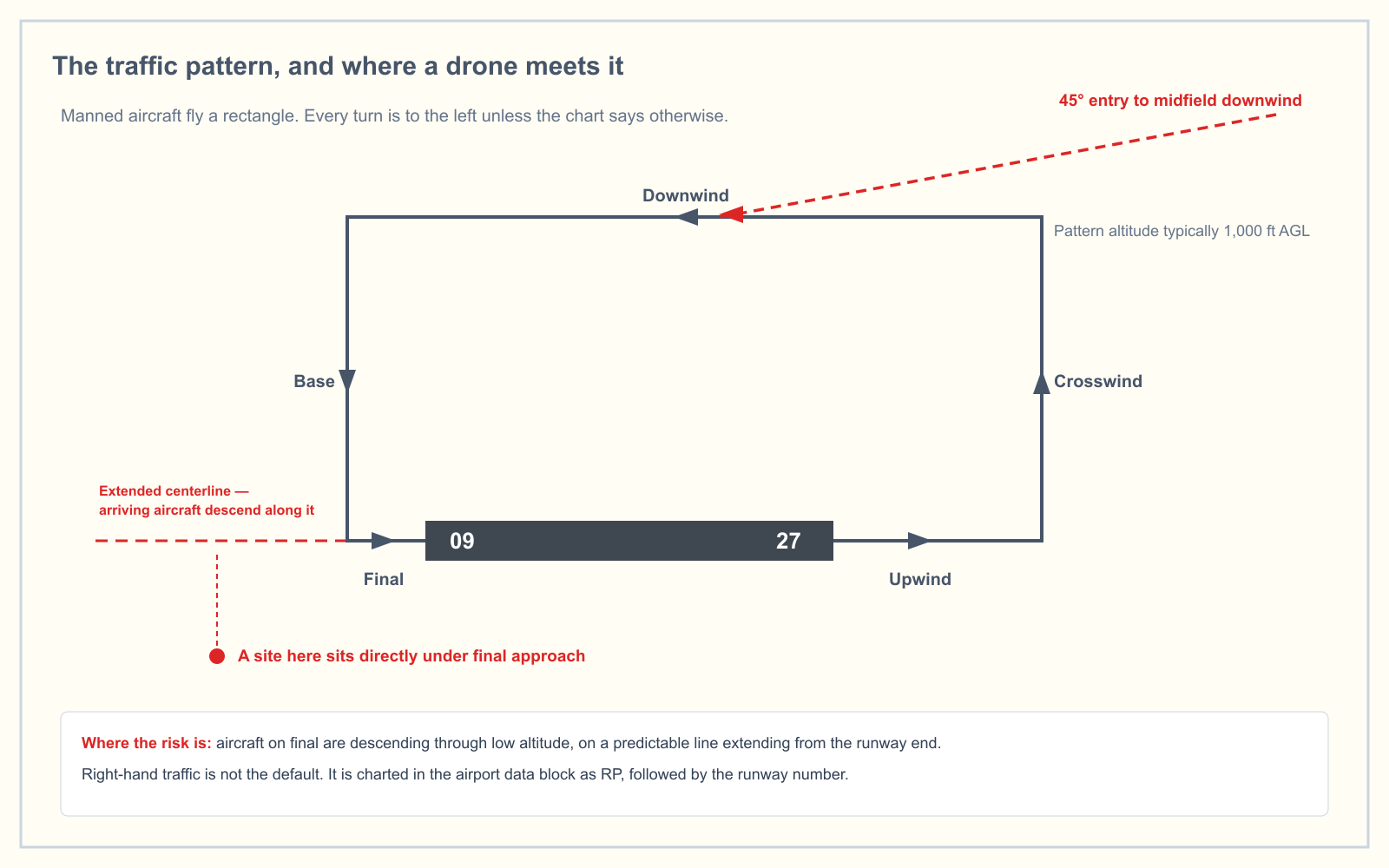
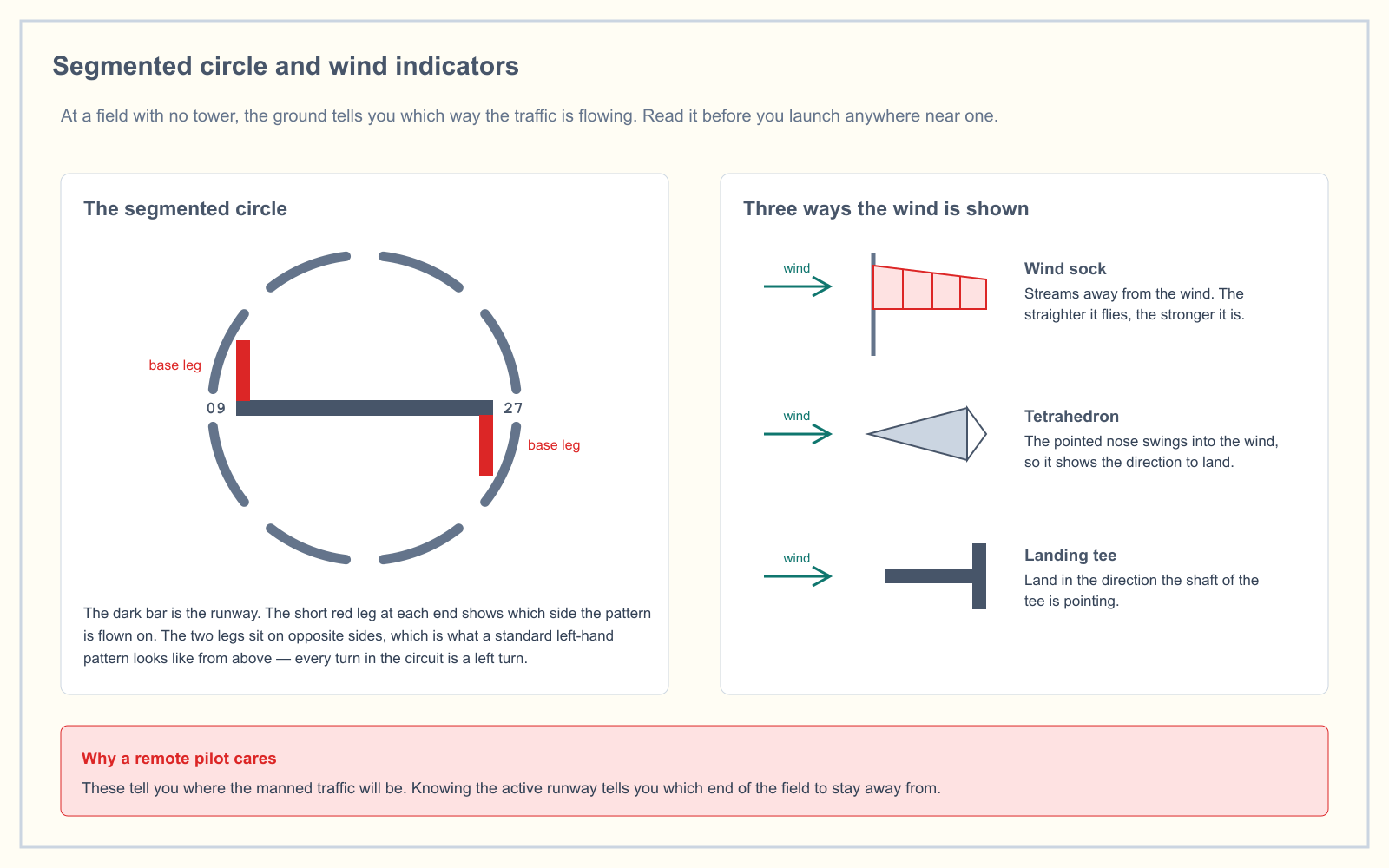
At a non-towered field, nobody is thinking about you at all. The advisory circular is explicit that at an uncontrolled airport the pilot in command is solely responsible for wake avoidance. Every pilot there is managing their own wake risk and has no idea you exist. Reading the ground before you launch — the wind cone, the segmented circle, which runway is active — tells you where the wake from the next departure is going to end up.
Section 107.43 is doing work here. You may not operate in a manner that interferes with operations and traffic patterns at any airport, heliport or seaplane base. Holding under a final approach path is not only a wake problem. It is a regulatory one. Add it to your preflight site survey rather than treating it as an airborne decision.
What the exam asks
Wake turbulence sits in the Operations area of the Unmanned Aircraft General knowledge test, which carries 25 percent of the questions under the blueprint effective 29 September 2025. The questions are recall, and they cluster on four points:
- The strength condition. Heavy, clean and slow. Distractors offer "light, dirty and fast" or swap one term.
- The circulation. Counter-rotating, moving upward and inward from beneath each wingtip.
- The wind condition. A light quartering tailwind is the answer whenever the stem mentions maximum caution on landing.
- Where to be relative to the generating aircraft. At or above its flight path, and laterally upwind. Never below and behind.
Frequently asked questions
What happens if you fly into wake turbulence?
The usual hazard is an induced rolling moment that can exceed the roll-control authority of the encountering aircraft. For a small unmanned aircraft with a wingspan of inches against a vortex core several feet across, there is no realistic recovery input. Expect an uncommanded roll, a rapid loss of control and probable loss of the aircraft.
How do pilots avoid wake turbulence?
By staying at or above the generating aircraft's flight path and offsetting laterally upwind of it. On landing behind a larger aircraft they note its touchdown point and land beyond it; on departure they rotate before the preceding aircraft's rotation point and climb above its path. Remote pilots have only the lateral and timing options.
How long does wake turbulence last?
There is no fixed figure, because decay depends on the initial strength plus wind, turbulence and airmass stability. Light winds, smooth air and a stable airmass preserve it longest. The FAA's reference interval after a larger aircraft's low approach or touch-and-go is at least 2 minutes, and air traffic control uses 2 to 3 minutes behind Heavy and Super category aircraft.
Is wake turbulence worse on takeoff or landing?
Both ends of the runway are hazardous, but for different reasons. Vortices begin at the rotation point on departure and end at the touchdown point on landing, and in both cases the aircraft is heavy and slow. Near the ground the wake stops sinking and spreads sideways instead, so it lingers in the touchdown zone and drifts toward adjacent runways.
Does wake turbulence affect drones?
Yes, and disproportionately. The AIM warns that short-wingspan aircraft have the greatest difficulty countering vortex-induced roll. The FAA has published no wake separation guidance for unmanned aircraft, so the manned-aircraft figures are what you have to reason from. Treat 500 to 900 feet below any overflying aircraft as contaminated air for at least a couple of minutes.
Do helicopters produce wake turbulence?
Yes. Hovering rotorcraft produce downwash and outwash extending roughly three times the rotor diameter, and in forward flight they trail vortices comparable to a much larger fixed-wing aircraft. Current FAA guidance is to treat a similar-sized rotorcraft as a larger aircraft for avoidance purposes and stay outside three rotor diameters.
Want to know whether this has actually stuck? The free readiness assessment mixes operations questions in with the other four knowledge areas, so you find out where you genuinely stand.
Sources
Put this guide into practice.
Take the free assessment to see how this topic fits into your current exam readiness.
Start free practice