Flight Operations
Aircraft Weight and Balance: How to Calculate the CG, and What It Means for a Drone
Weight and balance comes down to two lines of arithmetic. Here is the formula, a worked loading example, what the FAA actually requires, and why an off-center payload matters to a multirotor.
Key takeaway
Multiply each weight by its arm to get its moment, add up the weights and the moments, then divide total moment by total weight. That gives the CG, and it has to fall inside the envelope at that weight.
Aircraft weight and balance comes down to two formulas. Weight × arm = moment for each item, then total moment ÷ total weight = center of gravity (CG). The aircraft is legal to fly only if the total weight stays at or under the maximum and the CG falls inside the forward and aft limits the manufacturer publishes.
Most explanations stop at the arithmetic, and the arithmetic is the easy part. What people get wrong is why the CG matters, and that is what decides whether a heavily loaded aircraft flies normally or fights you all the way. It applies just as much to a quadcopter with a camera bolted slightly off center, even though nobody gives you a loading graph for one.
What is weight and balance in aviation?
Weight and balance are two separate limits that get checked together.
Weight is the total the aircraft carries: airframe, fuel, oil, people, baggage and anything attached. Too much, and the aircraft needs more runway, climbs worse, stalls at a higher speed and carries more load on its structure.
Balance is where that weight sits. The Pilot's Handbook of Aeronautical Knowledge defines the CG as the point where the aircraft would balance if you hung it from that point. What matters most is where the CG sits fore and aft. Too far forward and the aircraft is nose-heavy. Too far aft and it becomes tail-heavy and unstable.
You can be under maximum weight and still out of balance. You can also be perfectly balanced and overweight. Both are violations, which is why the check is always a pair.
The terms you need before the formula
| Term | What it means |
|---|---|
| Datum | An imaginary vertical reference line chosen by the manufacturer. All distances are measured from it. |
| Arm | The horizontal distance in inches from the datum to an item's CG. Plus if aft of the datum, minus if forward. |
| Station | A location in the aircraft named by its distance from the datum. Station 50 has an arm of 50 inches. |
| Moment | Weight × arm, in pound-inches. The turning effect of a weight about the datum. |
| Moment index | A moment divided by a constant such as 100 or 1,000, to keep the numbers manageable. |
| Useful load | Everything you can add to the empty aircraft: pilot, passengers, baggage, usable fuel. |
| CG limits | The forward and aft limits the CG must stay within, published in the AFM or POH. |
The datum is arbitrary. It might be the firewall, the nose, or a point in front of the aircraft. The answer does not depend on where it is, as long as every arm is measured from the same place.
How do you calculate weight and balance?
Three steps, every time:
- List every item with its weight and arm. Empty weight and its arm come from the aircraft's weight and balance record. Seat, baggage and fuel arms come from the flight manual.
- Multiply each weight by its arm to get its moment.
- Add up the weights, add up the moments, and divide total moment by total weight. The answer is the CG, in inches from the datum.
Then check two things: total weight is at or under the maximum, and the CG sits inside the envelope at that weight.
Fuel is the item people get wrong. It is listed in gallons and has to be converted. The FAA's standard weights are 6 pounds per gallon for aviation gasoline, 6.8 for Jet A, and 7.5 for oil. The handbook also says to use actual weights when you have them.
A worked example
This is an illustrative four-seat airplane, not any specific model. The arms are the kind you would find in a light single's POH.
| Item | Weight (lb) | Arm (in) | Moment (lb-in) |
|---|---|---|---|
| Basic empty weight | 1,500 | 39.0 | 58,500 |
| Pilot and front passenger | 340 | 37.0 | 12,580 |
| Rear passenger | 170 | 73.0 | 12,410 |
| Fuel, 40 gal × 6 lb | 240 | 48.0 | 11,520 |
| Baggage | 60 | 95.0 | 5,700 |
| Total | 2,310 | 100,710 |
CG = 100,710 ÷ 2,310 = 43.6 inches aft of the datum.
Suppose the flight manual says the envelope at 2,310 pounds runs from 38.5 to 47.3 inches. You are inside it, with some room toward the aft limit.
Now move the 60 pounds of baggage from station 95 to the empty rear seat at station 73. The weight stays the same, but the moment drops by 60 × 22 = 1,320 lb-in. The new CG is 99,390 ÷ 2,310 = 43.0 inches. The handbook has a shortcut for this, the weight-shift formula:
Change in CG = weight moved × distance moved ÷ total weight
Here that is 60 × 22 ÷ 2,310 = 0.57 inches forward. Same answer, less work.
Why a forward or aft CG changes how the aircraft flies
The handbook is blunt about both ends of the range.
| CG position | What happens |
|---|---|
| Forward of the limit | Nose-heavy. Higher stall speed, higher control forces, harder to raise the nose, and in extreme cases the pilot cannot flare to land. |
| Within limits | The aircraft flies the way the manufacturer tested it. |
| Aft of the limit | Tail-heavy. Less stability, very light control forces that make it easy to overstress the airframe, and violent stall characteristics that are harder to recover from. |
The aft case is the dangerous one. A forward CG makes the aircraft sluggish but predictable. An aft CG makes it twitchy, and past the limit it may not recover from a stall at all. The PHAK also notes that as the CG moves aft, the aircraft is less able to right itself after maneuvering or turbulence. For a small aircraft working in gusty low-level air, that line matters more than any other.
Weight works the same way. A heavier aircraft stalls at a higher speed and carries more load in a turn or gust, which is why this topic sits next to load factor on the knowledge test.
What are the FAA weight and balance regulations?
For manned aircraft, the rule is shorter than most people expect. 14 CFR 91.9 says no one may operate a civil aircraft without complying with the operating limitations in its approved flight manual, markings and placards. Weight and CG limits are among those limitations. 14 CFR 91.103 also requires the pilot to review takeoff and landing performance, and gross weight is one of the inputs.
As the PHAK puts it, Part 91 does not require a pilot to perform a weight and balance calculation before each flight. It requires you to stay within the limits. How you confirm that is up to you. Commercial operators flying under other parts run formal weight and balance programs, but that is outside anything a remote pilot deals with.
Part 107 has no loading graph and no CG envelope. It reaches the same idea in two places:
- 14 CFR 107.3 defines a small unmanned aircraft as weighing less than 55 pounds on takeoff, including everything on board or otherwise attached. The payload counts toward the limit.
- 14 CFR 107.49(e) requires the remote pilot in command, before flight, to ensure that anything attached to or carried by the aircraft is secure and does not adversely affect the flight characteristics or controllability of the aircraft.
That second rule is weight and balance written in plain English. It does not ask you for a number. It holds you responsible for the result.
What weight and balance means on a multirotor
A quadcopter has no nose-heavy or tail-heavy problem in the airplane sense, because it has no wing and no elevator. The flight controller levels it by varying motor speed. That is exactly why balance still matters. It just shows up in a different way.
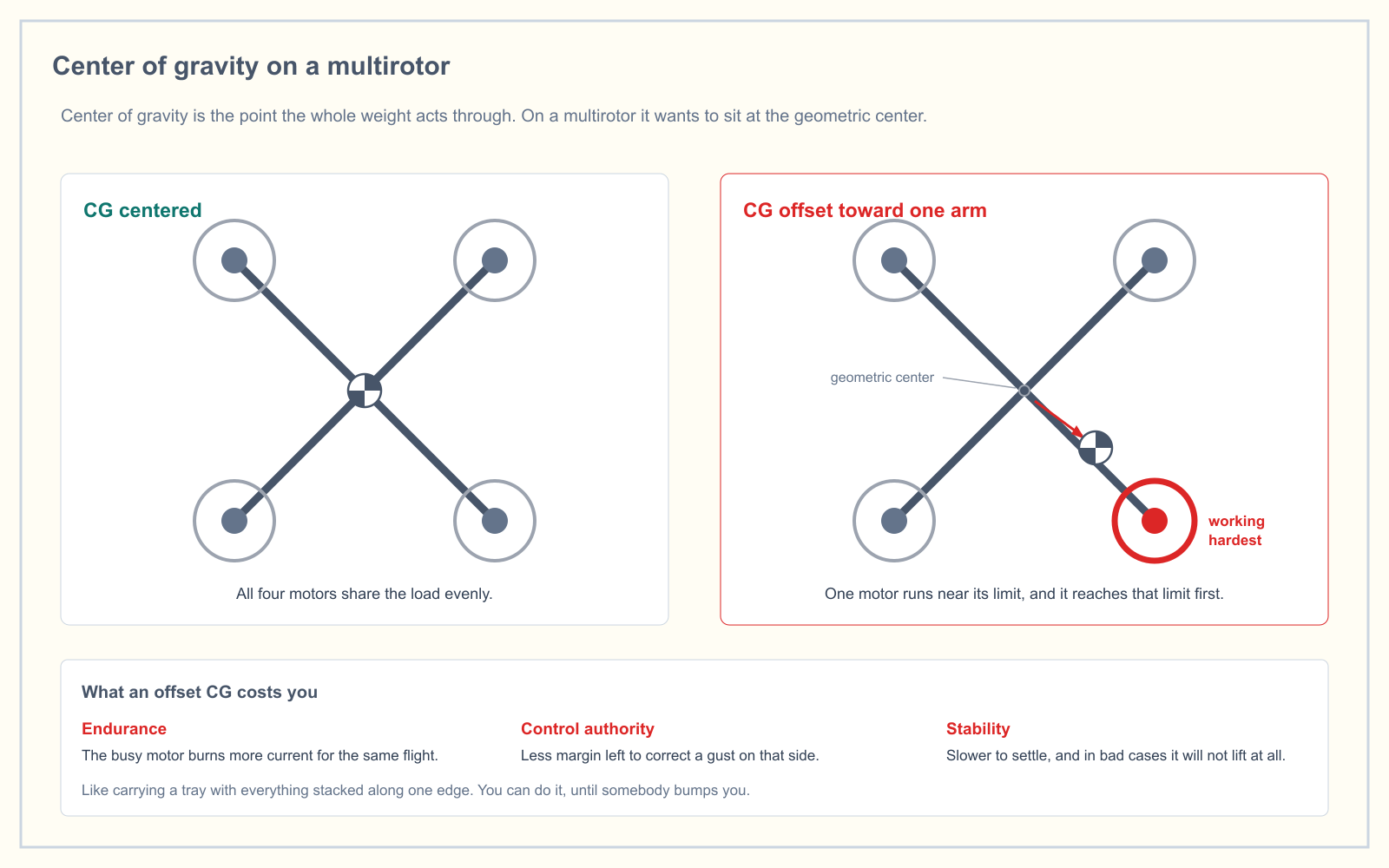
When the CG sits at the geometric center, all four motors share the load. Move it toward one arm, with an off-center camera mount, a spotlight, a sensor or a heavier battery that sits further back, and the flight controller has to run the motor on that side faster all the time just to hold the aircraft level. That motor now has less headroom:
- Endurance drops, because the busy motor draws more current for the whole flight.
- Control authority drops on that side, so a gust pushing the loaded corner down meets a motor that is already near its limit.
- In bad cases it will not take off cleanly, tipping on liftoff or drifting as soon as it leaves the ground.
Weight adds its own cost. More mass means more thrust just to hover, so there is less reserve for climbing or for fighting wind. A hot, high launch site cuts that reserve further, which density altitude covers in detail. Fixed-wing drones behave much more like airplanes: the manufacturer usually publishes a balance point, and flying one tail-heavy produces the same unstable pitch behavior the PHAK describes.
What this means when you are actually working
- Weigh the aircraft as it will fly. Battery, gimbal, payload, mounts, parachute. The 55-pound limit and the manufacturer's maximum takeoff weight both apply to that number, not the spec-sheet empty weight.
- Mount payloads on the centerline. If something has to sit off center, counterbalance it, or accept that one motor is doing extra work.
- Test every new configuration in calm air first. A short hover tells you whether the aircraft holds position without drifting toward the loaded side. That hover is your 107.49(e) check.
- Expect the balance to change during the flight. A payload release, a spray tank emptying or a dropped sensor changes weight and CG instantly. The aircraft that lands is not the one that took off.
- Watch the motor output or temperature data if your app shows it. An uneven spread in a steady hover is often the first sign of an offset CG.
How the exam asks about weight and balance
Weight and balance is part of Loading and Performance, which is 2 percent of the Unmanned Aircraft General test under the blueprint effective 29 September 2025. Expect one question, maybe two. The usual ones ask:
- What happens when the CG is too far aft (less stable, harder to recover from a stall).
- What excess weight does to performance (longer takeoff, lower climb rate, higher stall speed).
- Whether a payload that shifts in flight is a controllability problem (yes, and 107.49 makes it your problem before takeoff).
These are easy marks if you understand the why. The free readiness assessment scores you by knowledge area, so you can check whether Loading and Performance is costing you anything.
Frequently asked questions
How do I calculate weight and balance?
List every item with its weight and its arm, the distance from the datum. Multiply each weight by its arm to get its moment. Add up all the weights and all the moments, then divide total moment by total weight. The result is the CG in inches from the datum. Check it against the envelope at that total weight.
What is the formula for weight and balance?
The core formula is weight × arm = moment. Once you have the moments, CG = total moment ÷ total weight. For moving an item already on board, the shortcut is: change in CG = weight moved × distance moved ÷ total weight. Arms are positive aft of the datum and negative forward of it.
Do you have to do a weight and balance for every flight?
Under Part 91, no specific rule requires a calculation before each flight. Section 91.9 does require you to stay within the flight manual's weight and CG limits, so you need some way to know you are inside them. Part 107 requires no calculation, but 107.49(e) requires any attached object to be secure and not affect controllability.
What happens if the center of gravity is too far aft?
An aft CG reduces longitudinal stability, makes control forces very light, and makes it easy to overstress the airframe. Stalls become more violent and harder to recover from, and the aircraft is slower to right itself after turbulence. It is the more dangerous of the two out-of-limits conditions, and the one the knowledge test asks about most.
How much does aviation fuel weigh per gallon?
The FAA's standard weight for aviation gasoline is 6 pounds per US gallon. Jet A is 6.8 pounds, oil 7.5 pounds and water 8.35 pounds. The Weight and Balance Handbook says to use actual weights when you have them. Thirty gallons of avgas weighs 180 pounds, about as much as an extra passenger.
Does a drone need a weight and balance check?
Not a formal calculation, but the idea applies. Under 107.3, everything attached counts toward the 55-pound limit, and 107.49(e) requires payloads to be secure and not degrade controllability. On a multirotor, an off-center load makes one motor carry more of the weight, which cuts endurance and leaves less margin to handle gusts on that side.
Sources
- 14 CFR 91.9 — Civil aircraft flight manual, marking, and placard requirements
- 14 CFR 91.103 — Preflight action
- 14 CFR 107.3 — Definitions
- 14 CFR 107.49 — Preflight familiarization, inspection, and actions for aircraft operation
- FAA Pilot's Handbook of Aeronautical Knowledge, Chapter 10: Weight and Balance
- FAA Aircraft Weight and Balance Handbook, FAA-H-8083-1B
- FAA Airman Certification Standards
Put this guide into practice.
Take the free assessment to see how this topic fits into your current exam readiness.
Start free practice