Flight Operations
Ground Effect in Aviation: What It Does to a Wing, and What It Does to a Multirotor
Every explainer on this topic is written for airplanes floating down a runway. A multirotor spends most of its working life either in ground effect or leaving it, and the consequences are different.
Key takeaway
For a wing, ground effect is a drag reduction that scales with height: 47.6 percent at one-tenth of the wingspan, 1.4 percent at a full wingspan. For a rotor, the FAA puts the benefit at roughly one rotor diameter above the surface, and it shrinks over grass, brush and water.
Ground effect is the increase in efficiency an airfoil gets when it operates close to the surface, because the ground interferes with the downwash and the tip vortices. For a wing, the FAA measures it as a reduction in induced drag: 47.6 percent at one-tenth of the wingspan, 23.5 percent at one-fourth, and only 1.4 percent at a full wingspan. For a rotor, the benefit reaches to about one rotor diameter above the ground.
Almost everything written about ground effect is written for airplanes. It shows up as the float at the end of a landing, the mysterious reluctance to touch down. That framing is correct and it is also nearly useless to you, because you are not flying a wing down a runway. You are hovering a rotor a few feet off somebody's driveway, and then climbing out of the cushion that has been holding you there.
What is ground effect in aviation?
The Pilot's Handbook of Aeronautical Knowledge describes it as a change in the three-dimensional flow pattern around the aircraft. When an aircraft comes within several feet of the surface, ground or water, "the vertical component of the airflow around the wing is restricted by the surface." That alters the wing's upwash, downwash and wingtip vortices.
The common explanation is wrong, and the handbook is careful to avoid it. Ground effect is not a cushion of compressed air that the aircraft sits on. The PHAK states what is actually happening: "Ground effect, then, is due to the interference of the ground (or water) surface with the airflow patterns about the aircraft in flight."
Here is the chain. A wing or rotor lifts by accelerating a mass of air downward, and that acceleration is what creates induced drag. Put the surface underneath, and the tip vortices cannot spiral freely and the downwash cannot develop fully. Less downwash means a smaller induced angle of attack, and the induced drag falls with it. In the handbook's words: "the wing will require a lower AOA in ground effect to produce the same CL. If a constant AOA is maintained, an increase in CL results."
Less drag for the same lift. Free efficiency, as long as you stay low.
How close do you have to be? The numbers
This is the part worth memorizing, because it explains why ground effect is an event at the very start and very end of a flight and irrelevant in between.
| Height above surface | Reduction in induced drag |
|---|---|
| One-tenth of the wingspan | 47.6 percent |
| One-fourth of the wingspan | 23.5 percent |
| A full wingspan | 1.4 percent |
Those are the PHAK's figures, and note how fast the benefit collapses. The handbook's conclusion: "a large reduction in induced drag takes place only when the wing is very close to the ground. Because of this variation, ground effect is most usually recognized during the liftoff for takeoff or just prior to touchdown when landing."
Scale that to something you own. A small airplane with a 36-foot span is meaningfully in ground effect below about 9 feet. A rotorcraft uses rotor diameter instead, which is why a drone with a modest footprint stops caring about the ground very quickly indeed.
What causes ground effect on a rotor, and what is an IGE hover?
For a rotor the FAA uses different language for the same physics. The Helicopter Flying Handbook defines it in Chapter 2: "Ground effect is the increased efficiency of the rotor disk caused by interference of the airflow when near the ground. The air pressure or density is increased, which acts to decrease the downward velocity of air."
The consequences follow in a sequence you can reason through. Slowing the downward velocity of the air makes the relative wind more horizontal, which tilts the lift vector more vertically, so more of the rotor's output goes into holding the aircraft up. Induced flow velocities drop, angle of attack rises, and the blade needs less pitch to do the same job. Less pitch means less induced drag, which means less power to hover.
That is a hover in ground effect, abbreviated IGE. Out of ground effect, or OGE, is everything above it, and the handbook is blunt about the cost: "Induced flow velocity is increased, resulting in a decrease in AOA and a decrease in lift... This increased pitch angle and drag requires more power to hover OGE than IGE."
| IGE hover | OGE hover | |
|---|---|---|
| Height | Up to roughly one rotor diameter | Above that |
| Induced flow velocity | Reduced | Increased |
| Blade pitch needed | Lower | Higher |
| Induced drag | Reduced | Increased |
| Power required | Less | More |
| Related hazard | — | Vortex ring state |
The height limit is the number to carry. The handbook states that "rotor efficiency is increased by ground effect to a height of about one rotor diameter (measured from the ground to the rotor disk) for most helicopters."
For a multirotor, the honest reading is that the useful benefit is a matter of feet, not tens of feet. A quadcopter with propellers a foot across does not have a single rotor diameter to work with in the way a helicopter does, and the practical cushion sits low, roughly within the aircraft's own footprint of the ground. The direction of the effect is exactly as described. The scale is small.
The surface matters, and this is the part drone pilots meet most
Here is the clause that almost never makes it into the fixed-wing explainers, and it is the one that bites you on a real job.
The Helicopter Flying Handbook: "Maximum ground effect is achieved when hovering over smooth hard surfaces. When hovering over surfaces as tall grass, trees, bushes, rough terrain, and water, maximum ground effect is reduced."
A smooth hard surface reflects the downwash back cleanly. Tall grass, brush, gravel, a plowed field or open water absorbs it, scatters it, or lets it pass, so the efficiency gain you would have had over asphalt largely is not there.
Think about where you actually launch. A parking lot gives you the full effect. A hayfield, a construction site, a riverbank, the deck of a boat, a flat roof covered in loose gravel: all of these give you less than the manual suggests, and none of it is visible on your controller. The aircraft simply works a little harder than it did the last time, and the first place you notice is the battery.
It is also why a takeoff from a cluttered site can feel unstable rather than merely inefficient. The downwash returns unevenly, from walls or vegetation on one side and open ground on the other, and the aircraft spends the first few seconds correcting for an asymmetry that did not exist on the pad in your yard.
What happens when you leave ground effect?
Everything reverses, and the PHAK sets out exactly what changes. An aircraft leaving ground effect after takeoff will:
- Require an increase in AOA to maintain the same lift coefficient
- Experience an increase in induced drag and thrust required
- Experience a decrease in stability and a nose-up change in moment
- Experience a reduction in static source pressure and an increase in indicated airspeed
For a manned aircraft, the third and fourth items matter for handling and instruments. For you, the second one is the whole story: the power required to stay airborne goes up the moment you climb out of the cushion.
The classic fixed-wing trap follows from this. Because drag is reduced near the surface, an airplane "may seem capable of takeoff well below the recommended speed." It lifts off, climbs out of ground effect, meets the induced drag it was avoiding, and cannot sustain the climb. The PHAK notes the extreme case, in which "high gross weight, high density altitude, and high temperature" leave an aircraft airborne but "incapable of sustaining flight out of ground effect."
High, hot, heavy. Those are exactly the conditions under which a loaded multirotor lifts confidently off a hot parking lot and then labors on the climb to working altitude. The mechanism is not identical, because you have no airspeed to be deficient in, but the shape of the trap is the same: performance measured in the cushion is not performance you can count on above it.
What this means when you are actually working
The practical consequence is a single sentence. A hover check at two feet does not prove the aircraft can do the job at 200.
That runs against the natural habit. You power up, the aircraft comes off the ground crisply, everything feels right, and you climb. But the low hover was an IGE hover, borrowing efficiency from the ground, over whatever surface happened to be under you. The climb spends that borrowed margin and then asks for more.
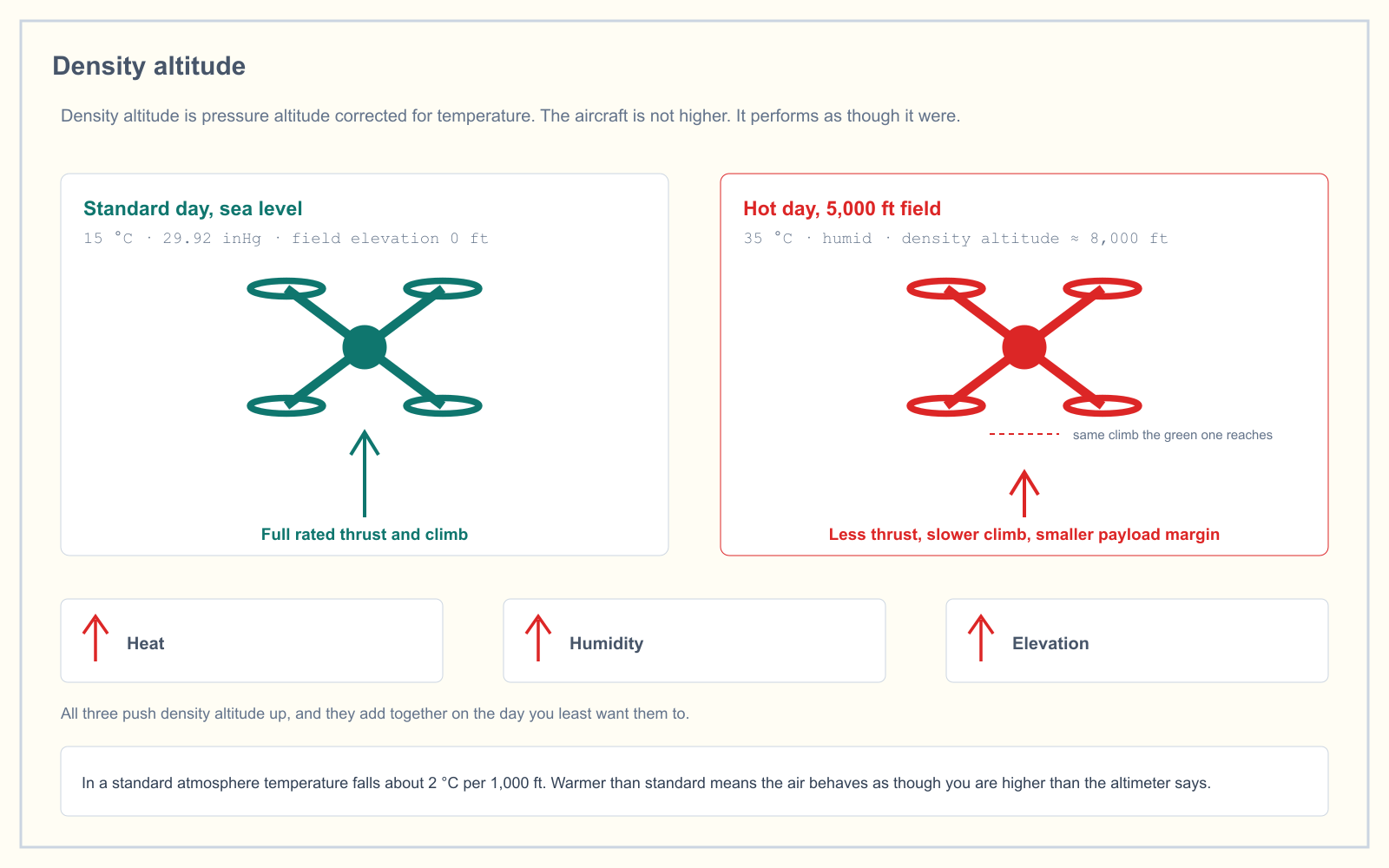
Density altitude sits underneath all of it, because it sets how much power you had to begin with.
A few things follow for a working remote pilot:
- Judge the aircraft on the climb, not the liftoff. Watch the rate of climb through the first hundred feet. If it is noticeably slower than usual, the flight is telling you something about weight, temperature or battery health before the flight is committed.
- Discount your launch surface. Grass, brush, gravel and water all give you less ground effect than the pad you tested on. Expect a heavier launch and plan the margin accordingly.
- Treat a heavy payload day as a different aircraft. Added weight shows up mildly in the hover and severely on the OGE climb, which is where the power demand peaks.
- Do not linger in the transition. The region just above ground effect is where power demand rises and where the handbook flags the conditions that invite vortex ring state if you then descend vertically back into your own downwash.
- Landings are not free either. Coming down into ground effect returns the efficiency, which is why a drone can feel like it stops descending or drifts sideways in the last few feet. That is not a malfunction, it is the cushion reasserting itself over a hard surface.
Two regulatory hooks attach to this, and neither one mentions ground effect by name. Under 14 CFR 107.49, you must assess the operating environment before flight, which includes local weather conditions and the surface you are working from. Under 14 CFR 107.19, the remote pilot in command is directly responsible for, and the final authority as to, the operation of the aircraft. Misreading your own performance margin is squarely inside that responsibility.
How the exam asks about ground effect
Ground effect lives in the Loading and Performance area, which carries just 2 percent of the current UAG blueprint effective 29 September 2025, and it can surface inside Operations questions at 25 percent as a judgment scenario. Do not spend a week on it. Do learn three things.
The mechanism. Ground effect is interference with the downwash and the tip vortices near the surface, producing a reduction in induced drag. It is not a cushion of compressed air, and a question offering that as an answer is offering you the distractor.
The height. For a wing, significance scales with wingspan and the FAA's figures are 47.6 percent at one-tenth span, 23.5 percent at one-fourth, 1.4 percent at a full span. For a rotor, the benefit extends to about one rotor diameter above the surface.
The direction of the change on climb-out. Leaving ground effect increases the induced drag and the power required. Any answer suggesting an aircraft gains performance as it climbs out of ground effect is wrong.
Scenario questions tend to combine this with density altitude: a heavy aircraft, a hot day, a high field elevation, and a climb that will not develop. The four forces of flight framing helps here, since the whole question is whether thrust still exceeds drag once the discount expires.
Frequently asked questions
What causes ground effect in aviation?
The surface interferes with the airflow around the airfoil. Within a short distance of the ground the wingtip vortices cannot fully develop and the downwash is restricted, which reduces the induced angle of attack and therefore the induced drag. The airfoil produces the same lift for less drag, so less power is required to stay airborne.
What happens to an airplane when it flies in ground effect?
Induced drag falls, so the thrust required at low speed falls with it. With a constant angle of attack the lift coefficient increases, which produces the familiar float during a landing flare. The FAA also notes an instrument consequence: increased local pressure at the static source produces a lower indicated airspeed and altitude than the aircraft actually has.
How high is ground effect for a drone?
The FAA's rotorcraft figure is about one rotor diameter above the surface, measured from the ground to the rotor disk. On a multirotor with small propellers that translates to a very low cushion, a matter of feet rather than tens of feet. Treat any hover above your own launch height as effectively out of ground effect.
Does ground effect work over water or grass?
Less well. The Helicopter Flying Handbook states that maximum ground effect is achieved over smooth hard surfaces and is reduced over tall grass, trees, bushes, rough terrain and water. A launch from a field, a gravel site or a boat gives you less efficiency than the same aircraft would get from asphalt, with no indication on the controller.
How do you get out of ground effect in a helicopter?
You climb above roughly one rotor diameter, and you plan for the power increase before you do it. The handbook is explicit that hovering out of ground effect requires more power than hovering in it, so the transition demands a margin you must confirm in advance. Attempting it without that margin is one of the situations that invites vortex ring state.
Is ground effect on the Part 107 test?
It can be. Loading and Performance is 2 percent of the current blueprint and Operations is 25 percent, and ground effect usually appears inside a performance scenario rather than as a definition. The testable points are that it reduces induced drag near the surface and that leaving it increases the power required. Test content is outlined in the FAA's airman testing materials.
Work through performance scenarios like these in the free Part 107 readiness assessment before you book the test.
Sources
- Pilot's Handbook of Aeronautical Knowledge (FAA-H-8083-25), Chapter 5: Aerodynamics of Flight — FAA
- Helicopter Flying Handbook (FAA-H-8083-21B), Chapter 2: Aerodynamics of Flight — FAA
- 14 CFR 107.49 — Preflight familiarization, inspection, and actions for aircraft operation — eCFR
- 14 CFR 107.19 — Remote pilot in command — eCFR
- FAA Airman Testing — FAA
Put this guide into practice.
Take the free assessment to see how this topic fits into your current exam readiness.
Start free practice