Flight Operations
Airport Signs Explained: The Six Types, What Each Color Means, and Which Ones a Drone Pilot Must Know
Airports use exactly six types of signs, and the colors tell you what each one wants from you. Red means stop, black means you are here, yellow means that way.
Key takeaway
Red background, white letters is a mandatory instruction sign. Nothing crosses it, aircraft, vehicle or drone crew, without a clearance.
The FAA recognizes six types of airport signs: mandatory instruction, location, direction, destination, information and runway distance remaining. The color tells you which is which. Red with white letters is an order. Black with yellow letters tells you where you are. Yellow with black letters tells you where things are. Black with white numerals counts down the runway.
Most explanations stop at the list. The useful part is the logic underneath it, because once you know the color code you can read a sign you have never seen before. For a remote pilot, one sign in particular matters more than the rest. The red runway holding position sign marks the line where the runway begins, and it applies to your crew and your vehicle just as much as it applies to a Cessna.
What are the 6 basic types of airport signs?
AIM 2-3-7 lists them. The detailed design standards live in FAA Advisory Circular 150/5340-18, but the table below covers everything a pilot needs to read them.
| Sign type | Background | Inscription | What it tells you | AIM paragraph |
|---|---|---|---|---|
| Mandatory instruction | Red | White | Stop, or do not enter | 2-3-8 |
| Location | Black | Yellow, with yellow border | The taxiway or runway you are on | 2-3-9 |
| Direction | Yellow | Black, with arrows | Which way the intersecting taxiways go | 2-3-10 |
| Destination | Yellow | Black, with arrow | The route to a place on the airport | 2-3-11 |
| Information | Yellow | Black | Frequencies, noise procedures, blind spots | 2-3-12 |
| Runway distance remaining | Black | White numerals | Thousands of feet of runway left | 2-3-13 |
There is one exception inside the location family. Runway boundary signs and ILS critical area boundary signs are yellow with black inscriptions, because they face the opposite way. They are read by a pilot leaving an area, not one sitting in it. That catches people on the exam, so it gets its own section below.
What does a red and white sign mean at an airport?
Red background, white inscription is a mandatory instruction sign. Per AIM 2-3-8, it marks either an entrance to a runway or critical area, or an area where aircraft are prohibited. There are four common kinds:
- Runway holding position sign. This is the one you will see most. It sits on a taxiway beside the holding position marking and shows the designation of the runway ahead, such as 15-33. The numbers are arranged to match the thresholds: runway 15's end is to the left, runway 33's is to the right. Where a taxiway meets the start of a takeoff runway, the sign may show only that runway's number.
- Runway approach area holding position sign. This keeps aircraft on a taxiway out from under an approach or departure path. It reads like 15-APCH, or 15-APCH/33-DEP where both areas are protected.
- ILS critical area holding position sign. This one reads ILS. It keeps aircraft clear of the area where a parked or taxiing aircraft would distort the instrument landing signal.
- No entry sign. It prohibits an aircraft from entering an area at all. It is usually found on one-way taxiways, or where a vehicle roadway could be mistaken for a taxiway.
AIM notes that holding position signs exist to give the pilot a visual cue to where the painted holding position marking is. The sign warns you from a distance, and the paint marks the exact place to stop.
What is the hold short line, and what does the sign next to it mean?
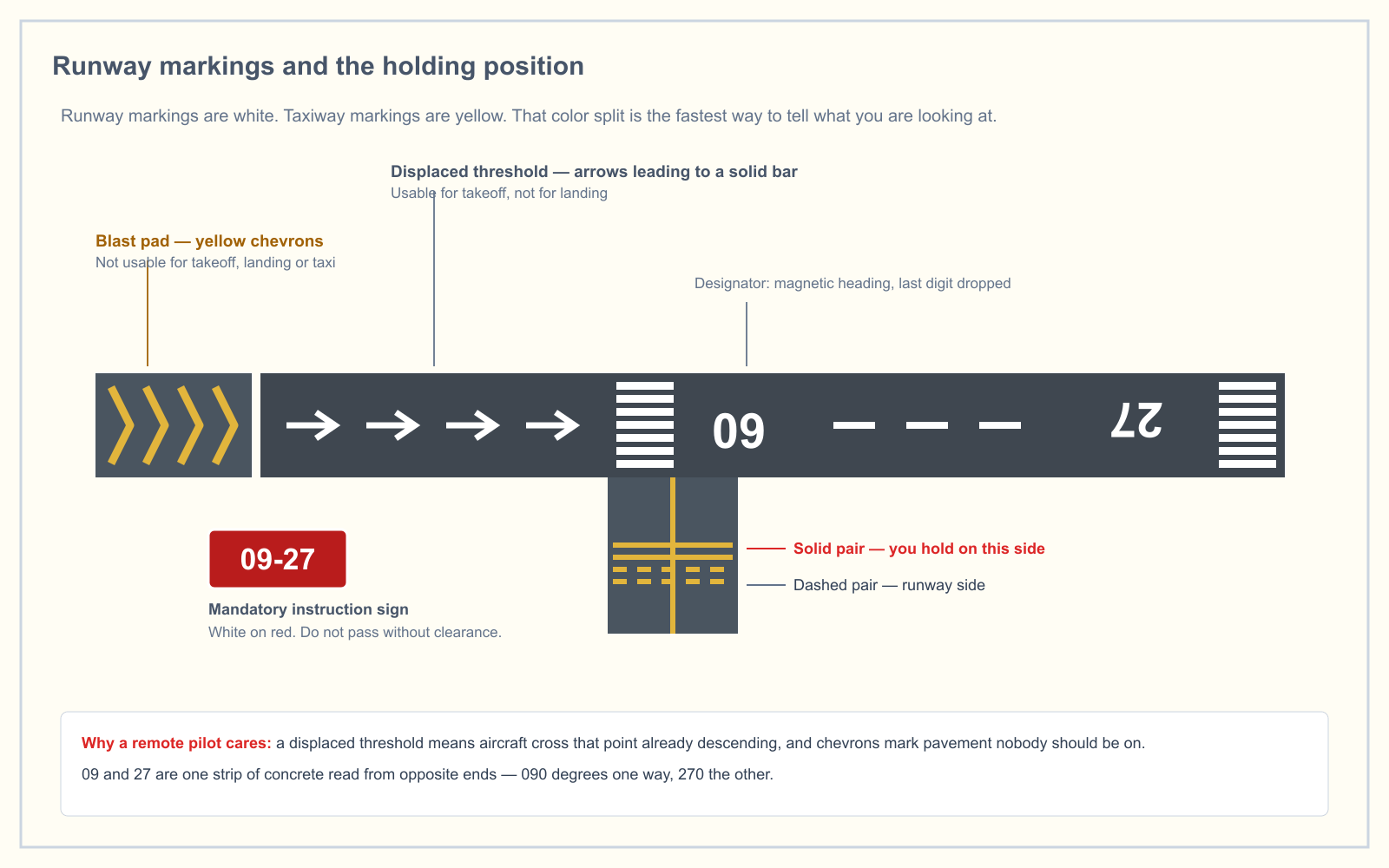
The runway holding position marking, which everyone calls the hold short line, is four yellow lines: two solid and two dashed, running across the taxiway. Per AIM 2-3-5, the solid lines are always on the side where the aircraft must hold.
At an airport with an operating control tower, pilots must not cross it without an ATC clearance. At an airport without one, pilots must make sure they have adequate separation from other aircraft, vehicles and pedestrians before crossing. An aircraft leaving the runway is not clear of it until every part of it has crossed the marking.
The reason is physical, not bureaucratic. The AIM notes that the marking generally identifies the boundary of the runway safety area. That is the cleared zone around a runway that exists for aircraft that land short, drift off the side or overrun the end. Anything on the wrong side of that line is inside the zone the runway is designed to keep empty.
The ILS critical area has its own marking: two solid yellow lines connected by pairs of solid lines ten feet apart, with an ILS sign beside it. Where one taxiway holds short of another, the marking is a single dashed yellow line.
The painted markings themselves, including runway numbers, thresholds and chevrons, are covered in the runway numbers and markings guide. This article sticks to the signs.
What do black and yellow airport signs mean?
Black background, yellow inscription and a yellow border is a location sign. It answers the question "where am I?"
- A taxiway location sign shows the letter of the taxiway you are on. It often stands beside a direction sign or a runway holding position sign.
- A runway location sign shows the runway you are on. These go up where runways sit close enough together to confuse a pilot, and are meant to back up the compass.
The pairing to remember is black and yellow beside red and white. At most runway entrances you will see a taxiway location sign next to the red holding position sign. Together they say: you are on taxiway B, and runway 15-33 starts here.
What are runway boundary and ILS critical area boundary signs?
These are the inverted cases. A runway boundary sign has a yellow background with a black inscription showing a picture of the holding position marking. It faces the runway, so a pilot exiting can see it. AIM 2-3-9 says it gives pilots another cue for deciding when they are "clear of the runway."
The ILS critical area boundary sign works the same way for the ILS critical area. Same colors, with a picture of the ILS holding position marking.
The logic holds even here. Yellow and black is information about what lies beyond. Once you are past the boundary, you are out of the protected area. If an exam question shows a yellow sign with the double-line graphic and asks what it means, the answer is about leaving, not entering.
What do yellow direction and destination signs mean?
Yellow background, black inscription, with arrows, is guidance.
Direction signs name the taxiways leading out of an intersection. Each designation gets an arrow showing the direction of the turn. They normally sit on the left before the intersection. The designations are arranged clockwise, starting with the first taxiway on the pilot's left. When a location sign is part of the array, everything to its left is a left turn, and everything to its right is straight ahead or a right turn.
Destination signs show a route to somewhere, not a taxiway name. Inbound signs use abbreviations the AIM lists, including APRON, RAMP, FUEL, CARGO, TERM, PAX, MIL and INTL. Outbound signs show runway numbers with arrows. A dot between two destinations means they share one route. A vertical divider means each has its own.
Information signs use the same colors. The airport operator decides what they say. They typically cover things like areas the tower cannot see, radio frequencies and noise abatement procedures.
What do the numbers on the side of the runway mean?
Those are runway distance remaining signs: black background, white numerals, placed along one or both sides of the runway. Each number is the distance of landing runway remaining in thousands of feet, so a 3 means about 3,000 feet left. Per AIM 2-3-13, the last sign, the 1, is at least 950 feet from the runway end.
They matter to a pilot deciding whether to abort a takeoff. For a remote pilot, they are mostly a way to recognize a runway edge from a distance.
What this means when you are actually working
Part 107 does not put you on the taxiway. But airport jobs exist: roof inspections, construction progress, obstruction surveys and wildlife work. Any of them can put a crew, a vehicle and a launch point somewhere the signs apply.
- Treat red and white as a wall. A mandatory sign and its hold line mark the edge of the runway safety area. No crew member, vehicle or launch point goes past it without airport operator coordination and, at a towered field, a clearance. The FAA publishes a separate Ground Vehicle Guide to Airport Signs and Markings because drivers are part of the runway incursion problem too.
- Use the location signs to report your position. If airport operations asks where your crew is, "on Alpha, short of runway 15-33" is an answer they can act on. "By the hangar" is not.
- Remember the airspace rule does not stop at the fence. 14 CFR 107.43 prohibits operating in a manner that interferes with operations and traffic patterns at any airport. Reading the signs tells you which runway and which approach path is next to your launch site.
- Controlled airspace is a separate question. A sign tells you nothing about airspace authorization. That still comes through LAANC or DroneZone under 14 CFR 107.41.
Airport operations sits in the Operations area, 25 percent of the current Unmanned Aircraft General knowledge test.
Frequently asked questions
What are the 6 basic types of airport signs?
AIM 2-3-7 lists six: mandatory instruction signs, location signs, direction signs, destination signs, information signs and runway distance remaining signs. Mandatory signs are red with white letters. Location signs are black with yellow letters. Direction, destination and information signs are yellow with black letters. Distance remaining signs are black with white numerals.
What are the types of mandatory signs found at airports?
The common mandatory instruction signs are the runway holding position sign, the runway approach area holding position sign, the ILS critical area holding position sign and the no entry sign. All have a red background with a white inscription. They mark the entrance to a runway or critical area, or an area aircraft may not enter at all.
What does a hold short line look like?
A runway holding position marking is four yellow lines across the taxiway: two solid and two dashed. The solid lines are on the side where you must stop. At a towered airport, you may not cross toward the runway without an ATC clearance. A red runway holding position sign normally stands beside the marking.
What does 15-33 mean on a red airport sign?
It is a runway holding position sign for the runway ahead, which is runway 15 in one direction and 33 in the other. The numbers are arranged to match the thresholds, so the runway 15 end is to your left and the runway 33 end is to your right. Stop at the marking unless you are cleared.
What is the difference between a runway location sign and a runway boundary sign?
A runway location sign is black with a yellow inscription and tells you which runway you are on. A runway boundary sign is yellow with a black picture of the hold line. It faces the runway so a pilot leaving can see it, and it confirms you are clear of the runway once you pass it.
What do black signs with white numbers beside a runway mean?
They are runway distance remaining signs. Each numeral shows the landing runway remaining in thousands of feet, so 4 means about 4,000 feet left. They may be placed on one or both sides of the runway, and the final sign showing 1 sits at least 950 feet from the runway end.
Sign and marking questions are quick points if the color code is automatic. Drill them in the flashcards, then take the free readiness assessment to see where the rest of your gaps are.
Sources
Put this guide into practice.
Take the free assessment to see how this topic fits into your current exam readiness.
Start free practice