Regulations
Airspeed Types Explained: Indicated, Calibrated, True and Ground Speed, and Why Part 107 Caps You at 87 Knots Groundspeed
Four airspeeds, one regulation. Learn what each type means, how wind and thin air change them, and why 14 CFR 107.51 limits groundspeed rather than airspeed.
Key takeaway
Part 107 limits groundspeed, not airspeed: 87 knots (100 mph) over the ground. Wind changes groundspeed without changing airspeed, so a tailwind can put you over the limit.
There are four main airspeeds: indicated airspeed (IAS) is what the instrument reads, calibrated airspeed (CAS) is IAS corrected for instrument and installation error, true airspeed (TAS) is CAS corrected for altitude and temperature, and groundspeed is your speed over the earth. Part 107 caps groundspeed at 87 knots (100 mph).
The exam question usually hides in the last sentence. The rule does not care how fast the air is moving past your aircraft. It cares how fast the aircraft is moving across the ground, and wind is the difference between the two.
What are the types of airspeed?
Each type answers a different question. The table below is the one to memorize.
| Type | What it is | What changes it |
|---|---|---|
| Indicated airspeed (IAS) | The raw reading from the airspeed indicator | Dynamic pressure at the pitot tube |
| Calibrated airspeed (CAS) | IAS corrected for instrument and position error | Pitot and static source placement, instrument error |
| True airspeed (TAS) | CAS corrected for air density | Altitude and nonstandard temperature |
| Groundspeed (GS) | TAS plus or minus the wind effect | Headwind, tailwind and crosswind components |
The first three describe how the aircraft moves through the air. Groundspeed is the only one that describes how it moves over the ground. That is why it is the one a regulator, a navigator and a battery all care about.
What is indicated airspeed?
Indicated airspeed is what a pitot-static airspeed indicator shows. The instrument measures the pressure of air ramming into the pitot tube and converts it to a speed. It is not measuring speed directly. It is measuring dynamic pressure, which depends on air density and velocity together.
That is why IAS is the number that matters for aerodynamics. Lift and stall behavior follow dynamic pressure, so an aircraft stalls at roughly the same indicated airspeed regardless of altitude. IAS is also what appears on the placards and in the performance charts of crewed aircraft.
What is calibrated airspeed?
Calibrated airspeed is indicated airspeed corrected for installation and instrument error. Air flows around the airframe in ways that disturb the pitot and static ports, and the error changes with speed and configuration. The FAA's Pilot's Handbook of Aeronautical Knowledge describes CAS as IAS corrected for these errors.
For most aircraft at normal speeds the difference is small. For the Part 107 exam you only need to know where CAS sits in the chain: IAS first, then CAS, then TAS.
What is true airspeed, and why is it higher than indicated?
True airspeed is the actual speed of the aircraft through the surrounding air. It is calibrated airspeed corrected for altitude and nonstandard temperature.
Here is the logic. At altitude the air is thinner, so fewer molecules ram into the pitot tube at a given speed. The indicator reads low. To find the real speed you must correct upward. As a rule of thumb TAS rises about 2 percent per 1,000 feet of altitude above IAS, and hot air, which is also less dense, pushes it further.
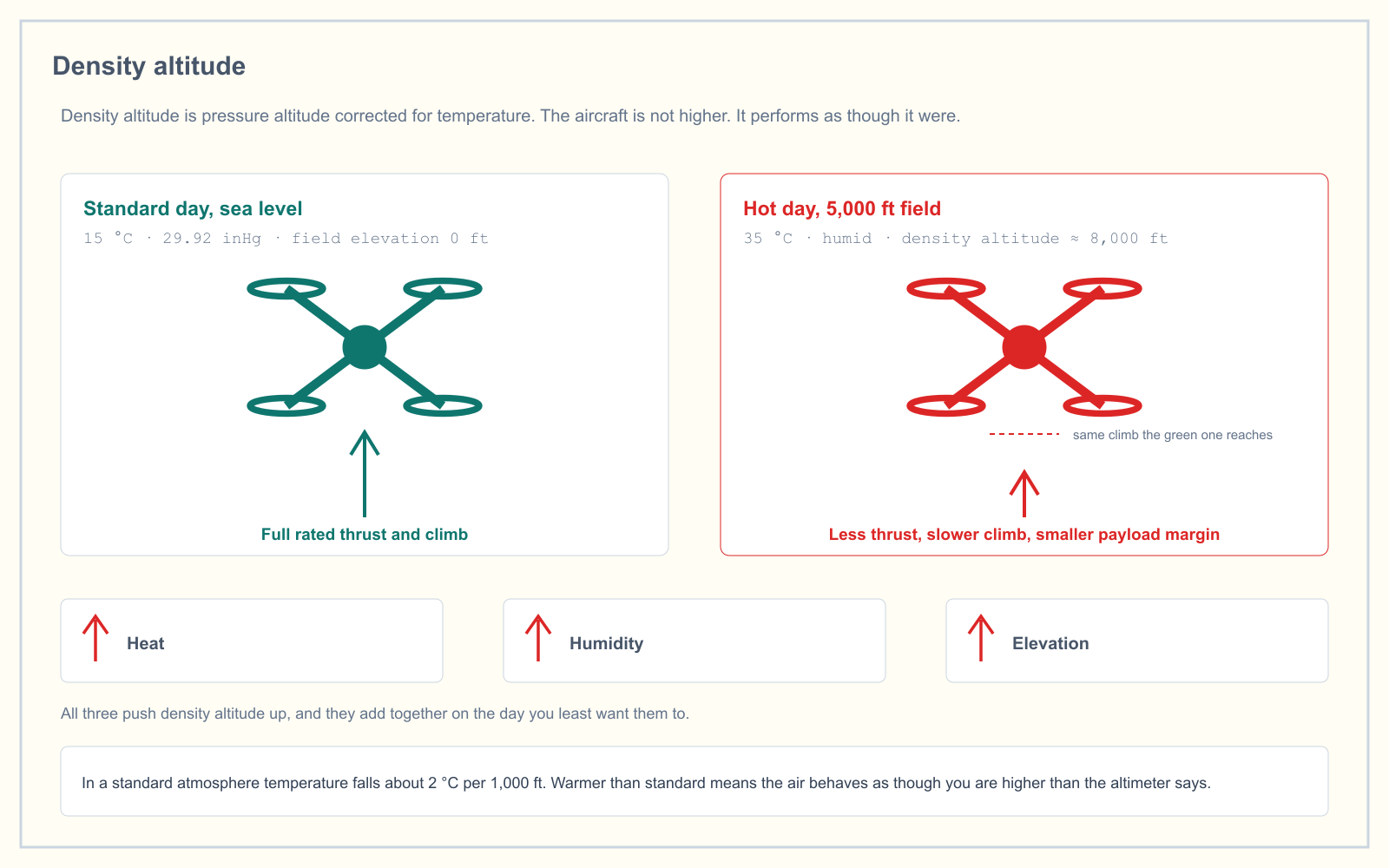
This links directly to density altitude. On a hot, high day the density altitude is far above the field elevation, and the gap between IAS and TAS widens with it. For a small drone below 400 feet AGL the practical effect on TAS is modest, but the same thin air is what saps thrust and battery life.
What is groundspeed?
Groundspeed is true airspeed with the wind added or subtracted. The aircraft moves through a mass of air, and that mass is itself moving over the earth.
- Headwind: groundspeed is lower than TAS.
- Tailwind: groundspeed is higher than TAS.
- Pure crosswind: groundspeed is roughly unchanged, but the aircraft drifts sideways unless corrected.
A simple example. Suppose a fixed-wing UAS flies at 55 knots TAS with a 40 knot wind directly behind it. Its groundspeed is about 95 knots. Its instrument would show a perfectly legal 55, and it would still exceed the limit.
Why does Part 107 limit groundspeed?
14 CFR 107.51(a) states that the small unmanned aircraft may not exceed a groundspeed of 87 knots (100 miles per hour). The rule is written in groundspeed because the concern is energy over the ground: how hard an aircraft hits something and how little time anyone nearby has to react.
An aircraft with 40 knots of tailwind has the same kinetic energy over the ground whether its airspeed indicator reads 10 or 60. Airspeed would be the wrong yardstick for that risk, so the rule uses the speed that actually matters on impact.
| Operating limit in 107.51 | Value |
|---|---|
| Maximum groundspeed | 87 knots (100 mph) |
| Maximum altitude | 400 feet above ground level, with the structure exception |
| Minimum flight visibility | 3 statute miles from the control station |
For the rest of the rule, see 14 CFR Part 107 explained and how high can a drone fly.
How does wind change groundspeed in practice?
Take a multirotor with a maximum airspeed in calm air of about 45 knots. That is well below the limit. Now put it in a 50 knot wind.
| Scenario | Airspeed | Wind | Approximate groundspeed |
|---|---|---|---|
| Calm, full speed | 45 kt | 0 | 45 kt |
| Flying into the wind | 45 kt | 20 kt headwind | 25 kt |
| Flying with the wind | 45 kt | 20 kt tailwind | 65 kt |
| Flying with a strong wind | 45 kt | 50 kt tailwind | 95 kt |
The last row exceeds 87 knots. Most pilots will never fly in 50 knots, and you probably should not be flying at all in that wind. The point for the exam is the principle: you can be legal by airspeed and illegal by groundspeed. To estimate the wind aloft, see how to read wind barbs, and for the sideways component see the crosswind component chart.
What this means when you are actually working
Most consumer drones do not carry a pitot tube. They report GPS groundspeed on the controller screen. That makes the Part 107 limit easy to watch in practice and the other airspeeds largely academic for multirotor work.
Still, groundspeed matters at the margins:
- Return-to-home with a tailwind. An aircraft hurrying home downwind can add a lot of groundspeed. Check the number, not the mode label.
- Battery planning. A headwind outbound means a tailwind home, but it also means the outbound leg drained more battery per mile covered. Plan the return from the worst leg.
- Fixed-wing and VTOL. These carry airspeed sensors and have a stall speed in airspeed terms. Stall and control follow airspeed. Legal limits follow groundspeed. You track both.
- Hot and high sites. Thin air raises TAS for the same IAS and costs thrust. See density altitude before a mountain job.
How does the exam ask about airspeed?
The test is built on the FAA's Remote Pilot study material, and airspeed shows up mainly through the regulation and the weather and performance knowledge areas. Expect the regulation to be tested directly.
- A question giving the maximum groundspeed and asking you to pick 87 knots or 100 mph.
- A question asking whether the limit applies to groundspeed or airspeed.
- A conceptual question about which airspeed is corrected for altitude and temperature.
The current UAG blueprint, effective 29 September 2025, puts Regulations at 48% of the test, which is why a one-line rule like 107.51(a) is worth knowing cold.
Frequently asked questions
What are the four types of airspeed?
The four are indicated airspeed, calibrated airspeed, true airspeed and groundspeed. Indicated is the raw instrument reading. Calibrated corrects for instrument and position error. True corrects for altitude and temperature. Groundspeed adds the wind to true airspeed and tells you how fast you cover the ground.
What is true airspeed?
True airspeed is the actual speed of the aircraft through the air around it. It is calibrated airspeed corrected for altitude and nonstandard temperature. Because thin air makes the indicator read low, true airspeed is higher than indicated airspeed at altitude, and it rises further when the air is hot.
Does Part 107 limit airspeed or groundspeed?
Part 107 limits groundspeed. Section 107.51(a) sets the maximum at 87 knots, which is 100 miles per hour. Because wind adds or subtracts from groundspeed, an aircraft with a strong tailwind can exceed the limit even when its airspeed is far below it.
How do you calculate groundspeed?
Add the tailwind component to true airspeed, or subtract the headwind component. A 40 knot true airspeed with a 15 knot headwind gives about 25 knots over the ground. A pure crosswind changes groundspeed very little, though it pushes the aircraft sideways.
Is 87 knots the same as 100 mph?
Yes, to the precision the rule uses. One knot is about 1.15 miles per hour, so 87 knots is about 100.1 miles per hour. Part 107 states both figures together as the same limit, and the exam accepts either form depending on the question.
Do drones have an airspeed indicator?
Most consumer multirotors do not. They display GPS groundspeed instead, which is the number the Part 107 limit is written in. Some fixed-wing and VTOL unmanned aircraft carry pitot-based airspeed sensors, and for those you need to keep indicated airspeed and groundspeed straight.
Check how well you know 107.51 and the other operating limits with the free Part 107 readiness assessment.
Sources
Put this guide into practice.
Take the free assessment to see how this topic fits into your current exam readiness.
Start free practice