Airspace
Class A Airspace Explained for Drone Pilots: 18,000 Feet MSL and Up, IFR Only, and Why a Part 107 Pilot Will Never Be There
Class A starts at 18,000 feet MSL, more than 17,000 feet above the highest altitude a drone may legally fly. Here is what it is, who uses it, and how the exam asks about it.
Key takeaway
Class A airspace starts at 18,000 feet MSL and extends up to and including FL600. Every flight in it is IFR under ATC control. A Part 107 drone is limited to 400 feet AGL, so you never operate there, but you still need to recognize it for the exam.
Class A airspace is the controlled airspace from 18,000 feet MSL up to and including FL600 (60,000 feet). Every aircraft in it must be on an IFR clearance and under ATC control, with VFR flight not permitted (14 CFR 91.135). A Part 107 drone is capped at 400 feet AGL, so it never gets close.
Class A is the one airspace class a drone pilot will never fly in and still has to know. The exam lists the classes together, and Class A is the top of the ladder that the others hang from. It is also the cleanest example of why altitude reference matters: its floor is measured from sea level, not from the ground you are standing on.
What is Class A airspace?
Class A is the most restrictive class of controlled airspace. 14 CFR 71.33 designates it over the 48 contiguous states and Alaska, extending upward from 18,000 feet MSL to and including flight level 600. The FAA's Aeronautical Information Manual describes it in the same terms and lists it as controlled airspace, alongside B, C, D and E.
Two words in that definition do the work. "Controlled" means ATC separates aircraft. "From 18,000 feet MSL" means the floor sits at a fixed height above sea level, so it is the same altitude on a coastal plain and on top of a mountain.
How high does Class A airspace go, and where does it start?
It starts at 18,000 feet MSL and ends at FL600. A flight level is a pressure altitude expressed in hundreds of feet, so FL180 is 18,000 feet on the standard 29.92 inches of mercury setting and FL600 is 60,000 feet. If pressure altitude is new to you, read pressure altitude.
| Boundary | Altitude | Reference |
|---|---|---|
| Floor of Class A | 18,000 feet MSL | Sea level |
| Ceiling of Class A | FL600 (60,000 feet), inclusive | Standard pressure altitude |
| Drone limit under Part 107 | 400 feet AGL (more only within 400 feet of a structure) | Ground level |
| Gap between the two | More than 17,000 feet | Not a close call |
The gap is the whole story for a drone pilot. The highest legal drone altitude is a few hundred feet above the ground, and the floor of Class A is almost three and a half miles above sea level. Even on top of a very high mountain, you are nowhere near it.
Below 18,000 feet MSL the airspace is Class E (or B, C, D or G near the surface). Class A simply replaces Class E from 18,000 feet upward. For the lower layers, see Class E airspace and Class G airspace.
Is VFR flight allowed in Class A airspace?
No. Under 14 CFR 91.135, each person operating an aircraft in Class A airspace must do so under instrument flight rules and in accordance with an ATC clearance. There is no visual-flight route into it, no matter how clear the day.
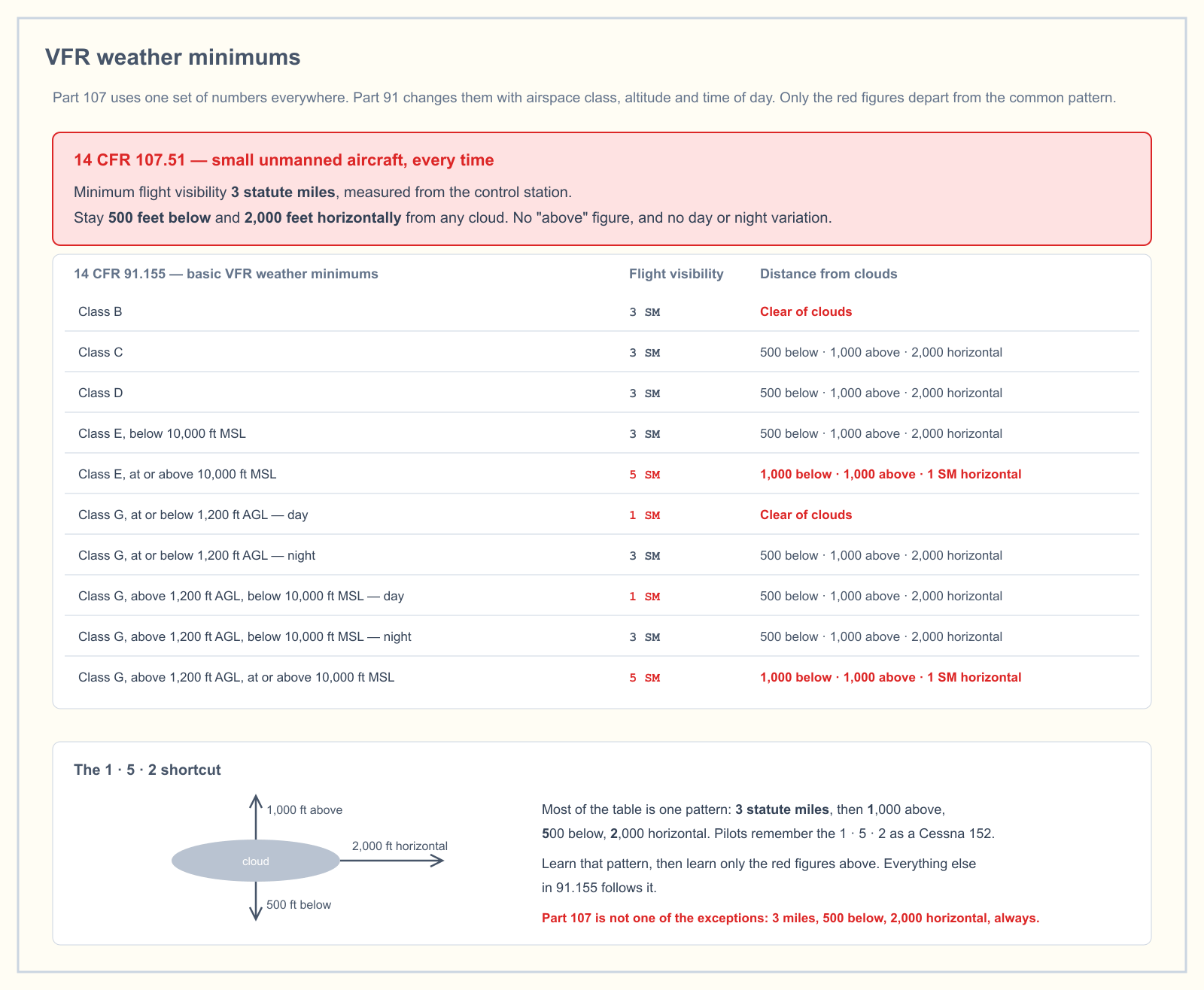
That is why it does not appear in the Part 91 VFR weather minimums table at all. There are no VFR minimums for Class A because there is no VFR in Class A. For the manned minimums in every other class, see VFR weather minimums.
What equipment and clearances does Class A require?
Aircraft in Class A need more than a clearance. The main requirements for manned flight are:
| Requirement | What it means | Source |
|---|---|---|
| IFR clearance | Operate under IFR and in accordance with an ATC clearance | 91.135 |
| Two-way radio | Maintain two-way radio communication with ATC | 91.135 |
| Altimeter setting | Set altimeters to 29.92 inches of mercury at and above 18,000 feet MSL | 14 CFR 91.121 |
| Transponder with altitude reporting | Required equipment in Class A | 14 CFR 91.215 |
The 29.92 setting is why Class A altitudes are stated as flight levels. Every aircraft is set to the same pressure reference, so the vertical spacing between them does not depend on local weather.
You do not need to memorize the equipment rules for the Part 107 exam. They are worth knowing because they explain what Class A is for: high-speed, high-altitude traffic that is fully controlled and fully equipped.
Can a drone pilot fly in Class A airspace?
Not in practice. Part 107 limits a small unmanned aircraft to 400 feet above ground level, or within 400 feet of a structure (14 CFR 107.51). The 400 feet is measured from the ground or the top of the structure, so you cannot climb into Class A by standing on something tall enough. No structure approaches 18,000 feet.
Compare the rule for the lower classes. 14 CFR 107.41 requires authorization in Class B, C and D airspace and within a Class E surface area. Class A is not on that list, and the reason is not that it is open. It is that a drone cannot be there. The classes where you need LAANC are covered in LAANC authorization.
The airspace mistakes drone pilots actually make happen near the ground, in Class B, C, D and E surface areas near airports, not five miles up.
How does Class A compare with the other airspace classes?
| Class | Typical floor | VFR allowed? | Drone authorization (107.41) |
|---|---|---|---|
| A | 18,000 feet MSL | No | Not applicable, out of reach |
| B | Surface (inner core) | Yes, with clearance | Required |
| C | Surface (inner core) | Yes, with two-way radio | Required |
| D | Surface | Yes, with two-way radio | Required |
| E | Surface, 700 or 1,200 feet AGL, or 14,500 feet MSL | Yes | Only inside a surface area |
| G | Surface | Yes | Never |
The pattern is a ladder. The classes that matter to a drone pilot are the ones that reach the ground. Class A is the one that starts far above it. For the other classes in detail, see Class B, Class C, Class D and the overview in FAA airspace classes explained.
Does Class A show on a sectional chart?
No. VFR sectional charts do not depict Class A airspace, because VFR aircraft are not permitted in it. The chart legend and the FAA's Aeronautical Chart User's Guide cover what is depicted. Class A is covered in the airspace section of the AIM instead.
This is a common exam trap in spirit: you will not find Class A by looking for a boundary on the chart. If a question describes Class A, it is testing the altitude definition (18,000 feet MSL) and the MSL reference, not chart reading. For the difference between the two altitude references, see MSL vs AGL.
What this means operationally
Class A rarely changes a drone mission, but three practical points follow from it.
- Altitude vocabulary. A pilot speaking in flight levels is above 18,000 feet. If you hear "flight level" on a frequency, that traffic is in Class A and far above you.
- Where the real risk lies. The aircraft that matter to you are in Class G and Class E near the surface, not in Class A. Low-altitude manned traffic is covered in non-towered airport operations.
- Altitude reference discipline. A Class A floor is MSL and your limit is AGL. On a high-elevation site, an MSL figure and an AGL figure can differ by thousands of feet, and mixing them is the mistake that fails exam questions and flight plans.
How the exam asks about Class A
I cannot point to FAA data on how often Class A appears on the test, so treat any claim about frequency with suspicion. The likely forms are the plain ones: a question that asks for the lower limit of Class A airspace, or one that asks which classes require authorization before a drone flies. Airspace carries 20% of the current blueprint, which took effect on 29 September 2025, and the FAA's Part 107 testing information describes the knowledge areas.
The answer to remember is 18,000 feet MSL. If a question offers 18,000 feet AGL, that is the distractor.
Frequently asked questions
Is there a Class A airspace?
Yes. Class A is the controlled airspace from 18,000 feet MSL up to and including FL600 over the 48 contiguous states and Alaska, designated under 14 CFR 71.33. It is the highest class of controlled airspace. Every flight in it operates under IFR and an ATC clearance.
What is the floor of Class A airspace?
The floor of Class A is 18,000 feet MSL. It is measured from sea level, not from the ground, so it is the same altitude regardless of terrain. At and above it, altimeters are set to 29.92 inches of mercury and altitudes are stated as flight levels, such as FL180.
Is VFR flight permitted in Class A airspace?
No. Under 14 CFR 91.135, all operations in Class A airspace must be conducted under instrument flight rules and in accordance with an ATC clearance. There are no VFR weather minimums for Class A because visual flight is not permitted there at all.
Can I fly a drone in Class A airspace?
Not under Part 107. A small unmanned aircraft is limited to 400 feet AGL, or within 400 feet of a structure, and Class A begins at 18,000 feet MSL. Class A is not listed in 14 CFR 107.41 because a drone operating within Part 107 cannot reach it.
How high does Class A airspace go?
Class A extends upward to and including FL600, which is 60,000 feet on the standard pressure setting. Above that ceiling the airspace is not designated as Class A. Most commercial jet traffic cruises within the range Class A covers.
Does Class A airspace appear on a sectional chart?
No. Sectional charts depict the airspace that VFR pilots use, and VFR flight is not permitted in Class A. You identify Class A by its definition, 18,000 feet MSL up to FL600, rather than by a boundary line on the chart.
Test yourself on every airspace class with the free Part 107 assessment.
Sources
- 14 CFR 71.33, Class A airspace (eCFR)
- 14 CFR 91.135, Operations in Class A airspace (eCFR)
- 14 CFR 91.121, Altimeter settings (eCFR)
- 14 CFR 91.215, ATC transponder and altitude reporting equipment (eCFR)
- 14 CFR 107.41, Operation in certain airspace (eCFR)
- 14 CFR 107.51, Operating limitations for small unmanned aircraft (eCFR)
- FAA Aeronautical Information Manual, Chapter 3, Section 2: Controlled Airspace
- FAA Aeronautical Chart User's Guide
- FAA: Become a drone pilot
Put this guide into practice.
Take the free assessment to see how this topic fits into your current exam readiness.
Start free practice