Flight Operations
ATC Light Gun Signals: What Each Color Means, in the Air and on the Ground
Six signals, three meanings each, and one column written for people standing on the airport rather than flying over it. Here is the full chart and what it means for a drone crew.
Key takeaway
Green is permission, red is prohibition. Steady means act now, flashing means act somewhere else. Alternating red and green is the only signal that means the same thing to everyone: extreme caution.
ATC light gun signals are colored beams a control tower aims at an aircraft or a person who has no working radio. 14 CFR 91.125 defines six: steady green, flashing green, steady red, flashing red, flashing white, and alternating red and green. Each carries a different meaning depending on whether you are in flight or on the surface.
Every guide to this subject is written for a pilot in a cockpit with a dead radio. That is the rarer case. The FAA's own table has a third column that almost nobody teaches, covering vehicles, equipment and personnel on the movement area, and that is the column a drone crew is most likely to find itself standing in.
What is a light gun, and why does one still exist?
A light gun is a handheld signal lamp in the tower cab with a focused beam and a color filter. A controller points it at a specific target and the beam is narrow enough that only that target sees it clearly. It is 1930s technology that survived because it needs nothing from the aircraft: no transponder, no radio, no electrical system, no agreement about frequency.
That is the whole design case. Radios fail, batteries die, and the tower still needs a way to say stop. A light gun works when everything else does not, which is why the regulation has never been withdrawn and why controllers still train on it.
The light gun signal chart
Two documents carry this table and they are not identical. 14 CFR 91.125 is the regulation, and it gives two columns: aircraft in flight and aircraft on the surface. The Aeronautical Information Manual reproduces the same six signals in AIM Table 4-3-1 and adds a third column for ground vehicles, equipment and personnel not equipped with radio.
Here is the full set, all three columns together:
| Signal | Vehicles, equipment, personnel | Aircraft on the surface | Aircraft in flight |
|---|---|---|---|
| Steady green | Cleared to cross, proceed or go | Cleared for takeoff | Cleared to land |
| Flashing green | Not applicable | Cleared to taxi | Return for landing, to be followed by a steady green at the proper time |
| Steady red | STOP | STOP | Give way to other aircraft and continue circling |
| Flashing red | Clear the taxiway or runway | Taxi clear of the runway in use | Airport unsafe, do not land |
| Flashing white | Return to starting point on airport | Return to starting point on airport | Not applicable |
| Alternating red and green | Exercise extreme caution | Exercise extreme caution | Exercise extreme caution |
Two structural facts fall straight out of the table. Flashing white has no in-flight meaning at all — it is a surface-only signal, which makes sense, because "return to your starting point on the airport" is meaningless to something already airborne. And alternating red and green is the only signal that says the same thing in all three columns. It is a general warning, not an instruction. It tells you something is wrong; it does not tell you what to do about it.
What each signal means to an aircraft in flight
The in-flight column reads as a sequence rather than a list, because a no-radio arrival is a sequence. The aircraft joins the pattern, watches the tower, and gets sorted into the flow one signal at a time.
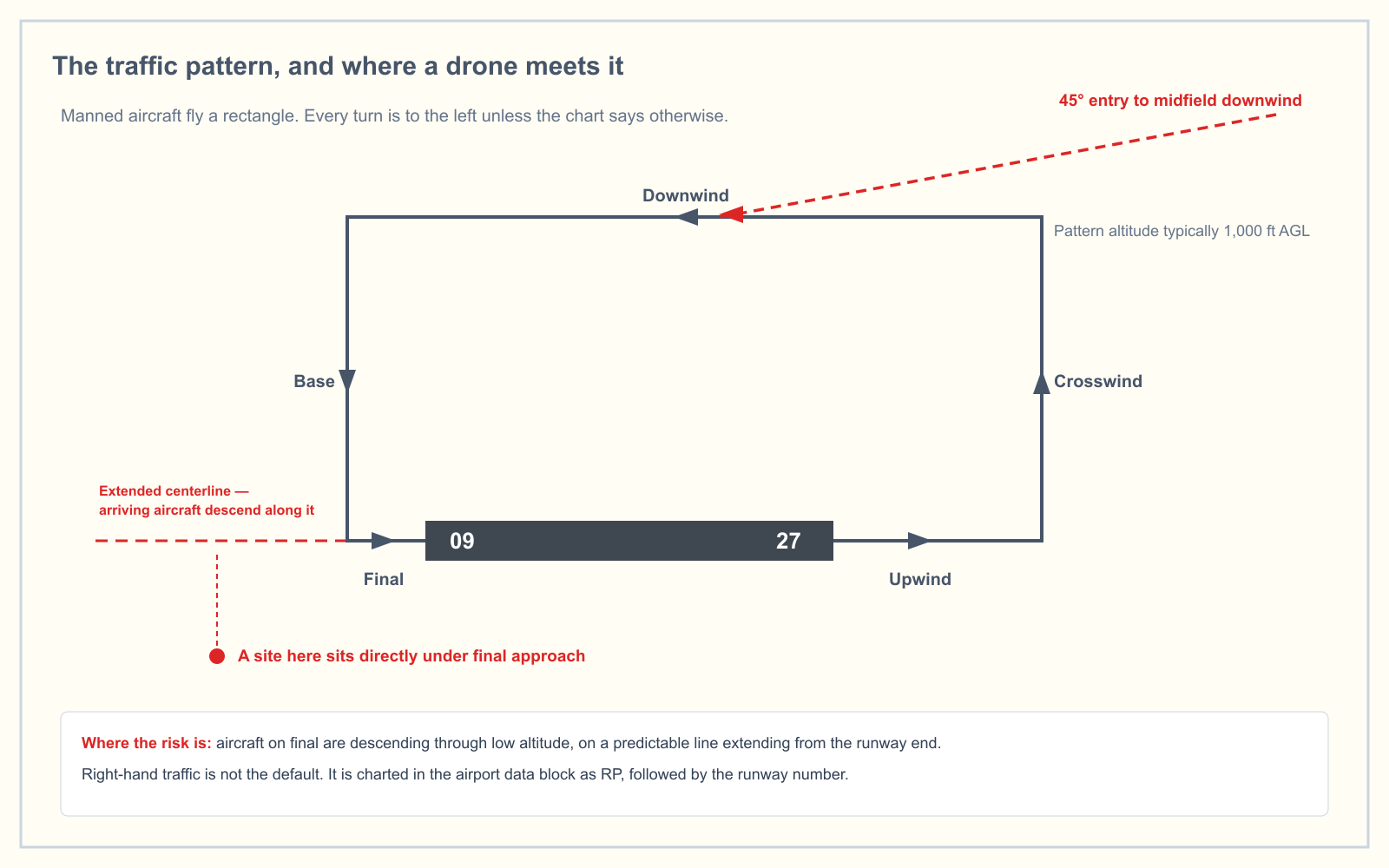
A steady red does not mean stop, because an airplane cannot stop. It means give way and keep circling — hold your place in the pattern until the tower has room for you. A flashing green is a summons rather than a clearance: return for landing, and expect a steady green later when it is actually your turn. A flashing red is the serious one. The airport is unsafe and you are not landing there, which means diverting.
Under AIM 4-2-13, a pilot with no radio at all is expected to stay outside or above Class D until they have worked out the direction of traffic flow, then join the pattern, maintain visual contact with the tower, and take their instructions off the light.
The column written for people on the ground
The vehicles, equipment and personnel column is the one that matters if you are a remote pilot working on airport property, and it is not a hypothetical situation. Pavement inspections, obstruction surveys, perimeter fence and wildlife work all put drone crews inside the movement area at towered fields, usually under an escort and a ground vehicle briefing.
The meanings simplify considerably in that column. Steady green means proceed. Steady red means stop where you are. Flashing red means get off the taxiway or runway. Flashing white means go back where you came from. Flashing green has no meaning for you at all, because "cleared to taxi" is an aircraft instruction.
Three things are worth being clear about, because prep sites blur them.
The signals are aimed at you, not at your drone. A tower cannot control an unmanned aircraft with a light gun. The aircraft has no eyes and the remote pilot is looking at the aircraft, not at the tower cab. Authorization for the flight itself comes through 14 CFR 107.41, which requires prior ATC authorization before operating in Class B, C or D airspace or in the surface area of Class E designated for an airport. In practice that is a LAANC authorization or a FAADroneZone request, not a light.
A light gun signal does not replace that authorization. A steady green pointed at your truck clears the truck across a taxiway. It does not clear a flight.
Radio is the primary method, and light is the fallback. If you are escorted onto a movement area you will normally be on a ground frequency. The light gun is what the tower reaches for when that fails.
How to remember the table
Do not memorize eighteen cells. Memorize two rules and three exceptions.
Green is permission, red is prohibition. Steady means act now, flashing means act somewhere else.
Test it. Steady green: do the main thing, now — land, take off, cross. Flashing green: the action happens elsewhere or later — come back and land, or start taxiing toward the runway. Steady red: stop, or if you cannot stop, hold in the pattern. Flashing red: move away from where you are — off the runway, or away from the airport entirely.
Then the three exceptions:
- Flashing white is surface only. No in-flight meaning.
- Flashing green is aircraft only. No meaning for vehicles or people.
- Alternating red and green is universal. Same warning to everybody, and it is a warning, not an instruction.
How do you acknowledge a light gun signal?
The tower is watching for a response, and the method depends on where you are and what time it is. From AIM 4-2-13:
| Situation | Daylight | Night |
|---|---|---|
| Aircraft in flight | Rock your wings | Blink the landing or navigation lights |
| Aircraft on the ground | Move the ailerons or rudder | Blink the landing or navigation lights |
| Helicopter, hovering | Turn toward the facility and flash the landing light | Flash the landing or search light |
A hovering helicopter turns to face the controlling facility before flashing, which is a nice detail: it is the rotorcraft equivalent of making eye contact. There is no published acknowledgment for a person on foot, for the obvious reason that the controller can see whether you stopped.
What this means when you are actually working
For most Part 107 work, the honest answer is that you will never receive a light gun signal, because you will be operating from a field a mile off the airport with a LAANC approval on your phone. The table earns its place for two narrower reasons.
The first is airport-property work. If your job takes you inside the fence at a towered field, you are a vehicle or a person under that third column, and the tower can control you with light. Knowing that steady red means stop before someone has to explain it to you afterward is the entire value.
The second is situational awareness. If you are set up near a towered airport and you see the tower working a light gun at an aircraft in the pattern, you have learned something useful about what is going on around you: there is an aircraft up there with no radio, flying a pattern nobody can talk to, and it may not be where you would expect. That is a good moment to bring your aircraft down.
Neither of these overrides 14 CFR 107.43, which says you may not operate in a manner that interferes with operations and traffic patterns at any airport. A light gun in use is direct evidence that operations are happening.
Where this sits on the exam
Airport lighting and manned-aircraft traffic patterns are both named knowledge areas in the Remote Pilot Airman Certification Standards, and light signals are the tower's half of that same subject. Operations is 25 percent of the Unmanned Aircraft General knowledge test under the blueprint effective 29 September 2025, alongside Regulations at 48 percent, Airspace at 20 percent, Weather at 5 percent, and Loading and Performance at 2 percent.
The signal table rewards recognition rather than recall. A question gives you a color and a state and asks what it means. The failure mode is reading the wrong column — answering "cleared for takeoff" for an aircraft in flight, or "stop" for one that is airborne. Fix the column first, then the color.
It pairs naturally with the airport beacon colors, which is the other light-based question on the same material, and with operations at non-towered fields, where there is no tower and therefore no light gun at all.
Frequently asked questions
What does a flashing white light gun signal mean?
Flashing white means return to your starting point on the airport. It is directed at an aircraft on the surface, or at a vehicle or person on the movement area. It has no in-flight meaning at all, and 14 CFR 91.125 lists it as not applicable for aircraft in flight, because the instruction makes no sense to something already airborne.
How do you acknowledge a light gun signal?
In flight during daylight, rock your wings. At night, blink the landing or navigation lights. On the ground during daylight, move the ailerons or rudder; at night, blink the lights again. A hovering helicopter turns toward the controlling facility and flashes its landing light by day, or the landing or search light by night.
Are light gun signals still used today?
Yes. Controllers are trained on them and towers keep a light gun in the cab. They are rare because radio failures are rare, but they remain the only method of control that requires nothing from the aircraft. The regulation at 14 CFR 91.125 is current, and the same table appears in the Aeronautical Information Manual.
Do drone pilots need to know light gun signals?
You need them if your work takes you onto airport property at a towered field, because the AIM table covers vehicles, equipment and personnel and the tower can direct you with light. They also help you interpret what you are seeing near a towered airport. They do not authorize a flight; that comes from ATC authorization under 14 CFR 107.41.
What does alternating red and green mean?
Exercise extreme caution. It is the only signal that means the same thing in all three columns, and it is a general warning rather than an instruction. It tells you something is wrong without telling you what to do about it, so the correct response is to slow down, look around, and be ready for a follow-up signal.
Can a control tower use a light gun on a drone?
No, and not for a regulatory reason so much as a practical one. An unmanned aircraft has no one aboard to see the beam, and the remote pilot is watching the aircraft rather than the tower. Control of a drone flight in that airspace runs through the ATC authorization required by 14 CFR 107.41 instead.
Airport operations questions are the ones candidates most often lose points on for reading the wrong column. You can find out where you actually stand with the free Part 107 readiness assessment.
Sources
- 14 CFR 91.125 — ATC light signals
- 14 CFR 107.41 — Operation in certain airspace
- 14 CFR 107.43 — Operation in the vicinity of airports
- AIM Chapter 4 Section 3 — Airport Operations, including Table 4-3-1 Traffic Control Light Signals
- AIM Chapter 4 Section 2 — Radio Communications Phraseology and Techniques, including 4-2-13 Radio Inoperative
- FAA Airman Certification Standards
Put this guide into practice.
Take the free assessment to see how this topic fits into your current exam readiness.
Start free practice