Weather
Can You Fly a Drone in the Rain? What Part 107 Says About Weather, Visibility and Airworthiness
No rule says 'no rain', yet rain can still make a flight illegal. Here is how visibility, airworthiness and your preflight assessment decide it.
Key takeaway
Part 107 has no rain ban. Rain makes a flight illegal only when it drops visibility below 3 statute miles, hides the aircraft from sight, or leaves the drone not in a condition for safe operation.
Yes, you can legally fly a drone in the rain under Part 107, because no section bans precipitation. But you still need 3 statute miles of flight visibility (14 CFR 107.51), you must keep the aircraft in visual line of sight (107.31), and the drone must be in a condition for safe operation (107.15). Rain often breaks one of those three.
The question trips people up because it mixes a legal question with an equipment question. The regulation says nothing about water. The manufacturer's manual says a great deal about it. A flight can be perfectly legal and still destroy a drone, and a flight can be a regulatory violation in a drizzle that your aircraft handles without trouble.
Does Part 107 prohibit flying in the rain?
No. Part 107 does not mention rain, drizzle, snow or fog as a prohibition. What it does is set weather minimums and require you to make a judgment before every flight. Precipitation is just one of the things that can push you below those minimums.
Three sections do the work:
| Section | What it requires | How rain gets involved |
|---|---|---|
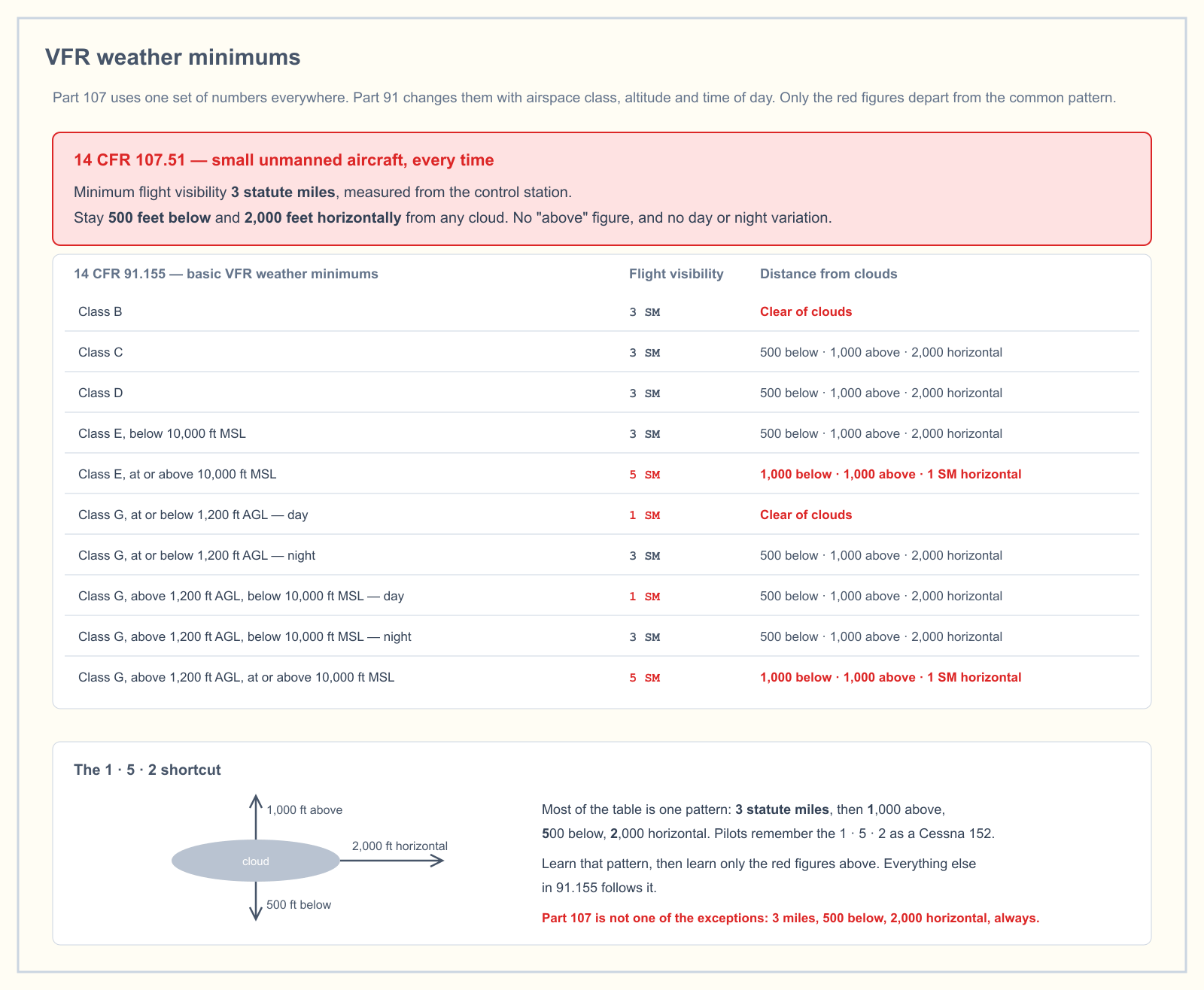
| 107.51(b) | 3 statute miles of flight visibility, 500 feet below and 2,000 feet horizontally from clouds | Heavy rain cuts visibility; rain usually comes from low cloud |
| 107.31 | Aircraft kept within visual line of sight of the remote pilot or visual observer | Rain on glasses, haze and low contrast make a small aircraft hard to see |
| 107.15 | Aircraft must be in a condition for safe operation, checked before each flight | Water ingress can damage motors, batteries and electronics |
| 107.49(a) | Assess the operating environment, including local weather conditions | You are required to look at the weather and think before launch |
How does rain affect the 3-mile visibility requirement?
Section 107.51(b) requires a minimum flight visibility, observed from the control station, of no less than 3 statute miles. Light rain on its own often leaves visibility well above that. Moderate to heavy rain, and especially rain combined with mist or low cloud, frequently does not.
You are the measuring instrument here. If you cannot identify prominent unlighted objects at about 3 miles, you do not have the visibility, whatever the aircraft's camera shows. The METAR from the nearest reporting station gives a good starting number, but the figure that counts is what you can see from where you are standing. For the full set of figures and how they differ from manned aircraft rules, see our guide to VFR weather minimums.
Can you still keep the drone in visual line of sight?
This is the one that catches pilots in light rain. Section 107.31 requires that the remote pilot or visual observer be able to see the aircraft with unaided vision, other than corrective lenses, well enough to know its position and attitude and to see the surrounding airspace for traffic and hazards.
Rain makes that harder in practical ways. Droplets on prescription glasses blur a small dark aircraft against a grey sky. Low contrast makes it hard to read orientation. Looking at a screen to compensate does not count: the rule is about your eyes, not the video feed. If you lose sight of the aircraft, the flight is no longer compliant, even if the video link is perfect.
What does "condition for safe operation" mean for a wet drone?
Section 107.15(a) says no person may operate a small unmanned aircraft unless it is in a condition for safe operation, and the remote pilot in command must check this before each flight. If you know, or have reason to know, that the aircraft is not in a safe condition, you must stop (107.15(b)).
Rain is where this rule bites hardest, and it is also where the regulation gives you no figures. Most consumer and many professional drones are not sealed against water. Water that reaches motors, the battery compartment or the flight controller can cause shorts, corrosion and sudden power loss, and the damage may not show until a later flight. If the manufacturer's manual says the aircraft is not water resistant, you have been told it is not designed for rain. Flying it anyway and having it fail is hard to defend as operating in a condition for safe operation.
Are any drones actually rated for rain?
Some are, and the difference is documented rather than assumed. Manufacturers that design for wet weather publish an ingress protection (IP) rating or a plain statement of what the aircraft tolerates, and typically describe limits on rain intensity, wind and temperature. Many drones carry no rating at all. Treat the manual as the authority for your aircraft and do not infer water resistance from a brand name, a price or a coating.
Two cautions apply even to rated aircraft. First, a rating generally describes the airframe in specific lab conditions, not the batteries, controller, charging ports or the remote and phone you are holding. Second, rain can come with wind, cold and low cloud, and those limits are separate.
What other weather comes with rain?
Rain rarely arrives alone, and the accompanying conditions are often the real reason to cancel.
- Wind and gusts. Fronts and showers bring turbulence and gust spreads. Check the METAR and TAF; see how to read a TAF.
- Low cloud and reduced ceilings. Stratus and rain-fed cloud can sit under 400 feet AGL and violate the 500 foot below-cloud requirement.
- Thunderstorms and lightning. A storm is an automatic no-go. See our guide to microbursts and thunderstorm stages.
- Cold temperatures. Freezing rain and structural icing are covered in aircraft icing.
- Reduced contrast and glare. Wet surfaces and overcast skies complicate seeing the aircraft and judging distance.
What does this mean when you are actually working?
In practice, treat rain as a go/no-go factor you document, not a yes/no legal question. A working remote pilot should:
- Check the forecast and current observations before leaving, and again at the site (107.49(a) requires you to assess local weather).
- Read your aircraft's manual for its stated water limits, and hold to them.
- Confirm you can see the aircraft clearly at the farthest point of the planned flight, with or without a visual observer.
- Inspect for moisture before each flight and after landing: battery bay, motor vents, gimbal and connectors.
- Set a hard abort rule. If visibility drops, rain intensifies or you lose sight of the aircraft, land.
- Log the decision. Insurers and clients care that you made the call deliberately.
Commercial clients are also affected. A job rained out because the aircraft is not rated is a scheduling problem. A job flown in rain that damages the client's property or injures someone is an accident-reporting and liability problem. Part 107 accident reporting is covered in our guide to waivers and reporting.
How does the Part 107 exam ask about rain?
The exam seldom asks "can you fly in rain." It asks about the pieces: the 3 statute mile visibility requirement, the cloud clearance figures, what the remote pilot must assess during preflight, and when an operation must be discontinued. Weather carries about 5% of the current UAG test blueprint, so questions are few, but the same preflight and airworthiness material also lives inside the much larger Regulations and Operations areas. Practice the wording in our free readiness assessment.
Frequently asked questions
Is it illegal to fly a drone in the rain?
Not by itself. Part 107 has no rain prohibition. It is illegal if the rain reduces flight visibility below 3 statute miles, you lose visual line of sight, or the aircraft is not in a condition for safe operation. Those are the rules that apply, not a ban on precipitation.
Can a DJI drone fly in the rain?
It depends on the model, and the manual decides. Many consumer drones are not water resistant, and manufacturers generally advise against flying in rain unless the specific aircraft is documented as rated for it. Check the published specifications for your exact model and treat anything unrated as unsuitable for wet weather.
Is light rain okay for a drone?
Legally it can be, if you keep 3 statute miles of visibility and visual line of sight. Mechanically it depends on the drone. Light rain can still let water into vents and connectors on an unrated aircraft, so a legal flight can still be a damaging one.
What weather conditions should a drone pilot avoid?
Avoid thunderstorms, icing conditions, winds beyond the aircraft's limits, and anything below the 107.51 minimums, meaning less than 3 miles of visibility or closer than 500 feet below or 2,000 feet horizontally from a cloud. Fog, heavy rain and snow often cross those lines.
Does Part 107 require me to check the weather?
Yes. Section 107.49(a) requires the remote pilot in command to assess the operating environment before flight, and that assessment must include local weather conditions, local airspace and restrictions, persons and property on the surface, and other ground hazards. A documented check is good practice.
What should I do if rain starts mid-flight?
Land. Once rain begins, visibility and your view of the aircraft can deteriorate quickly, and you are responsible under 107.19 for ensuring the operation does not pose an undue hazard. Bring the aircraft home, power down, and dry and inspect it before another flight.
Want to test yourself on weather minimums and preflight duties? Try the free Part 107 readiness assessment.
Sources
- 14 CFR 107.51 — Operating limitations for small unmanned aircraft
- 14 CFR 107.31 — Visual line of sight aircraft operation
- 14 CFR 107.15 — Condition for safe operation
- 14 CFR 107.49 — Preflight familiarization, inspection, and actions for aircraft operation
- 14 CFR 107.19 — Remote pilot in command
- FAA Remote Pilot Airman Certification Standards
Put this guide into practice.
Take the free assessment to see how this topic fits into your current exam readiness.
Start free practice