Weather
Aircraft Icing Explained: Structural Icing, Rime vs Clear Ice, and What Freezing Weather Does to a Drone
Structural icing needs two things: visible moisture and a surface at or below freezing. Here is how rime, clear and mixed ice differ, and why a drone's small propellers are especially exposed.
Key takeaway
Structural icing needs visible moisture plus a surface at or below 0 °C. Stable air and small droplets give rime ice; unstable air and large droplets give clear ice, which is heavier and harder to shed.
Aircraft icing is ice that builds up on an aircraft's surfaces or inside its engine. Structural icing needs two conditions together: visible moisture, such as cloud, fog or rain, and an aircraft surface at 0 °C or colder where the water strikes it. Ice adds weight, destroys lift, increases drag and, on a propeller, cuts thrust.
Most people picture icing as an airliner problem that happens at 20,000 feet. It is not. Icing happens wherever supercooled water meets a cold surface, which includes a fog bank at 200 feet AGL on a November morning. A multirotor has small, fast-turning propellers, which makes it one of the more ice-sensitive aircraft in the sky, not one of the least.
What two conditions are necessary for structural icing?
The FAA's weather guidance in AC 00-6A is blunt about it. Two conditions must both be present:
- The aircraft must be flying through visible water, such as rain or cloud droplets.
- The temperature at the point where the moisture strikes the aircraft must be 0 °C or colder.
Take away either one and structural ice does not form. Clear, dry air at −15 °C will not ice your propellers. Rain at +5 °C will not ice them either, unless the airframe itself has been cold-soaked below freezing.
This is the single most testable fact in the whole topic. The knowledge test phrases it as "one in-flight condition necessary for structural icing to form is," and the answer is visible moisture. The distractors are usually small temperature-dew point spreads or stratiform clouds, which are associated with icing but are not the necessary condition.
Why can water be liquid below freezing?
Water does not freeze the moment it drops below 0 °C. Small, clean droplets in a cloud can stay liquid well below freezing because they have nothing to freeze onto. That water is supercooled, and it is unstable. The instant it hits something, such as a wing, a propeller blade or a camera gimbal, it freezes.
Supercooled droplets are why icing is a cloud and fog problem rather than a cold-air problem. The water is already there, waiting for a surface.
Rime ice vs clear ice vs mixed ice
The type of ice depends mostly on droplet size and how quickly each droplet freezes.
| Rime ice | Clear ice | Mixed ice | |
|---|---|---|---|
| Droplet size | Small | Large | A mix of both |
| How it freezes | Instantly on contact, trapping air | Slowly, flowing back before it sets | Some of each |
| Appearance | Rough, milky, opaque white | Glossy, clear or translucent | Rough and cloudy, often with lumps |
| Weight and strength | Lighter, brittle, easier to remove | Dense, hard, heavy, difficult to break off | Has the bad qualities of both |
| Typical cloud | Stratiform, stable air | Cumuliform, unstable air, freezing rain | Varies |
| Typical temperature | Colder, roughly −10 °C to −20 °C | Warmer, roughly 0 °C to −10 °C | Across the range |
Rime ice forms when small droplets freeze on impact. Because each droplet freezes where it lands, air is trapped between them, which is what gives rime its white color. It builds forward into the airflow and makes a rough leading edge. It is the ice you are most likely to meet in a layer of stratus or fog.
Clear ice forms when large droplets hit the surface and do not freeze immediately. The water spreads back over the surface before it sets, forming a smooth, dense sheet. AC 91-51A describes clear ice as forming mostly between 0 °C and −10 °C. It is the more dangerous of the two: heavier, harder to see and much harder to shed.
Mixed ice is both at once, and it forms quickly when droplet sizes vary, as they do in a cloud carrying snow or ice crystals along with liquid water.
Why does stable or unstable air decide the ice type?
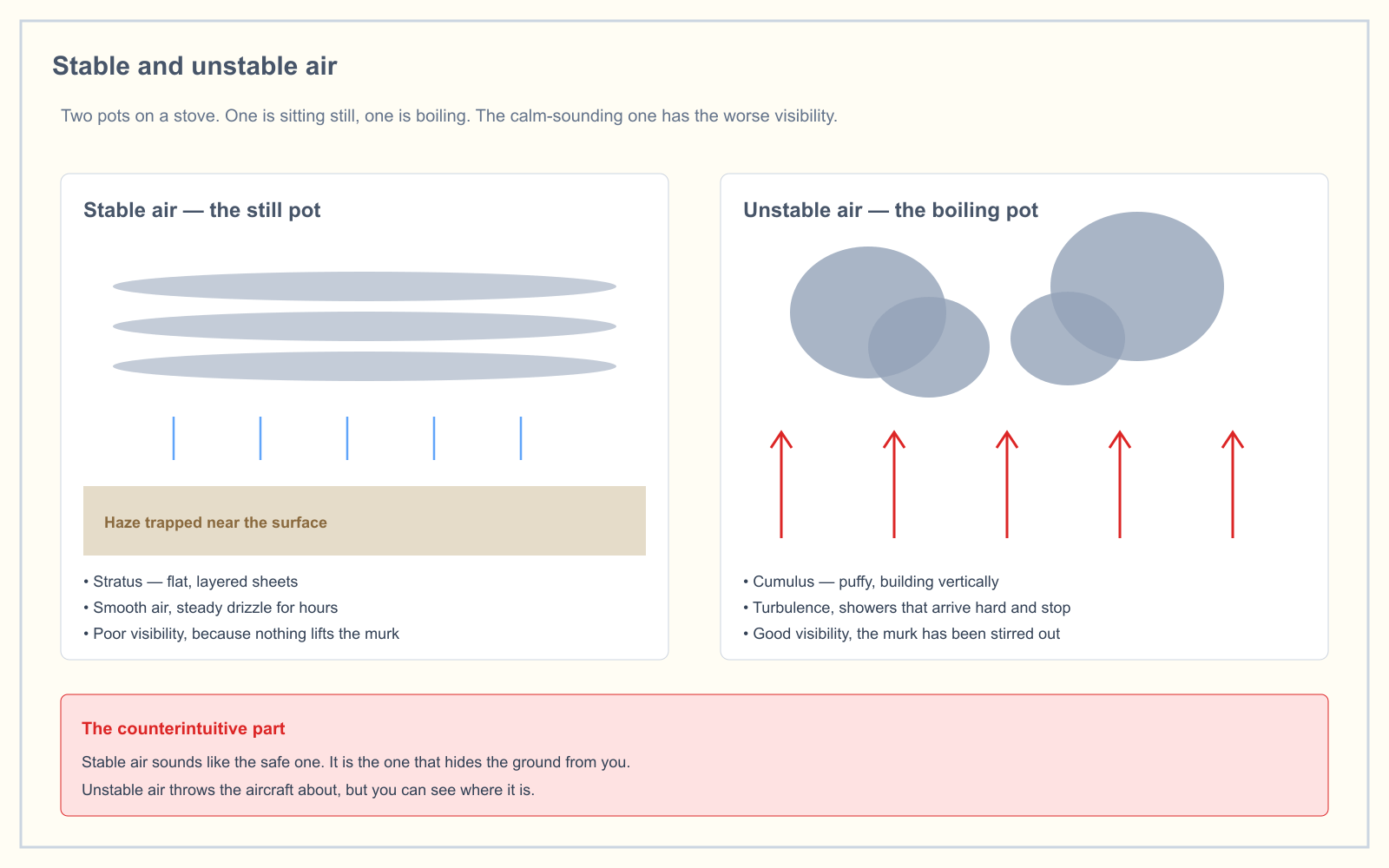
This is where icing connects to the rest of the weather section. Stable air produces flat stratiform clouds with gentle lifting and small droplets, so it tends to produce rime. Unstable air produces cumuliform clouds with strong updrafts that carry large droplets, so it tends to produce clear ice.
The trade-off is extent. A stratus layer can produce light rime over a very large area. A cumulus cloud produces heavier clear ice, but in a smaller area. If you know the cloud, you can predict the ice, which is why the exam groups cloud types and icing together.
What is freezing rain, and why is it the worst case?
Freezing rain forms when snow falls into a warm layer aloft, melts into rain, then falls into a layer of below-freezing air near the ground. The drops become supercooled and freeze on contact with anything they hit. Because the drops are large, the result is clear ice, and it builds fast.
Freezing rain tells you something about the air above you: there is warmer air at a higher altitude. That is a temperature inversion. Ice pellets at the surface carry the same message, because they are raindrops that refroze on the way down, so freezing rain is likely somewhere above.
In a METAR, freezing rain appears as FZRA, freezing drizzle as FZDZ and freezing fog as FZFG. Ice pellets are PL. Any of them at your launch site means a no-go for a drone. The groups are decoded in how to read a METAR.
What is induction icing?
Induction icing is ice in the engine's air intake, most famously carburetor ice in piston engines. It can form in clear air well above freezing, because the air cools as it speeds up through the carburetor venturi and as the fuel evaporates.
For a battery-powered multirotor this is largely irrelevant, since there is no carburetor and no air intake to block. It still appears in the FAA's material and can show up on the exam as a definition. Know that structural icing is on the outside of the airframe and induction icing is on the inside of the engine.
What does icing do to a drone?
The FAA's icing guidance in AC 91-74B lists the effects on any aircraft: ice reduces lift, increases drag and adds weight. On a fixed-wing airplane that means a higher stall speed and a lower climb rate. On a multirotor, every one of those effects lands on the propellers, which are your wings.
Small surfaces with sharp leading edges collect ice more efficiently than large, blunt ones. A drone propeller is about as small and sharp as aircraft surfaces get, and it is spinning, so it sweeps through far more air, and far more droplets, than the airframe does. The ice it collects is rarely even, either. Uneven ice on a blade puts it out of balance, which shows up first as vibration and then as a motor working much harder than normal.
What you will typically see, in order:
- Higher throttle in a hover as the props lose efficiency and the motors spin faster to compensate
- Faster battery drain, which is already reduced by the cold
- Vibration, from ice shedding unevenly from one blade and not another
- Degraded sensors, such as frosted camera lenses, iced obstacle-avoidance sensors and a clogged gimbal
Cold makes all of it worse, because lithium batteries deliver less capacity when they are cold. Your aircraft has less power available at exactly the moment ice is demanding more.
What this means operationally
Part 107 has no specific icing rule. It does not need one. 14 CFR 107.15 prohibits operating a small unmanned aircraft unless it is in a condition for safe operation, and requires the remote pilot in command to check that before each flight. 14 CFR 107.49 requires you to assess the operating environment, including local weather conditions. Flying into icing conditions fails both.
In practice, apply the two-condition rule directly:
- Below freezing and visible moisture? Do not fly. That covers fog, mist, low stratus, drizzle and any freezing precipitation.
- Below freezing and dry? Icing is unlikely, but watch the temperature-dew point spread. When it is within a couple of degrees, fog and freezing fog can form fast.
- Frost on the aircraft? Remove it before flight. Frost does not need cloud to form; it deposits directly onto a cold-soaked surface overnight, and a frosted propeller is a rough propeller.
- Check the forecast products. AIRMET Zulu covers moderate icing and freezing levels, and a SIGMET covers severe icing, as explained in AIRMET vs SIGMET. Pilot reports also describe icing by type (rime, clear or mixed) and intensity (trace, light, moderate or severe), covered in how to read a PIREP.
Keep the drone in its case until launch, keep batteries warm, and land at the first sign of rising hover throttle. The weather that ices a drone usually also fails the 3-statute-mile visibility minimum in 14 CFR 107.51, so it is often a no-fly day on two counts.
How the exam asks about icing
Weather is 5 percent of the Unmanned Aircraft General knowledge test under the blueprint effective 29 September 2025, and icing is a small slice of that. The questions are predictable, though, which makes them cheap marks:
- The necessary condition for structural icing: visible moisture
- What freezing rain at the surface indicates: warmer air at a higher altitude
- What ice pellets indicate: freezing rain at a higher altitude
- Which ice forms in stratiform clouds (rime) and which in cumuliform clouds (clear)
The FAA Aviation Weather Handbook is the source the questions are drawn from.
Frequently asked questions
What is one in-flight condition necessary for structural icing to form?
Visible moisture. Structural icing needs the aircraft to be flying through visible water, such as cloud, fog, rain or drizzle, and the surface where the water strikes must be at 0 °C or colder. Without visible moisture, cold air alone will not form structural ice on an airframe or propeller.
What are the different types of structural icing?
There are three: rime, clear and mixed. Rime ice is rough, white and brittle, forming from small droplets that freeze instantly. Clear ice is glossy, dense and heavy, forming from large droplets that spread before freezing. Mixed ice combines both and has the worst qualities of each, forming quickly in clouds with varied droplet sizes.
Which is more dangerous, rime ice or clear ice?
Clear ice is generally more dangerous. It is denser and heavier than rime, it is harder to see because it is transparent, and it is much harder to break off. Rime ice is brittle and easier to remove, but its rough shape still disrupts airflow and reduces lift, so neither is acceptable on a propeller.
What does freezing rain indicate?
Freezing rain indicates warmer air at a higher altitude. Snow melts into rain in a warm layer aloft, then falls into below-freezing air near the ground and becomes supercooled. It freezes on contact as clear ice. Ice pellets at the surface indicate the same structure, with freezing rain likely somewhere above.
Can a drone fly in icing conditions?
Consumer and most commercial drones are not certified or equipped for icing, and flying into visible moisture below freezing risks ice on the propellers within minutes. Under 14 CFR 107.15 the aircraft must be in a condition for safe operation, so a remote pilot should treat freezing fog, drizzle or low cloud as a no-go.
What is the difference between structural icing and induction icing?
Structural icing forms on the outside of the aircraft, on wings, propellers and sensors, and needs visible moisture at or below freezing. Induction icing forms in an engine's air intake or carburetor and can occur in clear air above freezing. Battery-powered multirotors have no carburetor, so induction icing rarely concerns them.
Icing, stability and clouds are tested together on the weather section. The free readiness assessment mixes them with the other knowledge areas so you can see where you stand.
Sources
- FAA AC 00-6A, Aviation Weather, Chapters 10 to 12 (Icing)
- FAA AC 91-51A, Effect of Icing on Aircraft Control and Airplane Deice and Anti-Ice Systems
- FAA AC 91-74B, Pilot Guide: Flight in Icing Conditions
- FAA Aviation Weather Handbook (FAA-H-8083-28)
- FAASTeam, Aircraft Icing (SA11)
- 14 CFR 107.15, Condition for safe operation
- 14 CFR 107.49, Preflight familiarization, inspection, and actions for aircraft operation
- 14 CFR 107.51, Operating limitations for small unmanned aircraft
Put this guide into practice.
Take the free assessment to see how this topic fits into your current exam readiness.
Start free practice