Airspace
Special VFR: What It Is, and Why It Matters to a Drone Pilot Who Can Never Use It
SVFR is the clearance that puts manned traffic into a surface area at 1 statute mile and clear of clouds. You cannot request it under Part 107, which is exactly why it belongs on your preflight radar.
Key takeaway
Special VFR is a Part 91 clearance, not a Part 107 one. Your minimums never move — but on a marginal day, SVFR is how an airplane legally appears out of the murk near a towered field.
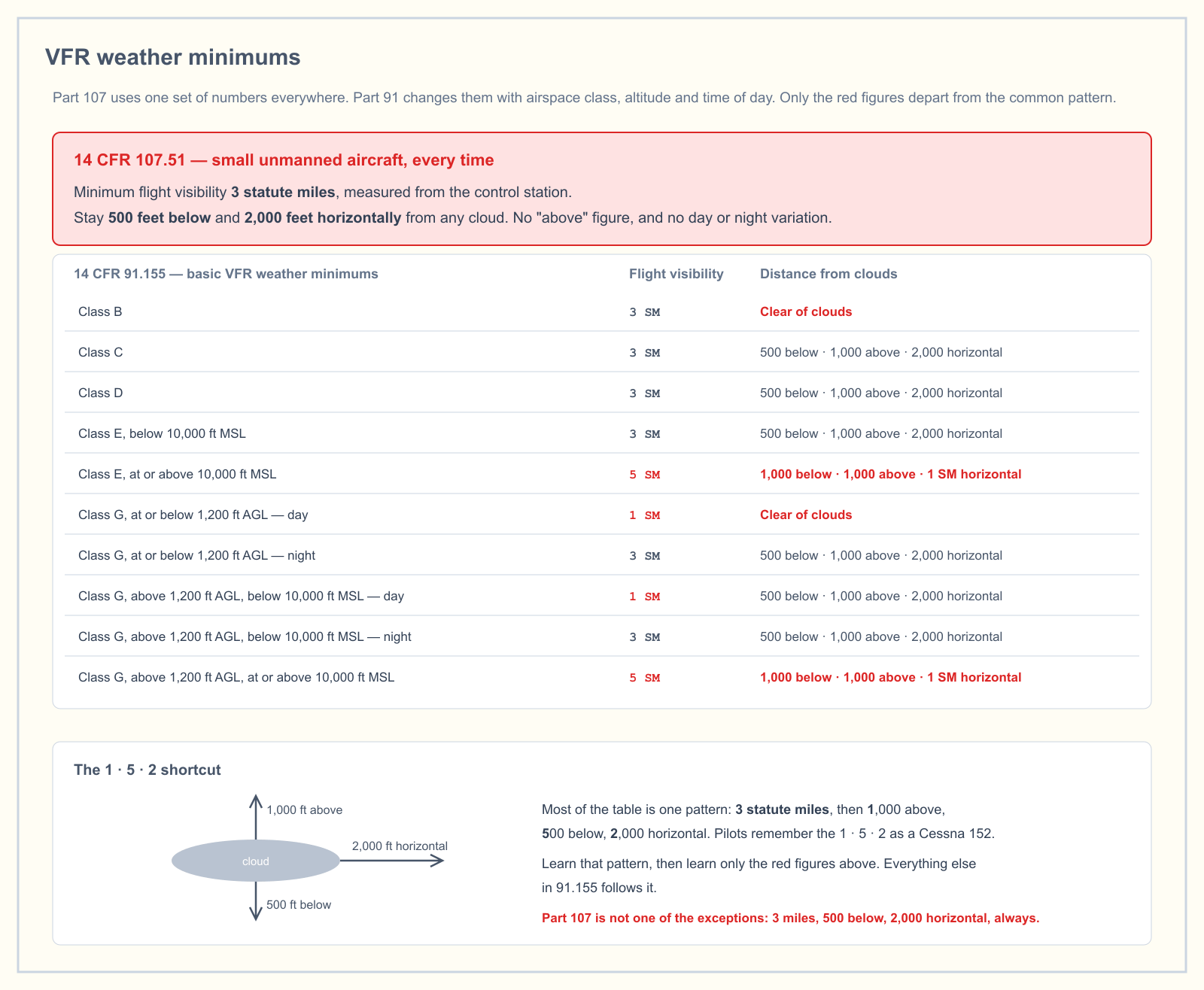
Special VFR is an ATC clearance that lets a pilot operate inside a surface area with as little as 1 statute mile of flight visibility while remaining clear of clouds, instead of the normal VFR minimums. It is granted under 14 CFR 91.157, it must be requested by the pilot, and it is not available under Part 107.
That last point is why this topic is worth your time rather than a footnote. Most drone candidates read "not available to me" and stop reading. The useful version of the question is the other way around: Special VFR is the mechanism by which a manned aircraft can legally be in the air, low, near an airport, in weather you would never expect traffic in. You cannot use it. You can absolutely be hit by someone who did.
What is Special VFR?
Start with the problem it solves. Under 14 CFR 91.155(c), a pilot may not operate beneath the ceiling under VFR inside controlled airspace designated to the surface for an airport when that ceiling is below 1,000 feet. Paragraph (d) adds that you may not take off, land, or enter the traffic pattern in a Class B, C, D or E surface area unless ground visibility is at least 3 statute miles.
Put those together and a 900-foot ceiling closes a towered airport to VFR traffic entirely. A pilot sitting on the ramp in good visibility, under a solid low deck, with clear skies ten miles away, is legally stuck.
Special VFR is the exception written into both of those paragraphs. Section 91.157 lets ATC clear an aircraft to operate below 10,000 feet MSL within the surface area under a reduced set of minimums. It is a clearance, not a waiver and not a rule change. Nothing outside the surface area is affected.
What are the Special VFR minimums?
| Requirement | Fixed-wing aircraft | Helicopter |
|---|---|---|
| ATC clearance | Required | Required |
| Distance from clouds | Clear of clouds | Clear of clouds |
| Flight visibility | At least 1 statute mile | No minimum specified |
| Ground visibility to take off or land | At least 1 statute mile, or 1 SM flight visibility if not reported | Not required |
| Time of day | Sunrise to sunset, unless night conditions are met | Any time |
| Altitude | Below 10,000 feet MSL | Below 10,000 feet MSL |
Two things in that table trip people up.
"Clear of clouds" is not a distance. There is no 500-and-2,000 under Special VFR, and no 1,000 feet above. You simply may not be in cloud. It is the loosest cloud requirement anywhere in the VFR rules, which tells you how marginal the conditions typically are when it gets used.
The helicopter column is genuinely emptier. Section 91.157 carves helicopters out of the 1-statute-mile flight visibility requirement and out of the daytime restriction. A helicopter can hold Special VFR at night with no stated visibility floor, on the reasoning that it can slow to a hover and land more or less anywhere.
Where does Special VFR apply, and where is it banned?
Only inside a surface area — the airspace from the ground up, designated to the surface for an airport. That means Class B, Class C, Class D, and the Class E surface areas that appear as a dashed magenta ring on a sectional. If you are unclear on which is which, the airspace classes explainer sorts them out.
The FAA's own controller guidance is blunt about the limits. Special VFR is authorized "only within surface areas" and "only when requested by the pilot," per Chapter 4, Section 6 of the Flight Services order. A controller will not offer it to you. If you want it, you ask.
It is also flatly prohibited for fixed-wing aircraft at a list of busy fields. Appendix D, Section 3 to Part 91 names them — Atlanta, Boston, JFK, Baltimore/Washington, St. Louis and a long list of others — because the IFR volume leaves no room to thread a VFR aircraft through at one mile. Those airports carry the notation NO SVFR on the sectional chart.
Read that notation precisely. It bans fixed-wing Special VFR. Helicopters may still request it at a NO SVFR field, which is a favorite exam distractor.
Can you fly Special VFR at night?
Only if two conditions are both met. Under 91.157(b)(4), a fixed-wing pilot conducting Special VFR at night must be instrument rated and current under Part 61, and the aircraft must be equipped for IFR flight under 91.205(d).
So the honest answer to "can I fly SVFR at night" is: if you are qualified to file IFR, yes. If you are not, no. Which raises the obvious question of why an instrument-rated pilot in an IFR-equipped airplane would scratch around at one mile instead of filing. Usually the answer is a short hop that is not worth a clearance, and the accident record suggests it is a decision worth being skeptical of.
Helicopters are exempt from both night conditions.
Why ATC can deny Special VFR, and frequently does
Special VFR is discretionary. The controller order requires facilities to "always retain SVFR operations authority when IFR operations are being conducted in surface areas," which is a polite way of saying IFR traffic comes first and a Special VFR request is the thing that gets shed when the sequence is tight.
Expect a denial, or a long hold, when there is an active IFR arrival stream, when the field is busy, or when the weather is deteriorating rather than improving. "Unable Special VFR, remain clear of the Class D" is a complete and common answer.
Why a Part 107 pilot can never request it
Two reasons, and they stack.
First, 91.157 is a Part 91 provision. Part 107 operations are conducted under Part 107, and 14 CFR 107.51 contains no Special VFR path, no reduced-minimum clearance, and no cross-reference to 91.157. Your numbers are 3 statute miles of flight visibility from the control station, 500 feet below a cloud and 2,000 feet horizontally from it, and they do not change for airspace class, altitude or time of day. The full weather minimums breakdown works through the comparison.
Second, a LAANC authorization is not a clearance. Airspace authorization lets you enter controlled airspace. It says nothing about weather. Inside authorized Class D at 1 statute mile, you are illegal under 107.51 no matter what paperwork you hold.
If the weather is genuinely below your minimums, the route out is a waiver of 107.51 applied for in advance, not a radio call. Asking a tower for Special VFR as a remote pilot is not a thing, and the controller has no mechanism to give you one.
What this means when you are actually working
Here is the part that earns its place in your preflight.
You are set up four miles from a Class D field on a gray morning. The METAR reports 4 statute miles and broken at 1,800. You check your numbers: 4 miles beats 3, and at 300 feet you have 1,500 feet below the layer. You are legal, and you launch.
What has also just happened is that the field is below the 91.155(d) threshold of 3 statute miles ground visibility for the manned traffic pattern. Every VFR airplane wanting in or out now needs a Special VFR clearance. The ones who get it will be flying the pattern at one mile, clear of clouds, scanning hard and seeing very little. Your aircraft is a 20-inch object in exactly that volume of air.
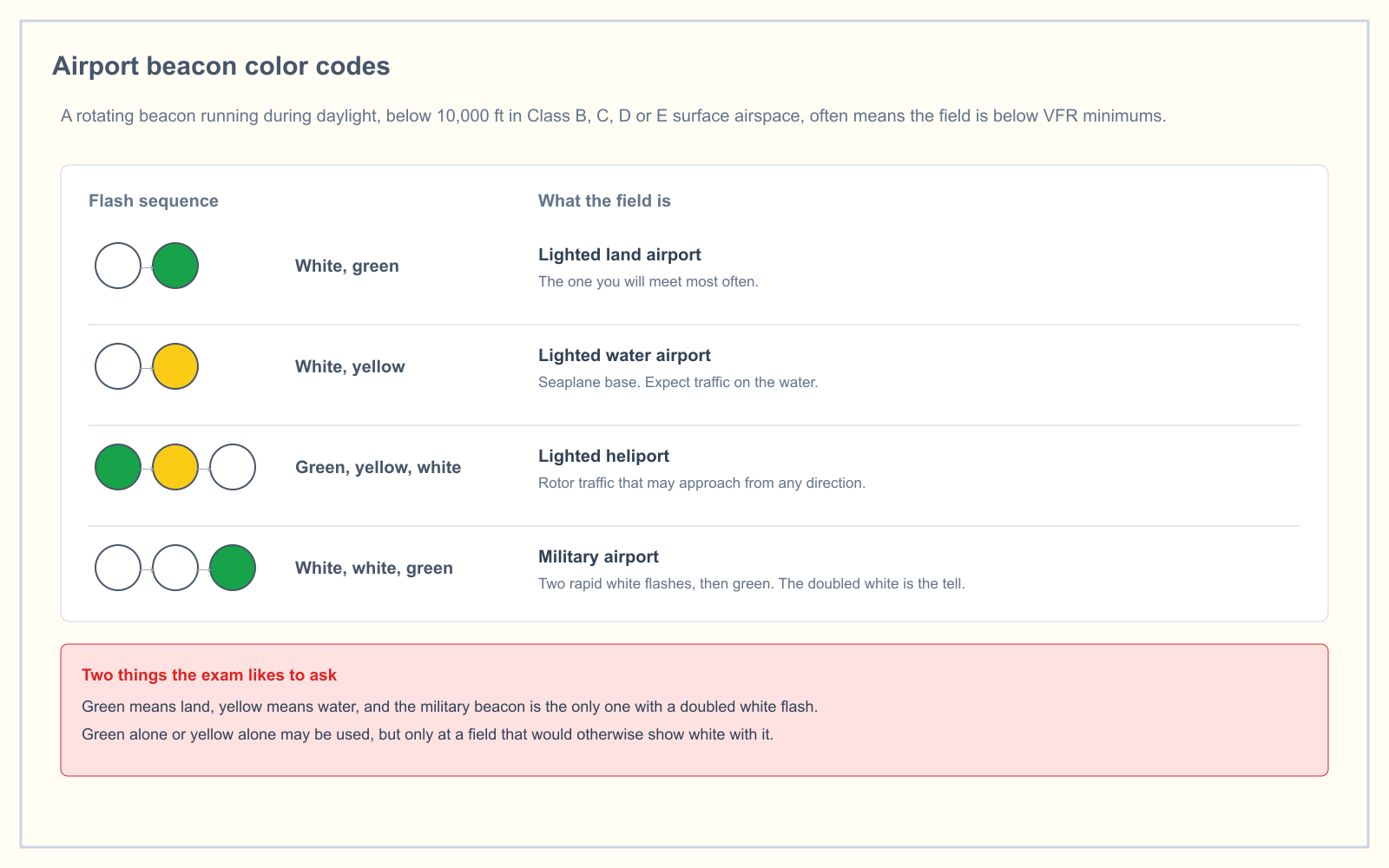
The visible tell is the rotating beacon. A beacon running during daylight hours at a Class B, C, D or E surface-area airport is a strong hint that the field is below basic VFR and that Special VFR is in play. It is a hint rather than a guarantee — there is no federal requirement to switch it on — but on a marginal day it is free information. The beacon colors article covers the rest of the code.
Practical response: on a day where the reported visibility is between 3 and 5 statute miles near a surface area, treat the traffic risk as higher than the number suggests, not lower. Monitor the tower or CTAF frequency, keep your visual observer looking toward the approach path rather than at the aircraft, and fly lower than you otherwise would.
How the exam asks about Special VFR
The Unmanned Aircraft General test rarely asks you to perform Special VFR, because you cannot. It asks you to recognize the figures. The stem that shows up most often is close to this:
A Special VFR clearance authorizes the pilot of an aircraft to operate VFR while within Class D airspace when the visibility is ...
The answer is at least 1 statute mile and the aircraft can remain clear of clouds. Distractors offer 3 statute miles, or pair 1 mile with the 500-and-2,000 cloud clearances. Both are the wrong rule stapled to the right number.
A second shape tests the boundary: whether Special VFR reduces your minimums. It does not. And a third tests the NO SVFR notation, usually by asking whether it applies to helicopters. It does not.
Airspace is 20 percent of the knowledge test under the blueprint effective 29 September 2025, so surface-area questions carry real weight relative to the 5 percent that weather holds on its own.
Frequently asked questions
Can Special VFR be denied?
Yes. Special VFR is a clearance issued at the controller's discretion, not an entitlement. FAA controller guidance requires facilities to retain Special VFR authority whenever IFR operations are underway in the surface area, so IFR traffic takes priority and a request will be denied or delayed when the sequence is busy or the weather is worsening.
Do you need an instrument rating for Special VFR?
Only at night. By day, any appropriately rated pilot may request a Special VFR clearance in a fixed-wing aircraft. For Special VFR at night, 14 CFR 91.157(b)(4) requires the pilot to meet the instrument flight requirements of Part 61 and the aircraft to carry the IFR equipment listed in 91.205(d). Helicopters are exempt from both.
What is the minimum visibility for Special VFR?
One statute mile of flight visibility for a fixed-wing aircraft, plus at least 1 statute mile of ground visibility to take off or land, or 1 statute mile of flight visibility if ground visibility is not reported at that airport. The aircraft must also remain clear of clouds. Helicopters have no specified flight visibility minimum under 91.157.
Can a drone pilot get a Special VFR clearance?
No. Section 91.157 is a Part 91 provision with no equivalent in Part 107, and 107.51 contains no reduced-minimum clearance. A remote pilot flying below 3 statute miles of flight visibility needs a certificate of waiver obtained in advance under 107.205, not a radio call to a tower.
What does NO SVFR mean on a sectional chart?
It means fixed-wing Special VFR operations are prohibited in that airport's surface area, usually because IFR traffic volume leaves no room for it. The affected locations are listed in Appendix D, Section 3 to Part 91. The prohibition applies to fixed-wing aircraft only — helicopters may still request Special VFR at a NO SVFR field.
Does Special VFR apply outside a surface area?
No. Special VFR exists only within the airspace contained by the upward extension of the lateral boundaries of controlled airspace designated to the surface for an airport, below 10,000 feet MSL. Outside a surface area, the ordinary 14 CFR 91.155 minimums for that airspace class and altitude apply with no Special VFR option.
Want to know whether the airspace questions are actually landing? The free readiness assessment samples all five knowledge areas so you find out where you stand rather than where you feel confident.
Sources
- 14 CFR 91.157 — Special VFR weather minimums
- 14 CFR 91.155 — Basic VFR weather minimums
- 14 CFR 107.51 — Operating limitations for small unmanned aircraft
- Appendix D to Part 91 — Airports/Locations: Special Operating Restrictions
- FAA Order JO 7110.10, Chapter 4 Section 6 — Special VFR Operations
- FAA Airman Certification Standards
Put this guide into practice.
Take the free assessment to see how this topic fits into your current exam readiness.
Start free practice